
Measuring social media ROI is about connecting what you spend on social media to what you get back in actual business results. The classic formula is a good start: [(Earnings – Costs) ÷ Costs] x 100%. But that simple math doesn't tell the whole story. It's about proving that your social channels are more than just a place for pretty pictures—they're a genuine engine for your business.
Defining What Social Media ROI Means for Your Business

Before you can touch that formula, you have to get clear on what success looks like for your business. Many marketers fall into the trap of chasing vanity metrics—likes, shares, and follower counts. These numbers might look good on a slide deck, but they often have zero connection to revenue.
Real ROI measurement starts when you tie social media activities to tangible business outcomes. The game is to shift your focus from feel-good engagement to metrics that directly affect your bottom line.
Moving Beyond Vanity Metrics
The first step is a gut check. You need to separate the metrics that make you feel popular from the ones that actually make you money.
For an e-commerce brand, a thousand likes on a post don't mean much if no one clicks the link to buy the product. In that world, conversions are king. For a B2B company, the real win isn't a bunch of profile views on LinkedIn—it's the number of qualified leads who downloaded your whitepaper or requested a demo.
This distinction is everything. By focusing on actionable Key Performance Indicators (KPIs), you're building a foundation for an ROI calculation that actually means something. These are the numbers that prove your work has a real impact on the business.
We all know the pressure to report big, flashy numbers. But experienced marketers understand that a handful of high-intent actions are far more useful than a sea of passive likes. This table breaks down the difference.
Table: Vanity Metrics vs Actionable KPIs
| Metric Type | Examples | Business Impact |
|---|---|---|
| Vanity Metrics | Likes, Follower Count, Shares, Reach, Impressions | Low. Feels good but doesn't directly correlate to sales, leads, or customer loyalty. Often misleading. |
| Actionable KPIs | Conversion Rate, Leads Generated, Click-Through Rate (CTR), Customer Acquisition Cost (CAC), Website Traffic | High. Directly tied to business objectives like revenue and pipeline growth. Provides clear signals for strategic decisions. |
Ultimately, the goal is to report on numbers that the CFO cares about. Shifting your focus from vanity to real outcomes is the first and most important step in that process.
The core of measuring social media ROI is translating clicks, comments, and shares into dollars and cents. It's about proving that your social media presence isn't just a branding exercise—it's a revenue-driving engine.
Connecting Social Actions to Business Objectives
Every business uses social media for different reasons, so your ROI goals need to be custom-fit to your strategy.
-
For E-commerce: The goal is usually direct sales. Here, success means tracking purchases made through social media links, attributing revenue straight from platforms like Instagram Shopping or Facebook Ads. It's clean, direct, and easy to measure.
-
For B2B Lead Generation: The mission is to fill the sales funnel. Your key metrics would be things like form fills for a whitepaper, webinar sign-ups, or demo requests that came from channels like LinkedIn. Each one is a potential customer knocking on the door.
-
For Brand Authority: Success is about building credibility and becoming a thought leader. The metrics might be less direct but still measurable: website traffic from social referrals to your blog, mentions in the media, or a noticeable increase in branded search queries.
With our Upvote.club service, you can boost early, genuine engagement on posts tied to these specific goals. For instance, getting real likes and comments on a new product announcement can increase its reach, pushing more traffic to your sales page and directly improving your ROI. Upvote.club is a community-driven growth service for Social Networks that helps users build real engagement without bots. Our platform lets members create unlimited tasks to receive likes, comments, reposts, saves, and followers from verified, human accounts.
Understanding the ROI Formula in Context
That standard ROI formula is a good starting point, but it's just the beginning. The projected global social media ad spend of $276.7 billion by 2025 shows just how much businesses are betting on these platforms. To justify that kind of investment, you have to look at the entire customer journey.
A single social media post might not trigger an immediate sale, but it could be the first time a customer hears about you. That initial touchpoint is a piece of a puzzle that might lead to a purchase weeks or even months later. This is why connecting social efforts to tangible results is so important for getting an accurate picture.
This process turns ROI from a simple percentage into a powerful story about your business’s performance. It shows not just what happened, but why it happened, giving you the clarity to make smarter marketing decisions. And for those just starting out, learning how to gain more Instagram followers is a practical first step in building an audience you can eventually monetize.
Building Your Social Media Tracking Infrastructure
Accurate ROI measurement isn't magic. It’s plumbing. Without a solid technical foundation, you’re just guessing at what works, hoping a stray like turns into a sale. Building a reliable tracking infrastructure is the only way to draw a straight line from a user's click on a social post to a final purchase on your site.
Think of it as creating a clear path for data to follow. It gives you the visibility you need to make smart decisions and ensures every dollar spent and every piece of content published can be tied back to a tangible result.
Mastering UTM Parameters for Clear Attribution
The first pillar of your tracking setup is the Urchin Tracking Module (UTM) parameter. These are just simple snippets of text you tack onto the end of a URL. They act like a digital breadcrumb trail, telling your analytics platform—like Google Analytics—exactly where your traffic is coming from.
Instead of seeing a generic "social media" traffic source, UTMs let you get granular. You can see which specific post on which platform drove the most useful traffic.
A link without UTMs is like getting a letter with no return address. You know you got mail, but you have no idea who sent it. UTMs provide that sender information, making them non-negotiable for anyone serious about measuring social media ROI.
A well-structured UTM system turns your analytics from a blurry overview into a high-definition map of your customer's journey. It’s the difference between knowing traffic came from Instagram and knowing it came from the second slide of your Tuesday morning carousel post about your new product.
We see this play out constantly with our Upvote.club service. A user will take a specific, UTM-tagged link and use our community to generate that first wave of engagement. A few hours later, they log into their analytics and see a direct correlation between that early boost and the resulting website traffic and conversions. It’s clear, undeniable proof of the return on their engagement efforts. For more on how to streamline this process, our guide on a powerful Chrome extension for social media managers can be a huge help.
Implementing Tracking Pixels for User Actions
While UTMs tell you where users came from, tracking pixels tell you what they did once they arrived. A pixel is a tiny piece of code from platforms like Meta (for Facebook and Instagram) or TikTok that you place on your website. This code fires whenever a user takes a specific action, sending that data back to the social platform.
This is necessary for a few key reasons:
- Conversion Tracking: Pixels let you see if the people who clicked your ad actually went on to buy something, fill out a form, or subscribe to your newsletter.
- Ad Retargeting: They allow you to build custom audiences of people who visited your site, so you can serve them follow-up ads that are far more likely to convert.
- Optimization: The data collected by pixels helps social media algorithms find more users who look and act like your best customers, making your ad spend way more efficient.
Installing a pixel is a one-time setup that unlocks a massive amount of data. Without it, you can only see the click—you're blind to all the actions that happen afterward.
Defining and Monitoring Conversion Events
Once your pixel is installed, the final step is to define your conversion events. These are the specific, useful actions you want users to take on your website. They are the finish line.
What counts as a conversion depends entirely on your business goals.
- For an e-commerce store: A "Purchase" event is the ultimate goal.
- For a B2B service: A "Lead" event (like a form submission) is key.
- For a content creator: An "Email Signup" or "View Content" event might be the priority.
You set these up right inside the ads manager of each social platform. By defining these events, you're telling the platform what success looks like for you. This allows you to directly connect ad spend to business outcomes—the very core of measuring social media ROI. As you build out your stack, exploring various analytical and tracking tools can sharpen your measurement capabilities.
This combination of UTMs, pixels, and defined conversions creates a complete tracking system. It’s the engine that makes accurate ROI calculation possible.
Choosing the Right Attribution Model for Your Data
So, you've got your tracking set up. Data is flowing in, showing you exactly what people do after they click your social media links. But here's the million-dollar question: how do you give credit where it's due when a customer bumps into five of your posts before finally buying something?
This is where attribution modeling comes into play. Think of it as the rulebook you create to assign weight to each touchpoint in a customer’s journey.
Picking the right model is absolutely necessary for measuring your social media ROI accurately. A bad model can make a rockstar channel look like a total waste of money, leading you to slash budgets that are actually filling your pipeline. It’s the lens through which you interpret your data, and it dictates where you put your money next.
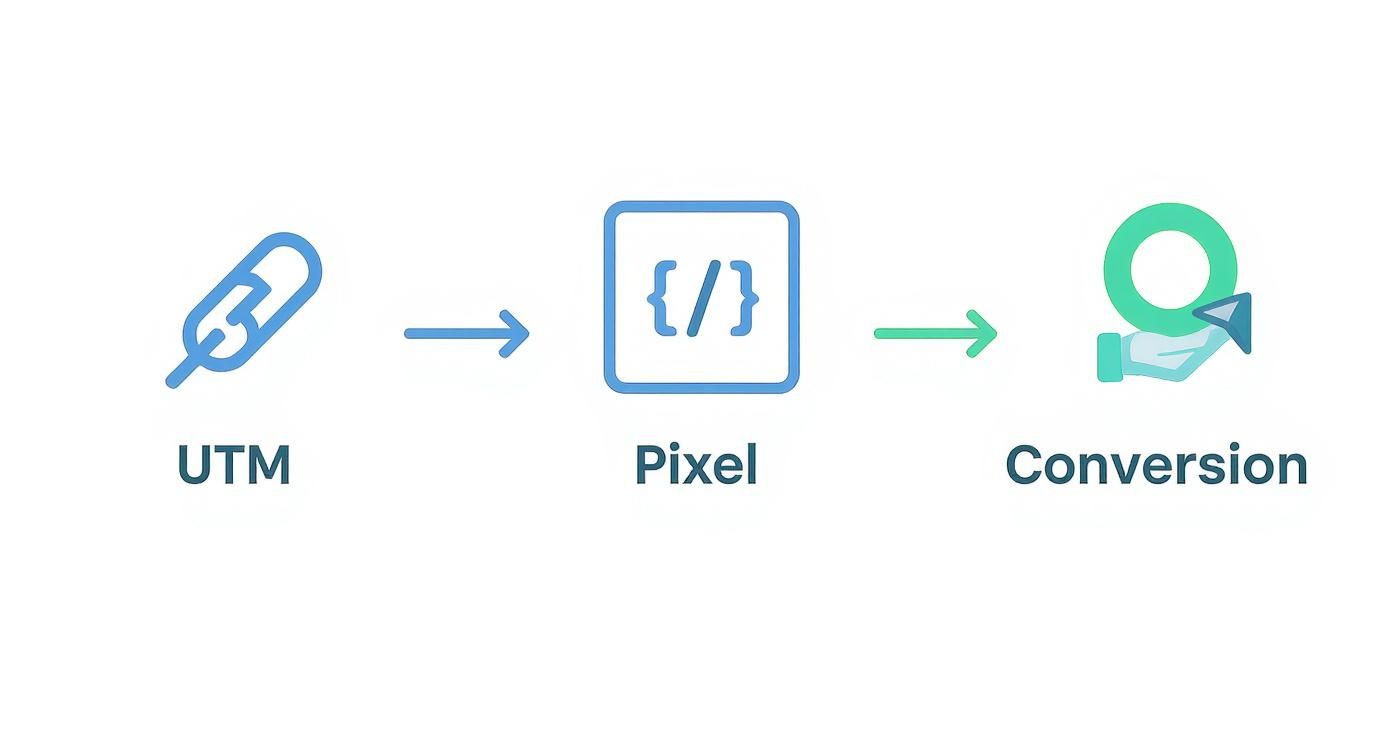
This setup—UTMs, pixels, and conversion goals—is the bedrock of good attribution. It’s how you gather the raw data needed to see the entire customer journey, not just the final step.
Common Attribution Models Explained
Different models tell different stories about the path your customers take. Knowing the common ones helps you choose the one that actually reflects how your audience behaves.
-
Last-Click Attribution: This is the default for many and the simplest to understand. It gives 100% of the credit for a sale to the very last thing a customer clicked. It’s easy, sure, but it’s often dead wrong.
-
First-Click Attribution: The polar opposite. This model gives 100% of the credit to the first touchpoint. It’s great for highlighting which channels are your best brand ambassadors, introducing new people to your world.
-
Multi-Touch Attribution (e.g., Linear, Time-Decay): This is where things get more realistic. These models spread the credit across multiple touchpoints. A Linear model gives every interaction an equal slice of the pie, while a Time-Decay model gives more weight to the interactions that happened closer to the conversion.
There’s a massive gap between what marketers want to measure and what they feel they can. A 2025 survey showed that while 65% of marketing leaders want to directly connect social media campaigns to business goals, a mere 30% of marketers are confident they can measure social ROI effectively. This confidence gap often comes from leaning on overly simplistic models that miss the bigger picture.
It's true as influencer marketing booms—delivering an average ROI of $5.78 for every $1 spent—because that success is built on a series of interactions, not one final click. You can dig into more social media ROI statistics to see how this trend is shaping strategy.
Why Last-Click Can Be Deceptive
Let’s walk through a real-world scenario. A user discovers your brand for the first time through an entertaining TikTok video (first touch). A week later, they see a retargeting ad on Instagram, click through to your site, and poke around but don’t buy. A few days later, they finally decide to buy, type your brand name into Google, click your search ad, and complete the purchase.
With a last-click model, Google Ads gets 100% of the credit. The TikTok video and Instagram ad—the touchpoints that did the heavy lifting of discovery and nurturing—get zero. This model screams that your top-of-funnel social efforts are worthless.
This is a trap so many businesses fall into. When you rely only on last-click, you risk cutting the budget for the very channels that are bringing new prospects to your door. It’s a dangerously narrow view that completely ignores the messy, multi-step reality of how people buy things today.
Selecting the Best Model for Your Business
The right attribution model really depends on your business goals and how long it takes for someone to become a customer.
-
For businesses with a short sales cycle and impulse-buy products, a Last-Click model can actually work just fine. The journey from seeing to buying is so quick that the last click often tells most of the story.
-
If you’re laser-focused on brand awareness and lead generation, a First-Click model is useful. It shows you which channels are best at pulling new people into your orbit.
-
For most businesses with a longer, more considered sales cycle, a Multi-Touch model gives you the most honest and complete picture. It respects the fact that different channels play different roles, working together to guide a customer from A to Z.
Our Upvote.club works differently from other services. While other platforms let you buy likes, Upvote Club is not about buying engagement — it's about participating in a community. Our service can shine within a multi-touch strategy because we help you get that authentic initial engagement—the likes, comments, and shares that get your content seen in the first place. That early traction becomes a "discovery" touchpoint.
In a multi-touch model, that initial, community-driven boost gets the credit it deserves for starting the whole conversation. Getting more people to share your content, for instance, can be a game-changing first touch. You can learn more about getting Twitter reposts and see this in action.
Calculating and Analyzing Your Social Media Returns
Alright, you've laid the groundwork. Goals are set, tracking is live. Now it's time to do the math. This is where we move from theory to a hard number that tells you what’s working and what’s just burning cash. This isn't just about spitting out a percentage; it's about seeing the financial story behind your likes and shares.
First things first: you need a brutally honest accounting of every single dollar you've poured into your social media machine. And I don’t just mean your ad spend.
Tallying Up Your Total Investment
To get a real ROI figure, you have to know your total investment. So many marketers make the mistake of only counting ad spend. That gives you a skewed, overly rosy picture that doesn’t hold up under scrutiny. A true calculation ropes in every resource you've dedicated to the cause.
These costs usually break down into a few key areas:
- Ad Spend: This one's the most obvious. It’s the total cash you've handed over to platforms like Meta, TikTok, or LinkedIn for your campaigns.
- Tool Subscriptions: Don't forget the monthly or annual fees for your scheduling tools, analytics platforms, and any other software that keeps your social media operation running.
- Content Creation Expenses: This bucket includes everything from photography and videography costs to graphic design software or fees for freelancers and creators.
- Team Time: This is the one people always forget. You have to factor in the salaries of your social media managers, strategists, and creators, prorated for the time they spend on social media.
Add all that up, and you’ve got the "Total Cost" part of the equation. This complete number is the bedrock of an honest assessment.
Gathering Your Revenue Data
Next, you need to pull the revenue figures generated by your social media activities. This is where all that setup work with UTMs and pixels pays off big time. You'll pull this data straight from your analytics platform—whether that’s Google Analytics, your e-commerce dashboard, or your CRM.
You’re looking for the specific conversion events you defined earlier. For an e-commerce brand, that’s the total dollar value of sales attributed to your social channels. For a B2B company, you might assign a monetary value to each qualified lead based on your historical close rate and average customer lifetime value.
Once you have both your costs and your returns tallied, you can plug them into the classic formula: (Revenue – Total Costs) / Total Costs x 100%.
Practical Calculation Examples
Let's run through a couple of real-world scenarios to see how this plays out.
E-commerce Instagram Campaign:
Imagine you dropped $2,000 on Instagram ads, another $500 on creating slick visuals, and allocated $1,500 in team salary for the campaign. Your total investment comes out to $4,000. You log into your analytics and see the campaign drove $16,000 in direct sales.
The math looks like this: ($16,000 - $4,000) / $4,000 * 100 = 300% ROI. For every single dollar you put in, you got four dollars back. Solid.
B2B LinkedIn Campaign:
Here, you spend $3,000 on LinkedIn ads and another $2,000 on content and management, making your total investment $5,000. The campaign brought in 50 qualified leads. If your historical data shows that each lead is worth about $250 to the business, your total return is $12,500.
The calculation: ($12,500 - $5,000) / $5,000 * 100 = 150% ROI.
Budgeting is a huge piece of this puzzle. The top-performing brands often sink about 60% of their social media budget into ad spend, splitting the rest between creative, management, and analytics. It's also worth noting that paid social content often has a lower cost per lead—around $65 compared to $95 for organic—which really shows how efficient a smart paid strategy can be.
This methodical approach gives you a clear, defensible number that proves the financial impact of your work.
To really dig into the financial side of your social media game, it's worth exploring these proven strategies for measuring marketing ROI. And if a piece of your strategy is building an audience from the ground up, check out our guide on how to grow your YouTube subscriber base the right way.
Improving ROI with Targeted Engagement Strategies

Running the numbers is just the starting line. The real work—and the real wins—come from actively pushing that ROI figure higher. You're not just trying to justify your social media spend; you're turning your channels into a well-oiled machine that predictably drives business growth.
One of the most potent levers you can pull is initial engagement. Social media algorithms are obsessed with how a post performs in its first hour, a window often called the "Golden Hour." A rapid burst of likes, comments, and shares acts as a signal, telling the platform your content is worth showing to a much wider audience. More organic reach for the same effort? That's a direct injection into your ROI.
Capitalizing on the Golden Hour
That first hour is your moment of truth. Strong early performance kicks off a snowball effect: more engagement leads to more visibility, which brings in even more engagement and, ultimately, more of the conversions you're tracking. Influencer agencies have used this exact play for years to guarantee their clients' content gets maximum traction. Now, we make this method accessible to everyday users who want more reach on social media.
With our Upvote.club service, you can secure that early engagement from real, verified human accounts. This isn't about buying fake interactions. It's about joining a community where everyone is invested in helping each other grow. There are only two real ways to grow on social media: consistently post high-quality content and get engagement. Getting engagement within the first hour after posting is what makes content perform well.
When you can reliably boost your content's organic reach, you dial back your dependency on paid ads. This cuts your overall costs while maintaining—or even increasing—your results. That’s a straight line to a much healthier ROI.
How Community-Driven Engagement Works
We operate on a community-based model where users help each other grow. When you join, you’re not just a user; you’re part of a network of creators, professionals, and brands all focused on growth. You earn points by completing tasks for other members, like leaving a thoughtful comment or sharing a post.
Those points become your internal currency, which you can spend to create your own tasks. In other words, by helping others, you earn the ability to promote your own content. When you post something important on Instagram, TikTok, or LinkedIn, you can immediately set up a task on Upvote.club to get likes, comments, or shares. Our community members then engage with your content, giving it the initial momentum it needs.
Here is how our service works:
- Registration Bonus: When you register with us, you receive 13 free points and 2 task slots to get started.
- Earning Points: You earn more points by completing tasks for others, which can then be used to create your own tasks. If you need more points, you must complete tasks for other users.
- Daily Rewards: We also give you 1 free task slot every 24 hours to keep the activity flowing.
- Strict Moderation: We have a zero-tolerance policy for bots. Every user and social media account is verified, ensuring the engagement you get is 100% genuine. No passwords are required for verification.
This model lets you strategically boost the posts that are directly tied to your ROI goals, whether it’s a product launch, a lead magnet, or a key announcement. Getting more real people to interact with your content expands its reach. You can see this principle in action and learn more about how to get free Twitter likes on our platform.
Because our service never asks for your passwords and uses a unique emoji-based verification system, your account’s integrity is always safe. By focusing on real human interaction, you're not just getting numbers; you're building a foundation for sustainable, organic growth that makes a measurable difference to your bottom line. We support multi-platform growth across Instagram, TikTok, Youtube, Twitter, Facebook, LinkedIn, Reddit, and more.
Common Questions About Social Media ROI
Even with a solid framework, some questions always seem to pop up. It makes sense—the process isn't static, and every business is working with its own unique variables. Let's tackle some of the most common ones I hear.
How Often Should I Measure Social Media ROI?
The right rhythm for measurement really depends on two things: the nature of your campaign and the length of your sales cycle.
For your continuous, "always-on" social media activity, a monthly review is a solid place to start. It’s a good middle ground—long enough to gather enough data for trends to emerge, but not so long that you let poor performance drag on for a whole quarter.
Now, for specific, time-bound campaigns like a product launch or a holiday sale, you’ll want to measure ROI right after the campaign wraps up. It's also smart to keep an eye on leading indicators like click-through rates and engagement on a weekly basis. These little check-ins let you make quick adjustments on the fly, but the full ROI calculation will give you the most accurate picture when you look at it over a period that matches how long it typically takes a customer to pull the trigger.
What Is a Good ROI for Social Media?
This is the million-dollar question, but there's no universal benchmark for a "good" social media ROI. The number can swing wildly depending on your industry, business model, and your profit margins. A frequently cited target for return on ad spend (ROAS) is somewhere between 3:1 and 5:1, meaning you generate three to five dollars for every dollar you put into ads.
But honestly, the most meaningful benchmark is your own. The first goal is just to get a positive return. A great ROI is one that starts outperforming your other marketing channels. Your real job is to establish your baseline and then relentlessly focus on improving it, month after month.
Getting fixated on a single industry number can be a distraction. Use your first calculations to set an internal standard and aim for steady, incremental improvement. That's where the real wins are.
How Can I Measure the ROI of Organic Social Media?
Measuring the ROI of your organic content is definitely trickier, but it’s absolutely doable with some diligent tracking. A lot of people assume it’s "free" since there’s no direct ad spend, but that completely ignores the very real investment of time and resources.
To get a proper read on it, here’s how you break it down:
- Track Your Traffic: This is non-negotiable. Use UTM parameters in every single link you share organically. This is how you isolate the website traffic coming directly from your non-paid social posts inside your analytics platform.
- Monitor Your Conversions: You need to have specific conversion goals set up in your analytics. This lets you see exactly how many of those visitors go on to complete a desired action, like buying something or signing up for your newsletter.
- Account for Your Costs: Tally up every associated cost. This means the prorated salaries of your social media managers and content creators, any subscription fees for scheduling tools, and expenses for things like photography or video production. Don't leave anything out.
The formula is exactly the same: (Revenue from Organic Social – Total Costs) / Total Costs. This method gives you a clear-eyed view of whether your organic efforts are actually profitable.
With our Upvote.club service, you can get a strategic edge. You can create tasks to get that early engagement, helping your organic posts break through the noise and reach a wider audience. This drives more of that trackable, UTM-tagged traffic, giving you a direct way to support your organic ROI without ever sharing passwords or putting your accounts at risk.
Ready to boost your engagement and see a better return on your social media efforts? Join the Upvote Club community and start getting real, human-powered likes, comments, and shares on your content today. Get started on Twitter.
More articles
alexeympw
Published November 7, 2025