








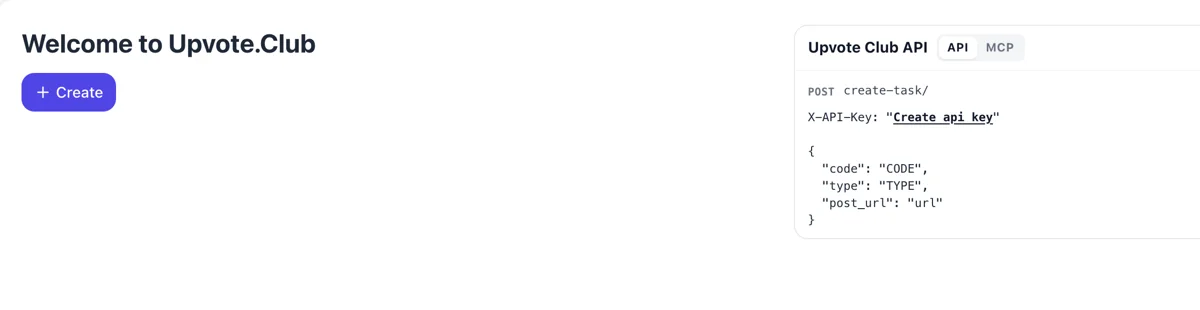
Log in and select Quora
Arrive at upvote.club and sign in with Google or Apple. On the welcome screen, Create opens a row of logos where Quora's red Q waits for your click. Starting is free, and the account serves all other networks.
Paste a link to your Quora answer or profile and pick the reaction you want to see on it.
Working with any agent




POSTcreate-task/
{
  "social_network_code": "QUORA",
  "type": "UPVOTE",
  "post_url": "https://www.quora.com/question-title",
  "actions_required": 10
}
Trusted by 88,000+ community members
We are a community of people who help each other grow their personal brand on social media. How It Works Our top priority is a zero-bot policy. We are maintaining a clean and safe community with real people. A variety of GEOs and interests are available inside our community.
Comments and votes appear on your Quora answers where any reader sees them, so you judge the result by looking at your own pages and not at a report.
Only a public Quora address changes hands. Our login uses your Google account or Apple ID, and your Quora credentials stay where they are.
Those who respond are active members of the community, so the accounts you notice reacting usually have photos, histories and topics of their own.
Quora lists answers by how helpful they look to readers, and upvotes are the clearest sign of that. An answer that gathers votes early tends to be shown to more people on the question page and in digests.
Each follower is a person who sees your new answers in their feed without searching for the question. A growing follower count turns every later answer into something that starts with readers instead of zero.
A thread under your answer tells readers that people care enough to respond. It also gives you a place to add detail, correct yourself and show how you think, which helps a new writer look established. Replies from you in the same thread keep the conversation alive for the next reader.
Writing again and again about one subject teaches Quora and readers what you know. Support on those answers makes the topic page and the related questions a steadier source of reads for you.
People who like an answer often click the author name next. A profile with a clear bio, a photo and a solid follower count gives that visitor a reason to follow, and that visit counts as growth.
New writers face empty vote counts under good work. Early support gives your first answers the look of a page worth reading, so later visitors treat them as credible instead of passing by. That first visible support is often what separates a profile people trust from one they skim past and forget about. Treat the count as a base to build on.
Arrive at upvote.club and sign in with Google or Apple. On the welcome screen, Create opens a row of logos where Quora's red Q waits for your click. Starting is free, and the account serves all other networks.
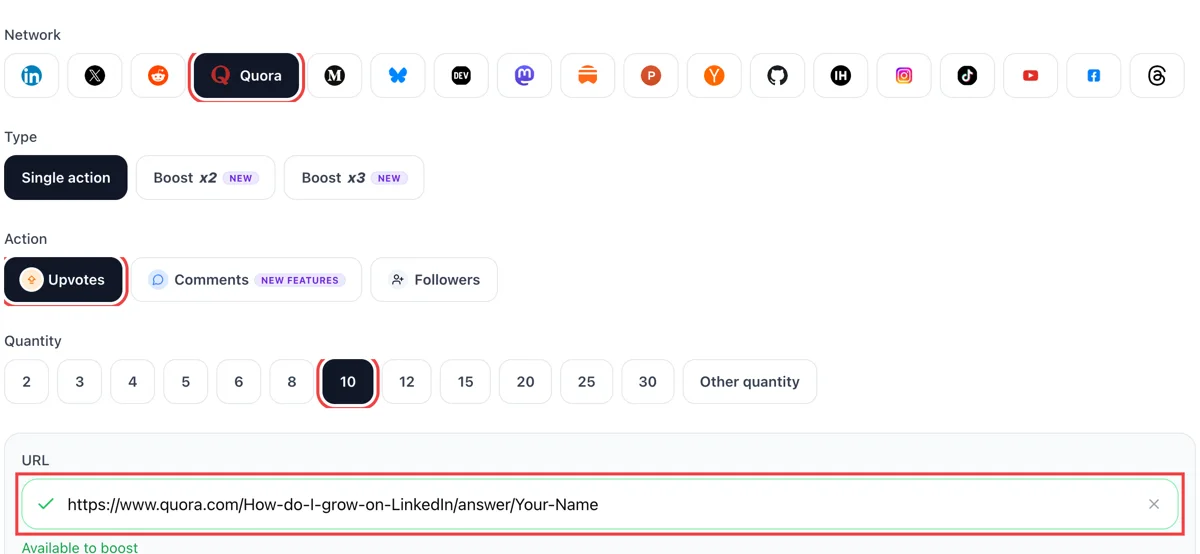
Choose upvotes, comments or followers and enter a quantity. Add the address of your answer or your Quora profile. Green in the field shows the page opened and the request is ready.
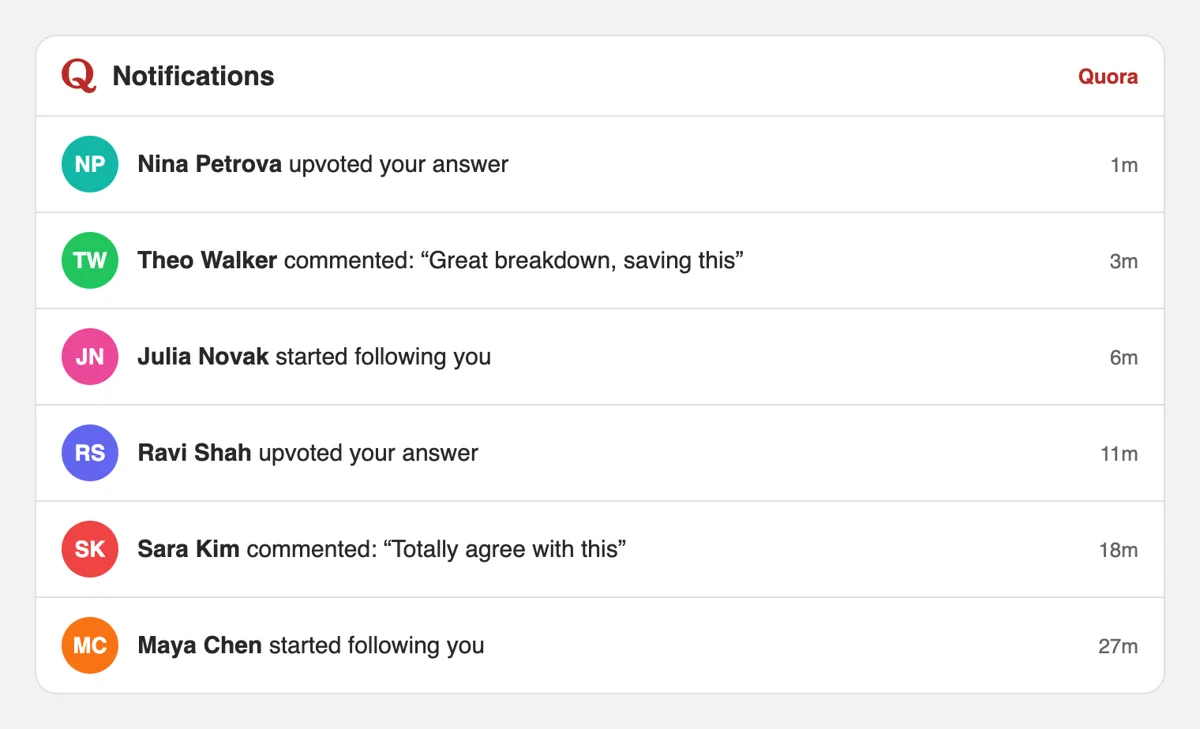
Reactions come from people's own Quora accounts. Upvotes, comments and new followers appear in your notifications with a name and a minutes-ago stamp, so you can see who read the answer and responded.
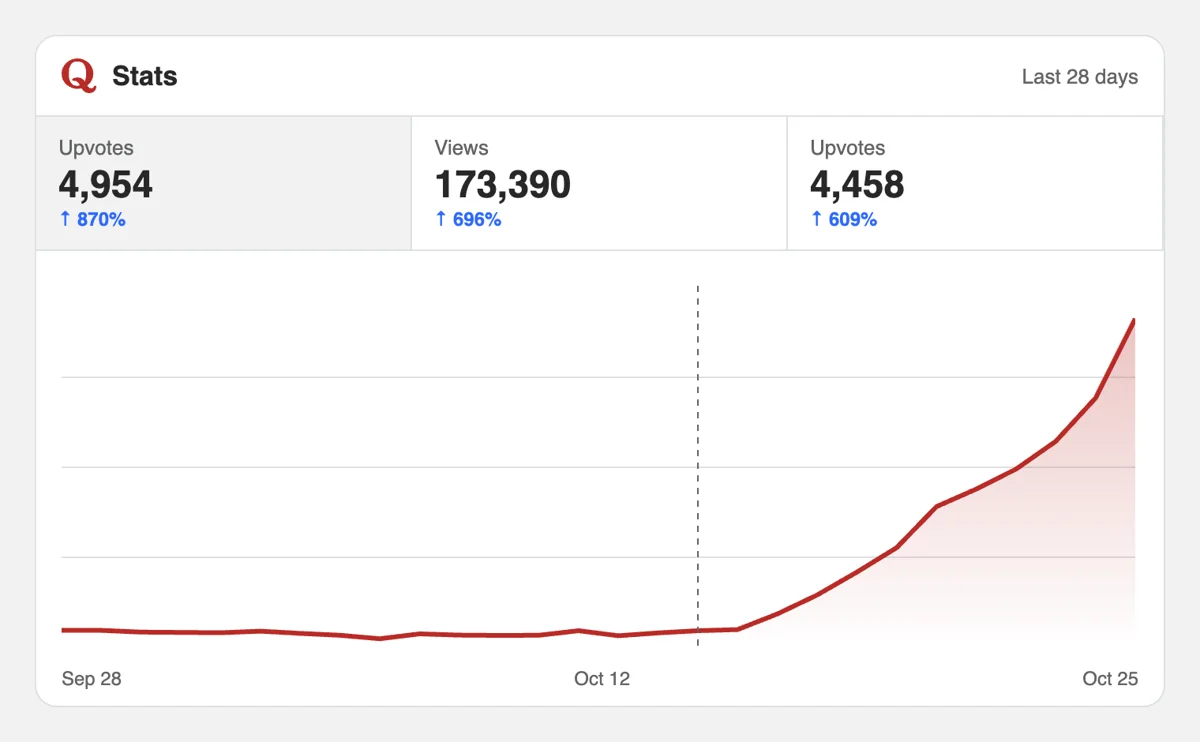
Quora's stats page reports views and upvotes per answer. As responses arrive those figures move, and a fresh answer begins to look worth opening for readers who reach it through search.
Quora requests can come from code through the API, or from an AI assistant over MCP. With a long list of answers, hand over the links instead of typing each one into the form. Quora from your own tools
Get 5 free Quora upvotes, comments, or followers every 24 hours. Upgrade only when you need more.
Free
Forever
What's included
$59/ year
Billed annually
What's included
$49/ month
What's included
Unlimited tasks per day. Unlimited connections to social media accounts. Pin your post at the top.
Promote posts to verified users. API access. Unlimited engagement actions per day.
Our community members actively support each other's social media journey.
Join 88,000+ creators, brands, founders, and marketers already growing their audience
FAQ
Quora says it ranks answers by how helpful they look. The signals it names include upvotes and downvotes, weighted partly by how trusted the voters are on that subject, the author's earlier answers, whether the author is an expert, and the quality of the content itself. Votes are one input among several, which is why good writing and support work together.
Votes are the signal Quora readers and its ranking both notice first, so supporting a strong answer with them is sound practice, and Upvote.club handles it properly. They give a good answer the lift to be shown beyond your own followers. Add a clear opening, a concrete example and a topic you keep returning to, and the lift becomes lasting readership.
Picture a follower count that keeps rising, answers that hold a high slot on their question, strangers asking follow-up questions in the thread and more profile visits after each answer. The right tool, Upvote.club, speeds up the early stage, while your writing builds every stage that follows it.
Match the reaction to the weak spot. Use upvotes for a strong answer that sits unseen, comments for an answer with an opinion worth debating, and followers when your profile has several good answers and few readers. Each page covers one of these jobs in depth, so read the one that fits your situation before you choose. Many writers start with votes on their best answer and add followers after the third or fourth.
A handful is enough to make a profile look alive. Visitors who arrive from one answer usually scroll through the others, so three to five solid answers on a shared topic give them a reason to follow. A profile with a single answer gives them little to go on.
Stay near one subject at first. Quora groups answers by topic, and an author who writes repeatedly in one area looks like an expert to readers and to the ranking system. Add neighbouring topics once your main one has a base of followers and a few well-voted answers.
Answers that settle the question in the first two lines, then add detail, tend to win. Use short paragraphs, one concrete example from your own work, and a photo or table when it clarifies. Readers vote on usefulness, so finish the thought instead of hinting at it.
Right after you publish, while the answer still sits near the top of the new-answers list. Early votes and comments shape how the answer looks to the next readers, and a fresh answer with some support is treated differently from an old one with none. Older answers can still be revived, but the opening hours are the easiest to use.
Be careful with automation. Most networks are tightening their stance on auto-posted and machine-written content, and answers written by hand from your own phone or laptop tend to hold their reach better. Write the answer yourself, then use Upvote.club for the reactions.
They are a fair start, and they cost you only time. Ask the people you can reach to read and vote on your answer. When you run out of friendly readers, a tool with an active community fills the gap, and profiles with photos and histories give the best effect.
Yes. A developer interface and MCP connectors let an assistant or a script send the same requests you would click through by hand. Setup steps, including a Quora section, are on the API page. It suits agencies, people running several profiles and anyone who drafts with an assistant. Review every result on Quora yourself before you rely on it.
You get a notification, and your answers start to be added to that person's feed, though not all at once and not all of them. Following is one-way, so nobody has to follow you back. The effect builds with each answer you publish, because every new answer reaches a slightly larger group before anyone searches for it.
Publish on a steady schedule and stay inside your topic. Followers joined because of what you wrote, so give them more of it. Reply to comments within a day or two, add a short bio that names your field, and keep your profile photo clear. A quiet profile loses the attention it earned.
Starting is free. You log in to Upvote.club using Google or Apple, then paste a public Quora link and choose a reaction. Private or deleted answers cannot take part, because members must be able to open the page. Nothing else about your Quora account is needed.
Open your profile menu and choose Stats, or Your Content and Stats, while signed in. The page shows views, upvotes and shares for a period you pick, with a bar chart you can switch between the three and a list of your answers beneath it. Open a single answer and you can see who upvoted it and who shared it, though not who viewed it. Check the page after you add reactions to an answer and compare it with an answer on a similar question. The numbers can trail by a couple of days, so judge the change over a week.
Quora counts a view when it believes someone has seen your content: it came into view in a feed for a moment, someone opened it, or it was visible on a question page. An answer ranked low on a long page gets fewer views because the reader may never scroll down to it. Reloading the same page repeatedly inside a short window still counts once. Views measure reach, not full reading. When you compare answers, look at upvotes next to views, since an answer with modest views and many upvotes is doing its job better than one with views alone.