Table of Contents
- Defining Your Community Before You Build It
- Set a Clear Purpose and Goals
- Identify and Understand Your Audience
- Choose the Right Social Platforms
- Creating Content That Starts Conversations
- Establish Your Core Content Pillars
- Develop a Consistent Brand Voice
- Create a Sustainable Content Calendar
- Breaking Through the Awkward Silence
- Why That First Hour is Everything
- Real People, Real Momentum
- So, How Does It Actually Work?
- Timing is Everything
- Keeping the Conversation Going Every Single Day
- Building a Safe and Accountable Community
- Crafting Shared Experiences People Love
- Social Media Platform Engagement Benchmarks
- Measuring Community Health for Long-Term Growth
- Key Metrics Beyond Follower Numbers
- Gathering Actionable Feedback
- Sustaining Growth with a Community-Based Model
- Got Questions About Community Building?
- How Long Does It Actually Take to Build an Active Community?
- What Are the Most Common Mistakes People Make?
- How Should I Handle Negative Feedback or Conflict?
Before you even post your first "hello world," you need a plan. Building a social media community is not a "build it and they will come" situation. You need to be intentional.
It all boils down to three core questions: Why are you building this community? Who is it for? And where will you all hang out? Nailing this foundation is what separates a vibrant, buzzing hub from a digital ghost town.
Defining Your Community Before You Build It
Think of this as drawing up the blueprints. Without a clear plan, you'll waste time and energy creating content that does not land or picking a platform where your ideal members are not even active. Get this part right, and everything else gets easier.
A strong community is built on purpose, not just proximity. You need to know exactly why you're bringing people together, who those people are, and the best place online to make it happen.

Set a Clear Purpose and Goals
First things first: what's the point? Your community's purpose is its north star. It dictates your content, your rules, and how you measure success. Are you creating a space for customers to help each other out? A mastermind for professionals in a tiny niche? Or a fan club for a specific hobby?
The "why" changes everything. A community for product support will be all about quick answers, FAQs, and troubleshooting. A group for indie developers, on the other hand, might focus on sharing works-in-progress, celebrating small wins, and collaborating on tough problems.
Here are a few common goals:
- Brand Awareness: Getting your name in front of new people through shared interests.
- Customer Support: Building a self-sustaining ecosystem where users help each other.
- Product Feedback: Turning your members into a real-time focus group for ideas and improvements.
- Collaboration & Networking: Connecting people who can learn from or work with each other.
A community without a clear purpose feels like a one-way broadcast from you to them. Define your "why" from day one to make sure it's a space that truly serves its members.
Identify and Understand Your Audience
Okay, you know your why. Now, who's your who? You cannot just say "everyone." You need to get uncomfortably specific. This is where creating member personas comes in handy.
And I'm not just talking about basic demographics like age and location. Dig deeper. What are their biggest difficulties? What motivates them? What keeps them up at night? The more you understand their world, the better you can serve them.
For example, a persona for a community of freelance writers is not just "writers." It's "Alex, 28, who's amazing at writing but struggles to find high-paying clients and feels totally isolated working from home." Boom. That one sentence gives you a dozen content ideas. You can find more on finding the right audience with our guide for indie hackers.
Choose the Right Social Platforms
This is a classic mistake: picking the platform you like best instead of the one your audience lives on. Your job is to meet them where they already are. Do not make them download a new app or learn a new interface if you do not have to.
Are you building for visual artists? Instagram or Pinterest is probably your best bet. A group for B2B software engineers? They're more likely hanging out on LinkedIn, a dedicated Discord, or maybe even a private Slack channel.
Different crowds flock to different platforms. For instance, research shows that 40% of Gen Z and Millennials are already active participants in online communities—you just need to find the right one.
Here’s a quick checklist for picking a platform:
- Audience Hangouts: Where do your people already spend their time online? Go there.
- Content Fit: Does the platform's format (video, long-form text, images, audio) match what you want to create?
- Community Features: Does it have the tools you need? Think groups, forums, live streaming, events, or polls.
Nailing this foundation makes your community feel like it was made just for them. It's the difference between a generic social media page and a destination—a place people genuinely want to be.
Creating Content That Starts Conversations
Great content is the engine of any community. Once you really get who you're talking to, the next difficulty is mastering how to create engaging social media content that actually gets people talking. This is not about chasing trends; it's about finding your voice and sticking to a few core themes that your members can rely on.
Think of your content as the campfire everyone gathers around. It needs to provide warmth (usefulness), light (education), and a few sparks (entertainment) to keep people sticking around.

Establish Your Core Content Pillars
Content pillars are just the handful of main topics your community will keep coming back to. Having 3-5 defined pillars is the secret to keeping your feed from feeling random and all over the place. It makes planning a million times easier and lets your members know what to expect from you.
Let's say you're building a community for freelance graphic designers. Your pillars might look something like this:
- Educational Tutorials: Quick tips on new software or a deep examination of something like color theory.
- Inspiring Case Studies: Showcasing a member's killer project, breaking down their process and results.
- Entertaining Stories: Sharing a funny (anonymous!) client horror story or a peek at your own messy workspace.
- Community Spotlights: Featuring a "member of the week" to celebrate their work and unique style.
See how that mix works? You've got helpful content, personal stories, and member features all working together. It creates a much more interesting space.
Develop a Consistent Brand Voice
Your brand voice is basically the personality of your community. Are you witty and informal? Or more professional and straight to the point? Nailing this makes your members feel like they're talking to a real person, not a faceless corporation.
A consistent voice builds that all-important trust and familiarity. If your group is for startup founders, a direct, no-fluff tone probably makes the most sense. But if it’s for hobbyist bakers, a warm and encouraging voice is the way to go. For some great starting points, check out our community-driven threads on content strategy.
Your voice is not just what you say, but how you say it. It should show up in everything from post captions and replies to your official community guidelines. Being genuine is everything.
Create a Sustainable Content Calendar
A content calendar is a community manager's best friend. Seriously. It can be a simple spreadsheet or a Trello board—anything that helps you plan your content in advance. This is how you avoid that daily "Oh no, what do I post?" panic.
When you plan ahead, you can be more strategic. You can map out your pillars across the week to ensure you've got a good mix. A simple weekly plan might look like this:
| Day | Content Type | Pillar | Call to Action |
|---|---|---|---|
| Monday | Interactive Poll | Community Spotlight | "Vote for this week's featured artist!" |
| Tuesday | Educational Carousel Post | Technical Skills | "Save this for your next project." |
| Thursday | Behind-the-Scenes Video | Entertaining Stories | "Share your biggest design difficulty below." |
| Friday | User-Generated Content | Case Studies | "Tag us in your work to be featured!" |
This structure gives your audience something to look forward to and, frankly, keeps you sane. The goal is a sustainable rhythm, not a frantic sprint you cannot maintain.
When you consistently put out content that educates, entertains, and inspires, you start turning those passive followers into active members. That's the real foundation of a thriving community. It’s what makes people feel seen and encourages them to add their own voice to the conversation.
Breaking Through the Awkward Silence
Let's be real: the hardest part of building a community is the very beginning. You’ve nailed down your purpose, your content is fire, but you’re posting to… crickets. That initial silence can feel brutal, but trust me, every single creator has been there.
Getting over this first hump is not just about getting any engagement. It's about getting it fast. Those first few interactions are what tell the platform's algorithm, "Hey, people actually like this!"
Why That First Hour is Everything
You’ve probably heard of the "Golden Hour." It’s that window right after you post where the platform is deciding if your content is worth showing to more people. Early likes, comments, and shares are like rocket fuel for your visibility.
This initial flurry of activity signals that your content is hitting the mark, triggering the algorithm to push it out further. Influencer agencies use this exact strategy to boost their clients’ content. The problem for most of us? We do not have a team on standby to jump on every post.
With our Upvote.club service, this powerful method is accessible to everyday users who want more reach on social media. Instead of crossing your fingers and hoping for the best, you can give your content the kickstart it needs.
Real People, Real Momentum
Sure, you can find dozens of sketchy services selling engagement, but that’s a fast track to nowhere. The platforms are smarter than you think; they can spot bot activity from a mile away and will happily penalize your account, tanking your reach for good. The only way to build something that lasts is with authentic interaction from real people.
While other platforms let you buy likes, our Upvote.club is not about buying engagement—it's about participating in a community. We built our service to help users build real engagement without bots. Our platform is a network of real, verified people helping each other grow.
With our Upvote.club service, you can create unlimited tasks to receive likes, comments, reposts, saves, and followers from verified, human accounts. Other members complete those tasks to earn points, which they then spend to get their own content in front of the community. We've built in a sustainable cycle of authentic interaction.
So, How Does It Actually Work?
When you’re just starting out, getting that first push feels impossible. We designed our system to help you break through that initial silence from day one.
Here’s a quick rundown of how our Upvote.club works:
- A Head Start, on Us: When you register, we give you 13 free points and 2 task slots. That’s enough to create your first task—say, getting a couple of likes on a new X (Twitter) post—without doing anything else.
- Earn by Helping Others: To get more points, you must complete tasks for others. The first time you complete a task, our system will ask you to verify your social media accounts. We use a unique, password-free emoji system so each social network only needs to be verified once. This is how we keep the community bot-free.
- Keep the Momentum Going: We give you one free task slot every 24 hours. We have also added daily streaks and a referral system so you can keep earning points to promote your content, day in and day out.
This model ensures every like, comment, and share is from a real person. We provide transparent visibility into who completes each task, giving you total accountability.
Timing is Everything
While getting that initial engagement is important, when you get it matters, too. Every platform has its own peak hours, and posting strategically can give you a natural advantage before you even layer on a community boost. For instance, data from Stack Influence shows that posting between 9 a.m. and 11 a.m. on Wednesdays, Thursdays, and Fridays often leads to high interactions on X (Twitter), which boasts 259 million daily active users.
When you combine smart timing with an initial engagement push from a community like ours, you’re giving your content its best shot at cutting through the noise. It turns that daunting feeling of posting into an empty room into a repeatable strategy for building real momentum. And for those who need to scale up faster, we also offer subscription plans with a large number of points and task slots right away.
Keeping the Conversation Going Every Single Day
A successful community is not just a number on your follower count. It's a living, breathing space where people feel genuinely comfortable sharing, connecting, and chiming in. The magic happens when you turn passive scrollers into active participants, and that’s built on a foundation of consistent, daily interaction. It does not happen by accident; it’s the result of small, deliberate habits that make your members feel seen and heard.
Your daily and weekly workflow should be simple but powerful. I’m talking about replying to every single comment—even a quick emoji shows you’re listening. It also means asking open-ended questions in your posts. Do not just ask "yes or no" questions; prompt for real stories and opinions that get members talking to each other.
Building a Safe and Accountable Community
Here’s the thing: people will not engage if they do not feel safe. A respectful and well-managed environment is non-negotiable for daily participation. This is where your community guidelines become your best friend, setting the tone from day one and giving you a clear framework for keeping things positive.
Effective social media content moderation is a cornerstone of a healthy community. At Upvote.club, we take this a step further by ensuring every single interaction comes from a real person. Our moderation is strict. We use a unique, password-free emoji verification for every social account, which confirms a human is on the other side of the screen without ever compromising their security. This bot-free policy guarantees the engagement you get is always authentic.
We are also built on total transparency. You can see exactly which community member completes each task you create. This visibility builds a powerful sense of accountability and trust, reinforcing that your community is growing through real connections, not anonymous clicks.
Thinking about when to post your most engaging content? This chart shows which days tend to get the most eyeballs and interaction.
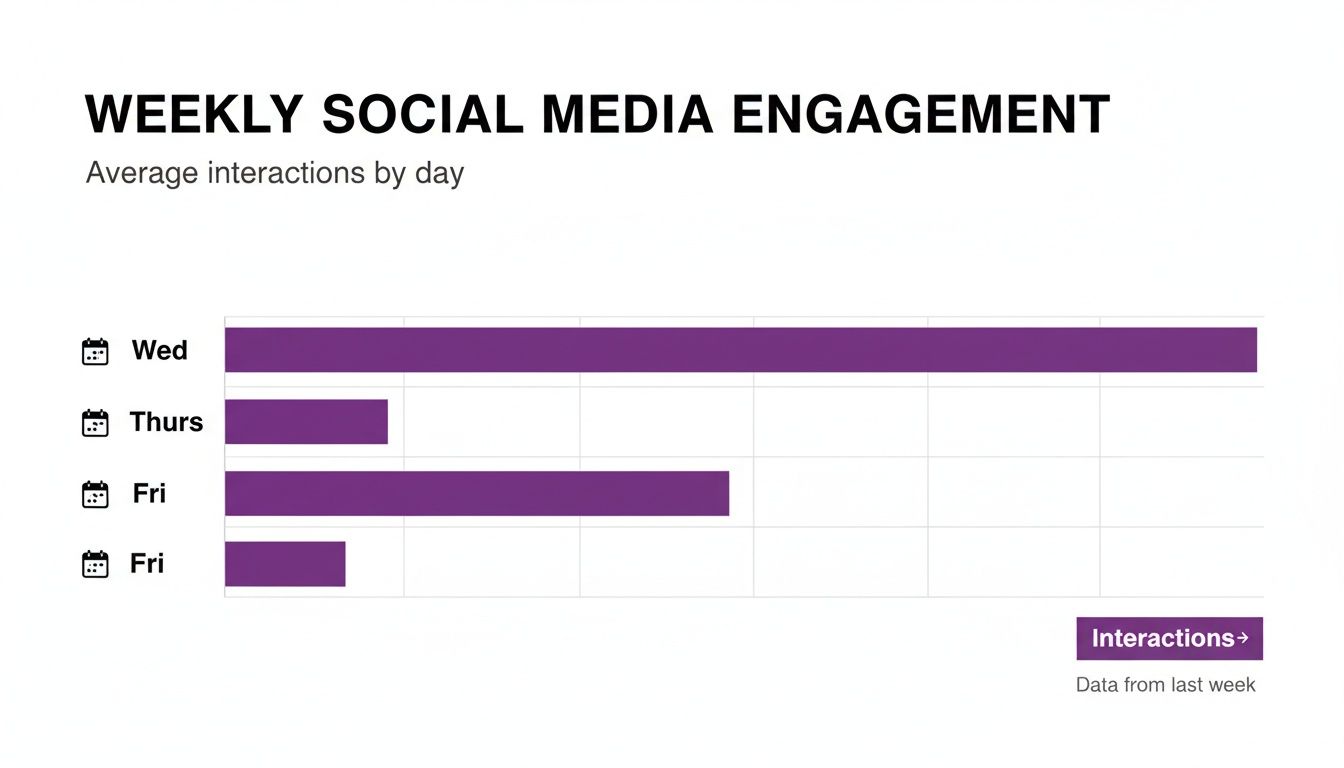
As you can see, Wednesday is often the sweet spot for grabbing your audience’s attention and encouraging them to jump into the conversation.
Crafting Shared Experiences People Love
Beyond a simple Q&A, you can use your platform’s native features to create shared experiences that bring everyone together. These interactive formats break up the monotony of the standard feed and give people an easy, fun way to participate.
Here are a few ideas to get you started:
- Run Weekly Polls: Let members vote on a future content topic, a new feature idea, or a fun, industry-related "this or that" question. It’s low-effort for them and gives you useful feedback.
- Go Live: Host an AMA (Ask Me Anything) session with an expert or take people behind the scenes of your process. Live video creates a sense of immediacy and lets you interact in real-time.
- Feature User-Generated Content (UGC): Create a branded hashtag and encourage members to share their own photos or stories. Highlighting a "Member of the Week" not only gives you authentic content but makes that person feel incredibly seen.
It's also important to have a realistic idea of what "good" engagement looks like. The table below shows some typical benchmarks to help you set achievable goals.
Social Media Platform Engagement Benchmarks
A look at average engagement rates across major platforms to help you set realistic goals for your community.
| Platform | Average Engagement Rate | Best For |
|---|---|---|
| 1.22% – 1.79% | Visual storytelling, influencer marketing, user-generated content | |
| 0.09% – 0.26% | Building tight-knit groups, local communities, event promotion | |
| X (Twitter) | 0.04% – 0.5% | Real-time conversations, news updates, customer service |
| 2.61% – 3.5% | B2B networking, professional thought leadership, industry news | |
| TikTok | 3.5% – 9.0%+ | Short-form video, trend-based content, creative expression |
These numbers can vary wildly based on niche and audience size, but they provide a solid starting point for measuring your own community's health.
By weaving interaction into the very fabric of your strategy—whether for a sprawling group or a niche Facebook community—you’ll build a space that people don’t just join, but one they actually want to come back to every single day.
Measuring Community Health for Long-Term Growth
To keep your community pointed in the right direction, you have to look beyond the vanity metrics. Follower count is nice, but it's not the whole story. The real health of your community comes down to how active and connected your members feel.
Tracking the right data shows you what’s hitting the mark and what you need to rethink. You're shifting from just counting heads to actually understanding how people behave inside your space. This means digging into the numbers that reflect genuine interaction and loyalty—the true foundations of a community that lasts.
Key Metrics Beyond Follower Numbers
To get a clear picture of your community’s health, you need a dashboard of a few key performance indicators. Think of each one as telling a different part of the story, from someone's initial interest all the way to their long-term dedication.
Here are the essentials I always keep an eye on:
- Engagement Rate: This is your most direct measure of interaction. It’s the percentage of your members who are actively liking, commenting, sharing, or saving your content. A high rate is a dead giveaway that your content is landing well.
- Active Members: Look at the number of unique members who contribute over a specific period (daily, weekly, or monthly). This tells you who is consistently showing up and participating, not just lurking.
- Member Retention Rate: This metric tracks how many people stick around over time. High retention is a huge signal that you’re providing real, ongoing usefulness.
- Sentiment Analysis: This is all about monitoring conversations to gauge the overall mood—is it positive, negative, or neutral? This qualitative data helps you understand how members truly feel about the community.
These metrics paint a much richer picture than a simple follower count ever could. For example, strong retention is a hallmark of successful online spaces. Twitter's monthly retention has climbed to 72.6%, which shows that users are finding continuous reasons to come back. You can find more about these user loyalty trends to see how the big players do it.
Gathering Actionable Feedback
Numbers only tell you what's happening, not why. To truly understand member satisfaction and find opportunities to improve, you have to collect feedback directly from your people.
Honestly, one of the most powerful things you can do is just ask. It shows you respect their input and are committed to making the space better for everyone.
Do not just assume you know what your members want. Create simple, direct ways for them to tell you. Their feedback is the most useful data you can collect for long-term success.
You can gather this information through a few straightforward methods:
- Surveys and Polls: Use tools like Google Forms or the native polls on platforms like X or LinkedIn. Ask specific questions about content preferences, community guidelines, or potential event ideas.
- Direct Conversations: Do not be a ghost. Actively participate in discussions and ask follow-up questions. When a member shares an opinion, ask "why?" to get to the heart of their feelings.
- One-on-One Outreach: Identify your most active members—your super-users—and reach out to them directly for a quick chat. Their point of view is incredibly insightful.
Sustaining Growth with a Community-Based Model
Sustainable growth means taking all these findings and continuously refining your approach. At Upvote.club, we actually built our service around this very idea of community-driven interaction. Our model operates on a community basis where users help each other grow.
This creates a positive feedback loop of authentic engagement that aligns perfectly with what platform algorithms want to see. Every like, comment, or share comes from a real person who is just as invested in growing their own presence as you are. For a deeper look at this, you might be interested in our guide to growing on Substack.
For those who need to accelerate their results, we offer subscription options that provide a large number of points and task slots right away. This allows you to scale your community-building efforts effectively, ensuring you consistently get the engagement needed to stay visible and continue growing.
Got Questions About Community Building?
As you start working on building a social media community, some questions always seem to pop up. Let's get them answered so you can sidestep the common hurdles that trip people up.
How Long Does It Actually Take to Build an Active Community?
Look, there’s no magic number here. The timeline really depends on your niche, how consistent you are, and your strategy for getting people to talk.
Generally speaking, you can expect to see real, meaningful activity within 3 to 6 months of dedicated effort. That initial growth is almost always the slowest part of the journey, so do not get discouraged.
The key is to focus on creating genuine connection from day one. With our Upvote.club service, we help spark that early interaction. Getting real engagement on your posts right away makes your content more visible, which helps turn that initial silence into a real conversation much faster.
What Are the Most Common Mistakes People Make?
New community builders often stumble over the same few things. The biggest mistakes I see are ignoring comments, posting sporadically, and being way too promotional without offering any real substance.
But the absolute worst mistake? Using bots or fake engagement.
Algorithms are specifically designed to sniff out and penalize this kind of activity, and it can completely destroy your reach. We actually built Upvote.club to solve this exact problem. Our platform uses only verified, human accounts to make sure every single interaction is authentic and contributes to real, long-term growth.
A community built on fake numbers is just a house of cards. Focus on real connections from the start—it's the only foundation that will actually last.
How Should I Handle Negative Feedback or Conflict?
Navigating disagreements is a non-negotiable skill for any community manager. When you get negative feedback, the best thing you can do is address it openly and professionally. Acknowledge their concern and thank them for taking the time to share it.
If things get heated or need a longer explanation, it's smart to take the conversation to a private channel like DMs.
When conflict pops up between members, point back to your community guidelines and step in as a neutral moderator. Your job is to keep the space safe and respectful. Handling these moments well can actually build a ton of trust and show your members you genuinely care.
Ready to kickstart the conversation and give your content the boost it deserves? With Upvote.club, you can tap into a network of real people to get the authentic engagement that platform algorithms love. Start building momentum today. Visit us at https://upvote.club/twitter to learn more.