Table of Contents
- Table of Contents
- Introduction With a Discovery Gap
- Channel Setup and Branding
- Build a channel page that explains itself fast
- Set up assets that push viewers to subscribe
- Defining Your Niche and Content Strategy
- Pick a niche narrow enough to win
- Use a content mix instead of guessing
- Content Formula Comparison
- Video Production and Retention Tactics
- Write the first seconds before you write the rest
- Use Shorts to feed long-form growth
- Build a simple editing workflow
- Optimize Discovery With SEO and Thumbnails
- Package the idea before you publish
- Match the click promise to the opening
- Run a pre-publish audit
- Scaling With Schedule Engagement and Analytics
- Build a publishing system you can keep for 90 days
- Use community distribution to solve the cold-start problem
- Track a short list of metrics and act on them fast
- Conclusion and Next Steps
You upload a video you worked on all weekend. The thumbnail looks decent. The topic is useful. You refresh YouTube Studio for the next few hours and get almost nothing. A few impressions. Barely any clicks. No comments. No real signal for YouTube to read.
That's where most new creators get stuck.
The worst part is that standard advice usually assumes you already have traffic. It tells you to check your analytics, study your audience, and double down on what already works. That breaks down for a new channel. Existing guides assume creators already have an audience, ignoring the initial discovery gap that leaves new channels without the data they need to train YouTube's algorithm (YouTube discussion of the discovery gap).
If you're trying to figure out how to get a following on YouTube, start by accepting one hard truth. Good videos alone don't fix a cold start. You need a tight topic, clean packaging, strong retention, and enough early engagement for YouTube to test your video with real viewers.
That's why new channels stall. Not because the creator is untalented, but because the system has no confidence yet.
The fix is a playbook built for zero traction. You need a channel that looks sharp, videos built for clicks and watch time, a weekly publishing rhythm, and a way to create momentum in the first hour after posting. That early window matters because YouTube is deciding whether your upload deserves wider distribution.
Table of Contents
- Introduction With a Discovery Gap
- Channel Setup and Branding
- Defining Your Niche and Content Strategy
- Video Production and Retention Tactics
- Optimize Discovery With SEO and Thumbnails
- Scaling With Schedule Engagement and Analytics
- Conclusion and Next Steps
Introduction With a Discovery Gap
A new creator usually makes the same mistake. They post as if YouTube will judge the video on quality alone. It won't. YouTube needs signals, and a brand-new channel has almost none.
That creates a miserable loop. You need viewers to get data, but you need data to know what viewers want. So you keep posting, guessing, and hoping one upload breaks through.
I've seen this with tutorial channels, commentary channels, and niche B2B creators. They often make solid videos, but the topic is too broad, the opening is slow, and the upload lands with no traction because nobody sees enough of it early.
Practical rule: New channels don't have an analytics problem first. They have a signal problem first.
A cold-start creator needs to think in stages. First, make the channel instantly understandable. Second, publish around one narrow viewer problem. Third, package each video so a stranger can grasp the promise in a second. Fourth, get enough early interaction to help YouTube test the upload.
That last part matters more than is often acknowledged. The first hour after posting can decide whether a video gets buried or tested. If nobody clicks, comments, or watches, YouTube has no reason to keep showing it.
The good news is that this is fixable. You don't need celebrity status, a studio, or luck. You need a structure that removes guesswork and builds momentum from upload to upload.
Channel Setup and Branding
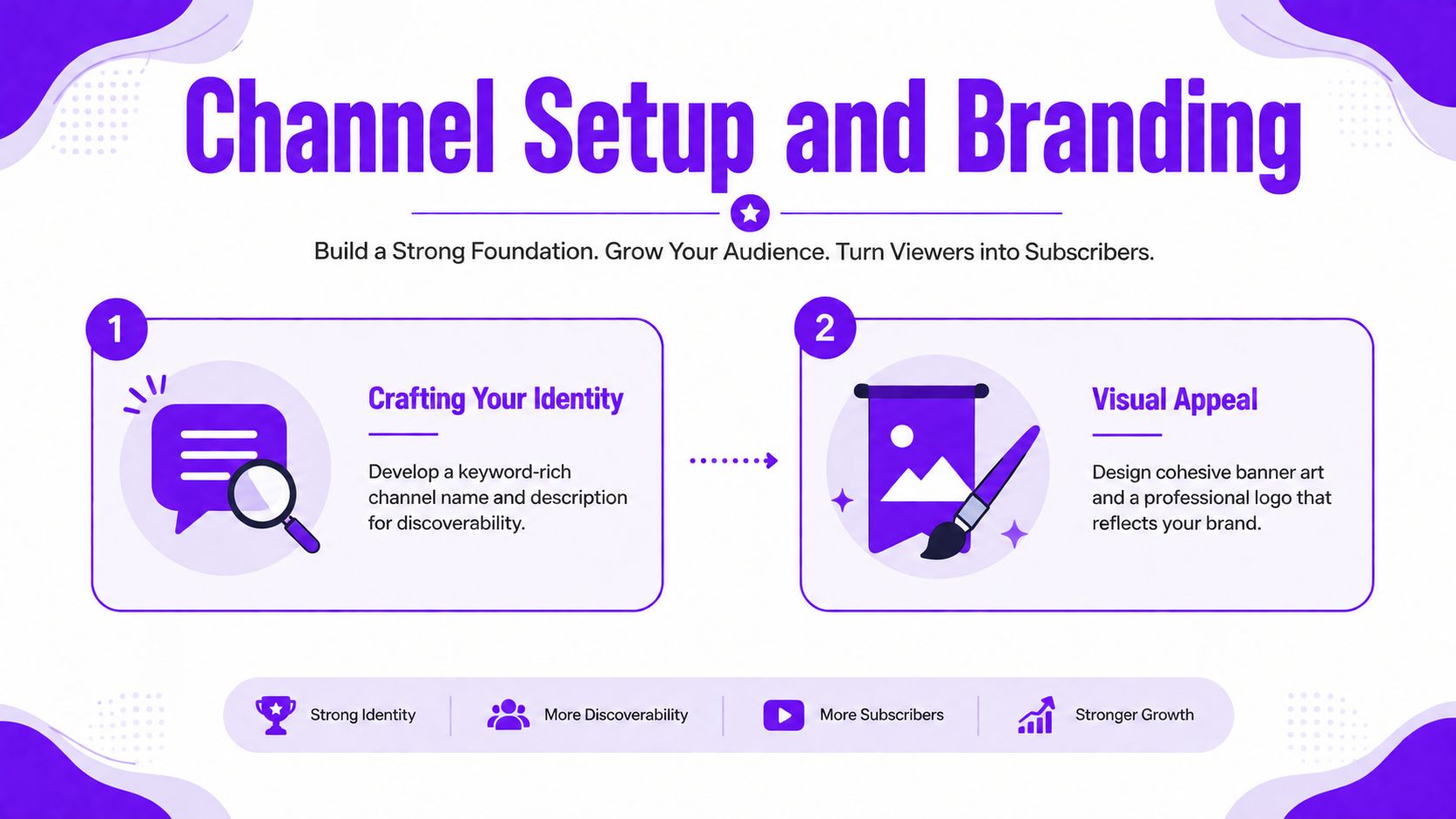
Most channels lose subscribers before the first video even starts. The page is vague, the banner is messy, and the visitor can't tell who the channel is for.
Your channel page needs to answer three questions fast. Who is this for? What kind of videos do I get? Why should I subscribe now?
Build a channel page that explains itself fast
Start with the channel name. Don't get clever if clarity is available. If your videos are about budget filmmaking, AI coding, or YouTube growth, make that obvious in the name or the surrounding profile text.
Your description should do simple work:
- State the topic clearly: Tell people the narrow subject of the channel in plain English.
- Name the viewer: Say who the content is for, such as new freelancers, indie founders, or beginner editors.
- Set the publishing expectation: Mention your posting rhythm so visitors know this isn't a dead channel.
Then fix your visuals. Your banner should support the topic, not distract from it. Use one main promise, one visual style, and one color system. If your profile image is a logo, make sure it's readable at small size. If it's your face, use the same image style across YouTube and your other social accounts.
A polished home tab also matters. Don't dump every upload into one feed. Organize the page with playlists built around outcomes, not vague labels.
Try playlist names like:
- Start here: For your best beginner-friendly videos
- Fix this problem: For a pain-point series
- Watch next: For a deeper sequence that keeps people on channel
Set up assets that push viewers to subscribe
YouTube gives you one small but useful conversion tool that many creators ignore. YouTube allows channel owners to add a branded watermark to every video via YouTube Studio customization settings, which serves as a persistent, clickable subscribe button available throughout the entire playback duration (watermark walkthrough on YouTube).
Use it. Keep it simple. A clean logo mark works better than cluttered text.
Your channel page should make sense with the sound off and in under three seconds.
Also connect your wider creator identity. If you're active on more than one platform, keep your names, profile photos, and value statement aligned. That includes side channels where your audience may also know you. If you manage cross-platform creator branding, our Instagram growth page at Upvote.club shows the same principle in practice. Keep the identity consistent so people recognize you instantly.
A basic setup checklist:
| Asset | What good looks like |
|---|---|
| Channel name | Clear, topic-linked, memorable |
| Banner | One promise, clean visual style |
| About section | Topic, audience, posting rhythm |
| Playlists | Organized by viewer intent |
| Watermark | Visible, clickable, simple |
| Profile image | Readable at small size |
Messy branding won't kill a great channel. But clear branding gives every viewer one less reason to leave.
Defining Your Niche and Content Strategy
If your channel is about “productivity, business, motivation, AI, mindset, and lifestyle,” it's not a niche. It's a pile.
Small channels grow faster when the viewer knows exactly what they'll get. Pick one narrow promise and repeat it long enough for YouTube and the audience to trust you.
Pick a niche narrow enough to win
The right niche sits at the overlap of three things: what you can keep talking about, what viewers already search for or watch, and what you can package with a fresh angle.
Bad niche: “tech”
Better niche: “AI tools for solo marketers”
Bad niche: “fitness”
Better niche: “strength training for busy desk workers”
That narrowness matters because YouTube learns from repeated patterns. If every upload targets a different type of viewer, the platform gets mixed signals and your audience does too.
A lot of creators quit too early because they chase novelty. One week it's a tutorial, the next week a vlog, then a hot take, then a random challenge. That isn't experimentation. That's drift.
Use a content mix instead of guessing
A better approach is to work from proven content formulas. Expert methodology for YouTube growth involves a structured content formula: the 3-3-3-1 framework and the 70-20-10 content rule to balance reliability with innovation (YouTube growth framework reference).
The point isn't to follow a formula like a robot. The point is to stop making random editorial decisions.
Here's how I'd use both frameworks.
- 3-3-3-1 works well for channel planning: It gives you a practical monthly structure.
- 70-20-10 works well for risk control: It stops you from overloading your channel with experiments.
- Together, they fix inconsistency: You keep enough stable formats while still testing new angles.
If you publish weekly, sketch out a rolling content bank instead of choosing topics the night before upload. Keep at least ten ideas sorted into buckets like tutorial, opinion, trend response, and test format.
For creators who repurpose written knowledge into video, side platforms can also reveal recurring audience questions. Our Quora community page at Upvote.club is a good reminder that real question-driven demand often shows up outside YouTube first.
Content Formula Comparison
| Framework | Educational | Entertaining | Trend Adapted | Experimental |
|---|---|---|---|---|
| 3-3-3-1 | 3 | 3 | 3 | 1 |
| 70-20-10 | 70% | 20% | 20% adapted trends fit this bucket less cleanly, but usually sit inside the flexible portion | 10% |
The table looks uneven because the frameworks do different jobs. One is a content mix by type. The other is a risk split.
Pick a subtopic you can stick with for months, not a trend you can only talk about once.
A simple 90-day content calendar should include:
- Core videos: Your repeatable format around one viewer problem.
- Trend-adapted videos: Timely angles that still fit your niche.
- Entertainment-driven videos: Content with stronger personality or story.
- Experiments: New packaging, new format, or a harder opinion.
Most creators don't need more ideas. They need more restraint.
Video Production and Retention Tactics
A weak opening kills more channels than bad editing.
You can fix lighting later. You can improve gear later. But if the first moments drag, viewers leave before the video has a chance.
Write the first seconds before you write the rest
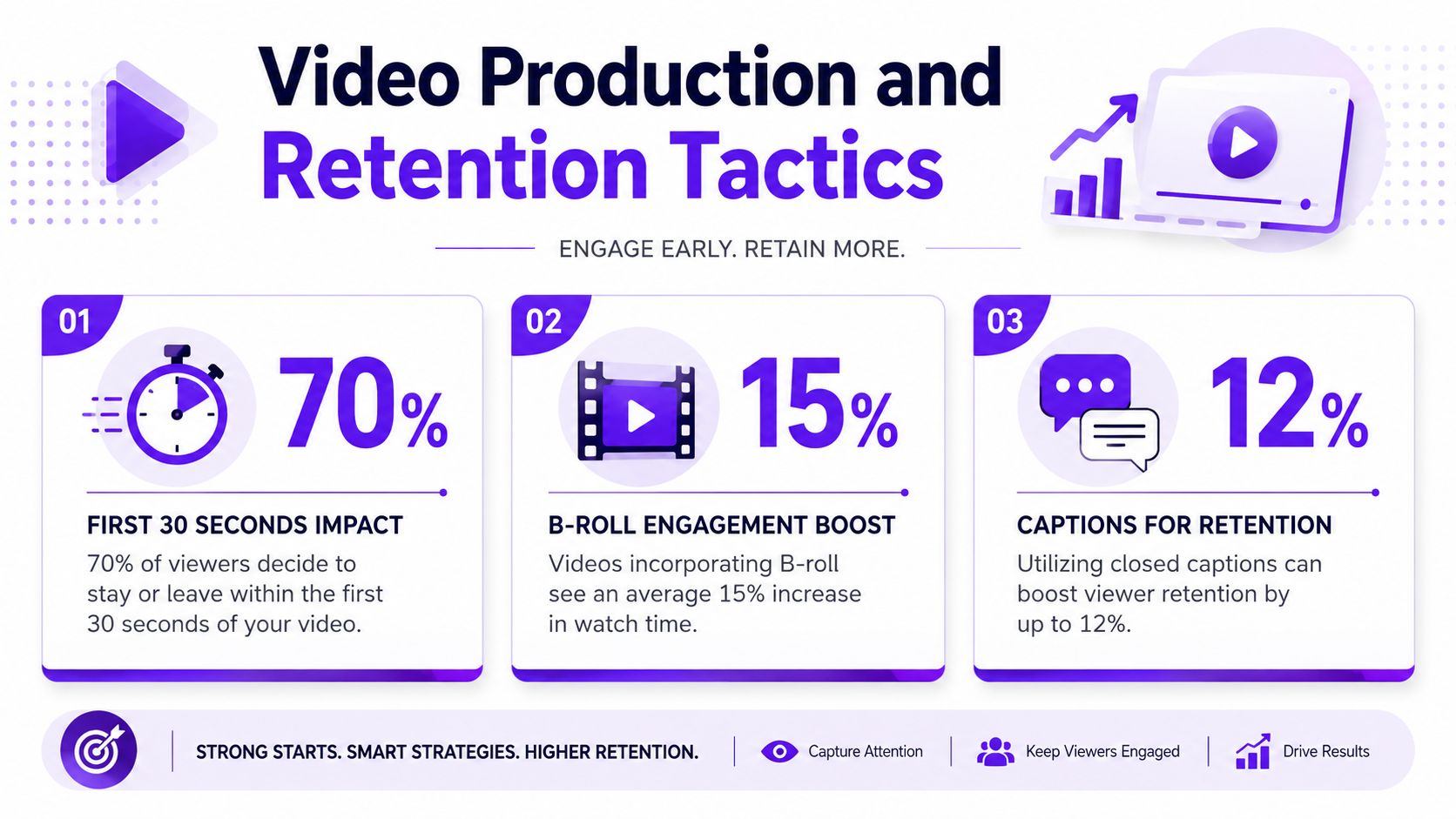
Creators must capture viewer attention within the first 10 seconds of a video, as this initial window determines whether the audience continues watching or abandons the content, directly impacting retention metrics (Shopify on first 10 seconds).
That means your opening should do one job. Confirm the click.
Don't start with “Hey guys, welcome back.” Don't open with a long animation. Don't spend half a minute warming up. State the problem, promise the outcome, and show that you understand why the viewer clicked.
Three hook templates that work:
- Direct payoff: “If your YouTube videos get views but no subscribers, this is the fix.”
- Fast contrast: “Most creators blame the algorithm. Their opening is the problem.”
- Tension hook: “This thumbnail can get clicks, but it can also destroy retention if your intro does this.”
The first half-minute needs pacing too. Cut dead air. Remove repeated phrases. Use text on screen only when it supports the point. B-roll should clarify, not distract.
There's also a less talked-about issue. Some videos get the click but lose the viewer because the packaging and the opening don't match. That friction is brutal. Data shows that 79% of viewers may leave if thumbnails and content don't align (Podia on retention friction).
Use Shorts to feed long-form growth
Many channels miss out on a straightforward advantage. YouTube Shorts deliver 65% of daily views from users who do not yet follow the creator, making them a primary discovery engine for new subscribers (discussion on Shorts discovery).
That makes Shorts a discovery tool, not just a side format.
Use Shorts for:
- Quick proof: One sharp takeaway from a longer video
- Opinion clips: A clear stance in a few seconds
- Micro-tutorials: One fix, one example, one CTA to the full video
The mistake is posting Shorts with no bridge to the channel. Every Short should point somewhere. Mention the deeper video, pin a comment, and build thematic overlap so a viewer who likes the Short also wants the long-form upload.
If you're trying to speed up scripting, rough cuts, or visual drafts, tools that streamline YouTube content workflow with AI can save time without changing your core editorial voice.
Build a simple editing workflow
You don't need a fancy post-production stack. You need repeatability.
Use a workflow like this:
- Script the hook first
- Outline the proof points
- Record with energy slightly above normal speech
- Cut pauses and duplicate thoughts
- Layer in captions or text only where clarity improves
- Pull one or two Shorts from the same edit session
If you publish both YouTube and short-form vertical content, keep your topic engine unified. Our TikTok growth page at Upvote.club reflects the same principle. One idea can become a long video, a Short, and a short-form clip for another platform.
Editing should serve retention. If a cut, zoom, caption, or B-roll shot doesn't help the viewer keep watching, remove it.
Optimize Discovery With SEO and Thumbnails
YouTube growth is packaging plus payoff. If people don't click, the video dies. If they click and bounce, it also dies.
That's why SEO and thumbnails can't be treated as separate chores. They're part of the same promise.
Package the idea before you publish
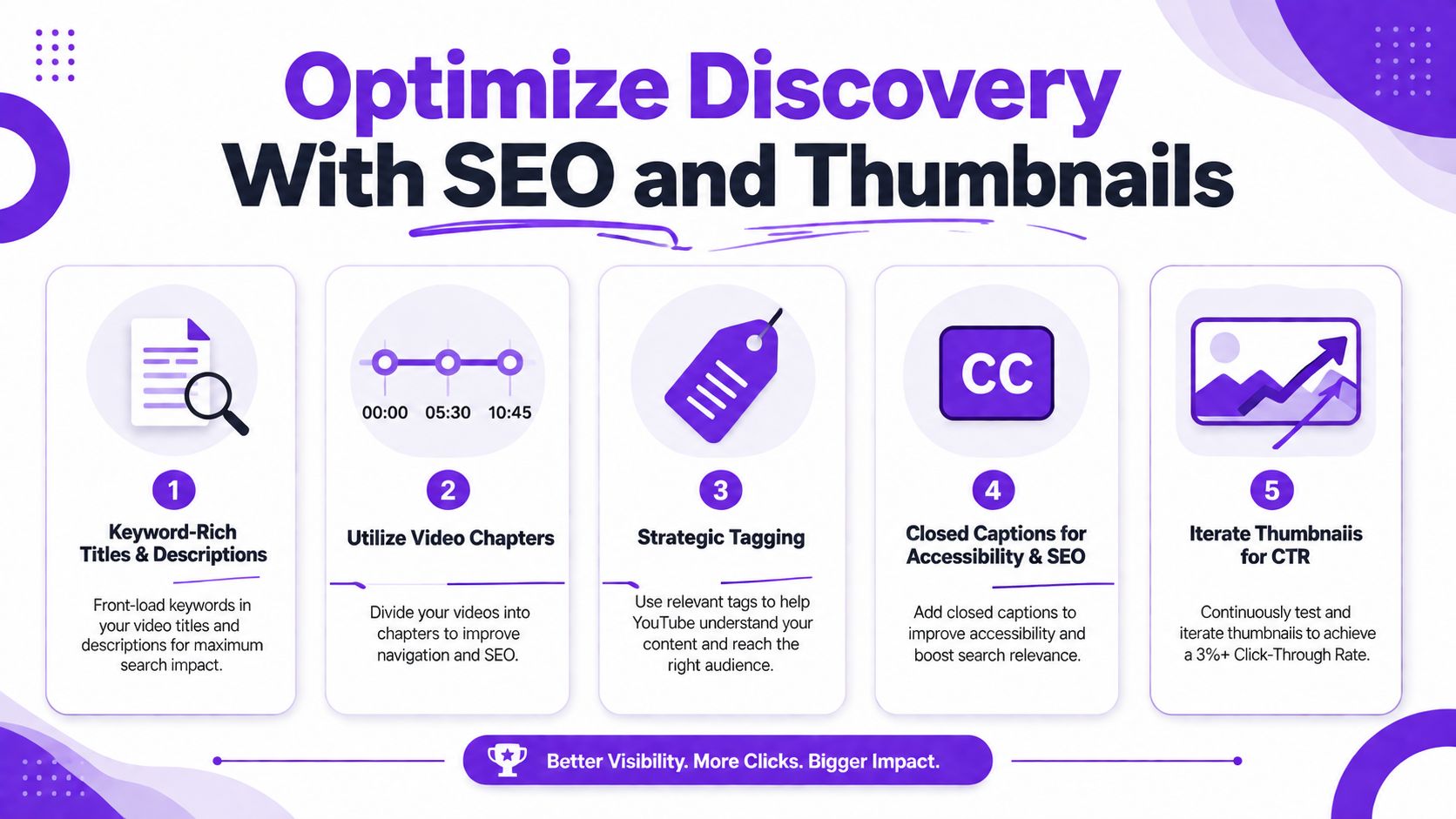
The title should say what the video is about in plain language. Don't hide the topic behind clever wording. Front-load the main keyword and keep the wording tight.
The description matters too. Put the main keyword early, then write a clear summary that supports the same promise as the title and thumbnail. If the spoken script naturally uses the topic phrase, YouTube gets cleaner context from captions as well.
A strong metadata checklist looks like this:
- Title: Main keyword near the front
- Description: Main keyword early and a clear summary
- Chapters: Useful labels, not filler
- Tags: Relevant, limited, topic-specific
- Captions: Clean enough to reinforce topic accuracy
Match the click promise to the opening
Thumbnail work is one of the highest-return tasks on YouTube. A 1–2% improvement in CTR can double a channel's long-term growth rate, making thumbnail iteration a powerful tactic for subscriber growth (YouTube growth video on CTR).
That's why lazy thumbnails cost channels so much. If the image doesn't create clear curiosity or a fast outcome, fewer people click. If it overpromises, people click and leave.
Good thumbnails usually do one of these:
- Show a sharp before-and-after contrast
- Highlight one object or emotion, not five
- Use very little text, if any
- Support the title instead of repeating it
A useful audit question is simple. Could a stranger understand the video promise from the thumbnail and title in one second?
Here's a practical example to study before your next upload:
Run a pre-publish audit
Before you hit publish, check alignment:
- Thumbnail promise: Is it specific?
- Title clarity: Does it use the viewer's language?
- Opening line: Does it confirm the click fast?
- Topic fit: Is the video clearly inside your niche?
- End goal: Does the viewer know what to watch next?
If the thumbnail makes one promise and the intro makes another, fix the intro first.
If you're serious about how to get a following on YouTube, stop treating SEO like a plugin task and thumbnails like decoration. They are audience filters. Better filters bring better clicks. Better clicks give you better retention opportunities.
Scaling With Schedule Engagement and Analytics
You publish a strong video, it gets a small burst, then nothing happens. The next upload starts from zero again. That cycle kills channels.
YouTube growth comes from repeated signals. A real schedule gives the platform more chances to test your videos, gives viewers a reason to come back, and gives you a workflow you can sustain.
Build a publishing system you can keep for 90 days
Channels publishing at least one video per week grow subscriber counts significantly faster, as regular uploads train the algorithm and accelerate discovery (Sprout Social on weekly publishing).
Weekly is the right target for most creators. It is frequent enough to build momentum and realistic enough to maintain without burning out.
The simplest effective cadence looks like this:
- One long-form video per week
- Two to five Shorts cut from that video
- One or two community posts tied to the same topic
- One review session for comments, audience questions, and analytics
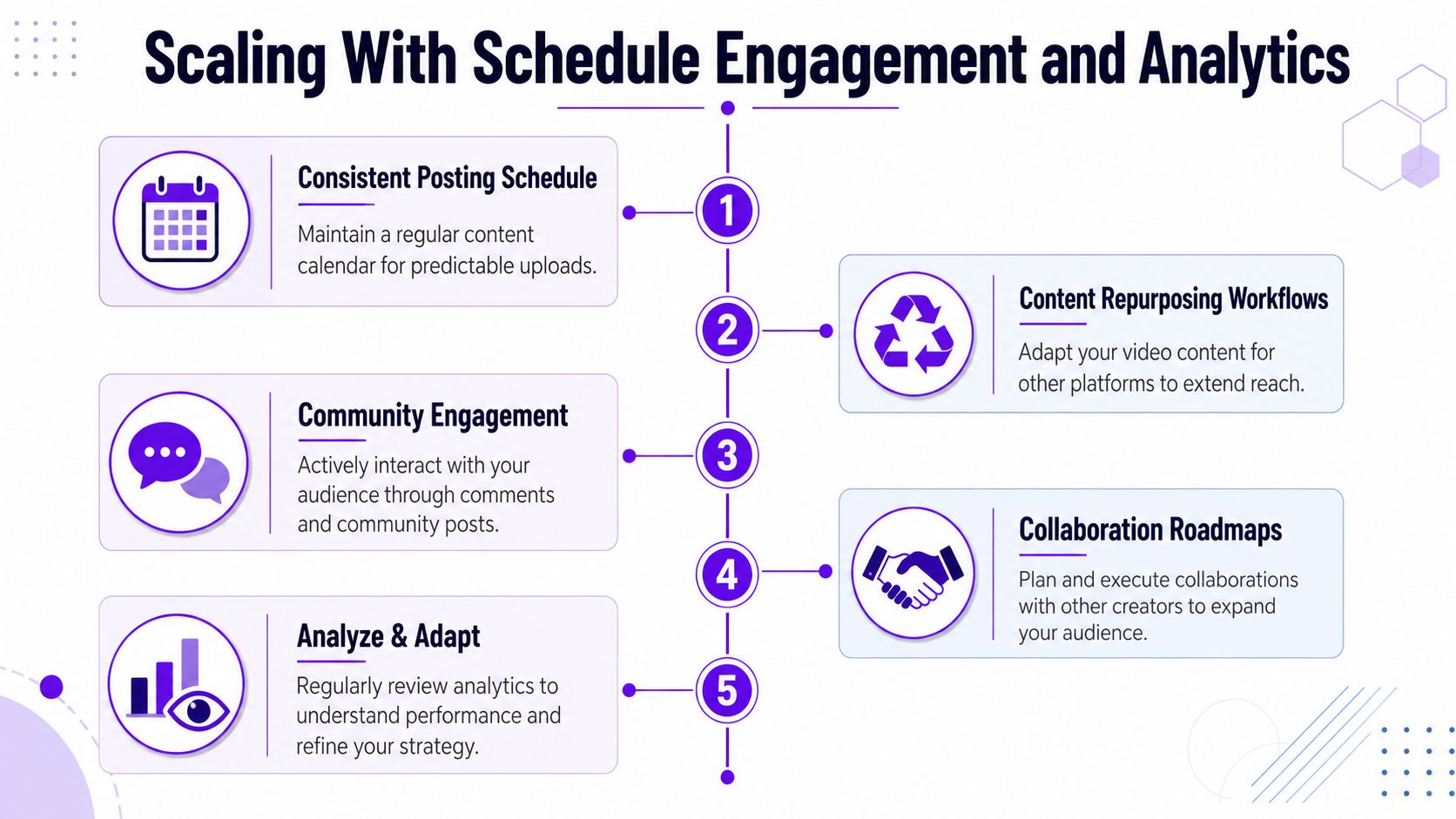
That schedule matters because it forces operational discipline. You stop reinventing your process every week. You start building templates, recurring formats, and a production pace your audience can trust.
Use a calendar like this:
| Day | Focus |
|---|---|
| Monday | Topic selection and outline |
| Tuesday | Script and thumbnail draft |
| Wednesday | Record |
| Thursday | Edit and cut Shorts |
| Friday | Publish and reply to comments |
| Weekend | Review performance and plan next topic |
Do not obsess over the exact days. Pick your rhythm and keep it consistent.
Use community distribution to solve the cold-start problem
Small channels usually do not fail because the content is invisible forever. They fail because each upload gets too little early activity to generate useful momentum.
That is why community distribution matters. After publishing, push the video into relevant conversations where the topic already has demand. That can mean niche subreddits, creator communities, Discord groups, newsletters, or comment sections where your audience already spends time. The goal is simple. Get real people to watch, respond, and give YouTube enough engagement data to keep testing the video.
Our Reddit growth page at Upvote.club helps creators get in front of active communities that can close that early discovery gap with consistent real engagement. Used properly, it is not about fake hype. It is about putting strong videos in places where interested viewers already exist, then maintaining enough momentum for YouTube to keep distributing the content.
Repurpose each upload so you are not relying on one asset only:
- Pull Shorts from the strongest moments
- Turn comments into follow-up community posts
- Repost one key insight as a discussion prompt
- Use objections and questions to shape the next video
Collabs help too, but pick them with discipline. Go after creators who reach the same viewer with a different angle, not random channels with a bigger subscriber count.
A simple outreach message works:
I liked your recent video on [topic]. I cover [related topic] for [audience]. A joint video on [specific angle] would fit both audiences because they are trying to solve closely related problems. If you're interested, I can send three tight concepts.
If monetization is part of your longer-term plan, read FLYP LTD's creator monetization guide. It becomes useful once your channel has a steady audience and you need revenue options beyond ad views.
Track a short list of metrics and act on them fast
Many creators waste hours inside YouTube Studio and still miss the obvious problem. You do not need more dashboards. You need a weekly review with a small scorecard.
Track these metrics:
- Views
- Click-through rate
- Average view duration
- Watch time
- Subscriber growth
- Returning viewers
- RPM
That is enough to diagnose almost every growth problem.
Use the numbers like this:
- Low CTR with solid retention means the topic packaging is weak.
- Strong CTR with poor retention means the opening or structure is disappointing viewers.
- Good retention with low reach means the topic, distribution, or audience targeting is off.
- Rising returning viewers means your channel identity is getting stronger.
Review one video at a time. Pick the biggest failure point. Fix that on the next upload.
Do not change five variables at once. If the thumbnail failed, improve packaging. If viewers drop in the first 30 seconds, rewrite your intros. If good videos stall early, use stronger distribution and community traffic to help them get enough initial response to stay alive longer in the recommendation system.
Growth at this stage is rarely dramatic. It is usually a steady build created by consistent publishing, real audience feedback, and better decisions each week. That is why creators who combine a fixed schedule with community-driven engagement usually outperform creators who sit back and hope the algorithm finds them.
Conclusion and Next Steps
If you want a following on YouTube, stop waiting for a lucky break and start building a machine.
Make the channel easy to understand. Pick a narrow topic. Use a content formula instead of random uploads. Open every video with a clear promise. Package the idea with a title and thumbnail that earn the click. Post weekly. Track the small set of numbers that show what's broken.
That's the playbook.
It works because each part supports the next. Better branding makes new visitors trust the channel. Better niche focus helps YouTube understand who to show your videos to. Better openings improve watch time. Better thumbnails improve CTR. Better scheduling gives the platform repeated data. Better analytics review keeps you from guessing.
If your goal is your first real audience, give yourself a clean 90-day run. Don't change niche every week. Don't disappear for a month. Don't judge the strategy after three uploads.
Stay on one path long enough for patterns to show up.
A simple next-step checklist:
- This week: Fix your channel page and banner
- Next: Build a 90-day calendar around one subtopic
- Then: Publish one strong long-form video each week
- After each upload: Cut Shorts and review packaging
- Every week: Check the same core metrics and make one improvement
Most creators fail because they stay vague, inconsistent, or impatient. Don't do that. If you're serious about how to get a following on YouTube, your job is to create clarity, repetition, and momentum.
If you want help creating that early momentum, Upvote Club is built for that job. With our Upvote.club service, you can take part in a community-driven system where real users help each other generate engagement without bots. We let members create unlimited tasks for likes, comments, reposts, saves, and followers from verified human accounts across YouTube and many other platforms. We use strict anti-bot moderation, clear task visibility, and an emoji-based verification system that doesn't require passwords. New users get 13 free points and 2 task slots to start, then earn more points by completing tasks for others. Every 24 hours, we add 1 free task slot. That makes Upvote Club useful for creators who need help during the Golden Hour, when early engagement can give a post or video a better shot at wider reach. Upvote Club works differently from services that sell fake activity. We're not about buying engagement. We're about participating in a real community where helping others gives you the ability to promote your own content.