Table of Contents
- Table of Contents
- Why Most New YouTube Channels Stall in the First 60 Days
- Running a 30-Day Niche Validation Sprint
- What to look for in the first 5 uploads
- Packaging Videos for Clicks and Watch Time
- Titles and thumbnails need different jobs
- A simple packaging checklist
- Building a Sustainable Publishing Cadence
- Choose a pace you can repeat
- Use one format to feed another
- Leveraging Community Engagement in the Golden Hour
- How to use the first hour well
- Tracking KPIs and Iterating Your 60-Day Plan
- A practical 60-day checklist
Most new YouTube channels don't fail because the creator lacks talent. They stall because the first month gets spent on branding, broad topic ideas, and “good” videos that don't answer a clear viewer problem fast enough. If you want how to grow a new YouTube channel fast, the path is tighter than most advice makes it sound. It's about picking one lane, publishing enough to learn, and packaging each upload so viewers click and stay.
A new channel usually needs a lot of reps before it looks stable. A practical benchmark says many consistent creators reach 1,000 subscribers in 6 to 12 months, and that often takes 40 to 150 videos. The same data set links 12 or more posts per month with 66% faster subscriber growth than 1 to 3 posts per month Instant Views. That doesn't mean spam. It means the first 60 days reward volume, consistency, and repeated learning more than polished perfection.
Table of Contents
- Why Most New YouTube Channels Stall in the First 60 Days
- Running a 30-Day Niche Validation Sprint
- Packaging Videos for Clicks and Watch Time
- Building a Sustainable Publishing Cadence
- Leveraging Community Engagement in the Golden Hour
- Tracking KPIs and Iterating Your 60-Day Plan
Why Most New YouTube Channels Stall in the First 60 Days
A single viral upload rarely rescues a brand-new channel. Most creators who stall are trying to make too many ideas work at once, so the channel never teaches YouTube who it serves or why viewers should come back. The key insight is that early growth is usually a validation problem first, then a volume problem, then a packaging problem.
YouTube's discovery system is not mostly search. One cited report says 70% of YouTube traffic comes from recommendations, so browse and suggested videos matter more than people expect ZipDo. That means a fresh channel has to earn its way into the feed by giving the system repeated signals, not by waiting for a perfect upload to carry everything. YouTube also says the first 3 seconds have to hook viewers, and that strong titles and thumbnails drive clicks YouTube Support.
Practical rule: treat the first month like a test bench, not a brand launch. If you can't explain the channel in one sentence, viewers won't do it for you.
The mistake I made on early channels was spreading effort across formats before I'd earned any signal. That made every metric noisy. A better approach is to pick one niche, publish enough related videos to compare performance, then improve the same type of upload instead of reinventing the channel every week. YouTube's own guidance also says growth usually starts after 20 to 30 uploads YouTube Support, which is another reason the first two months should be about learning fast.
If you also repurpose the same idea for other platforms, keep the core topic stable. Tools like Upvote Club's Quora setup can sit beside your video work if you want to extend the same topic into text, but the channel itself still needs one clear promise.
Running a 30-Day Niche Validation Sprint
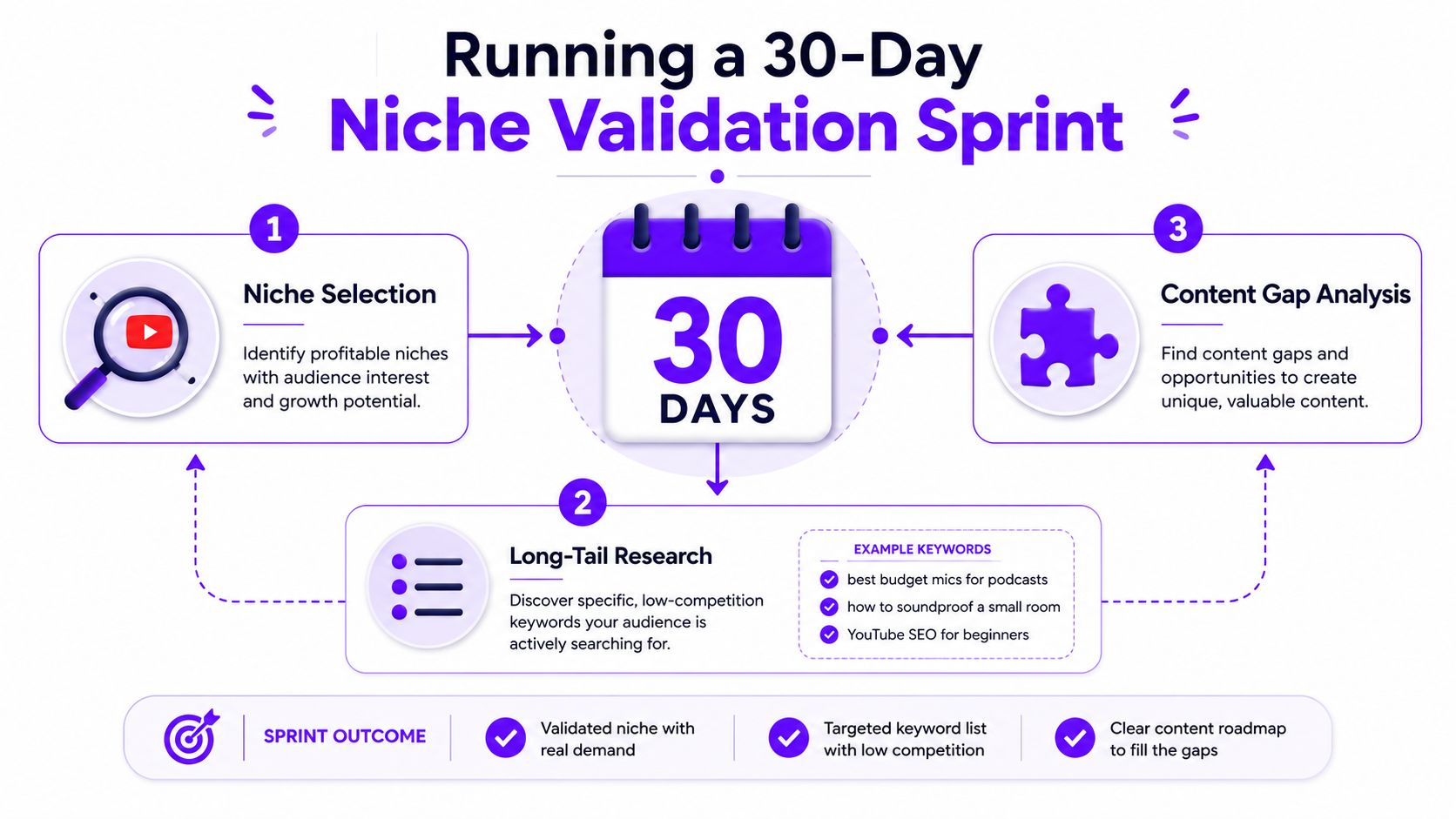
The cleanest way to start is to stop treating the niche as a branding choice and start treating it like a test. Pick one tightly defined topic, then publish 3 to 5 videos around the same viewer problem. A strong niche is specific enough that a stranger can guess what the next video will be, but broad enough that you can still make a dozen uploads without running out of angles.
A recent creator guide recommends exactly that tighter validation pattern, using comments and nearby channels to confirm whether the niche gap is real SponsorRadar. I'd go one step further. Search for long-tail questions that smaller channels can win, then compare the top results to your idea. If the strongest competing videos are old, vague, or poorly packaged, that's a cleaner opening than trying to outmuscle a giant channel on a broad keyword.
What to look for in the first 5 uploads
The first five videos should all solve the same kind of problem. If one video is for beginners, another is for advanced users, and the third is a random trend, you won't learn much. Keep the format tight enough that you can compare thumbnail performance, title performance, and retention without guessing.
Read the comments like a research log. Are people confused by the same step, asking for a related follow-up, or repeating a pain point in their own words? Those comments are not fluff, they're topic validation. A channel in the early stage can use that language to shape the next four uploads around the same viewer need instead of drifting into unrelated ideas.
Use the next upload as the answer to the last comment thread. That's often more useful than brainstorming from scratch.
If you want to widen distribution after you've identified the right topic, Upvote Club's Reddit option can support discussion around the same subject without changing the channel's core focus. The important part is that the channel keeps teaching one audience one thing until the signals are clear.
Packaging Videos for Clicks and Watch Time
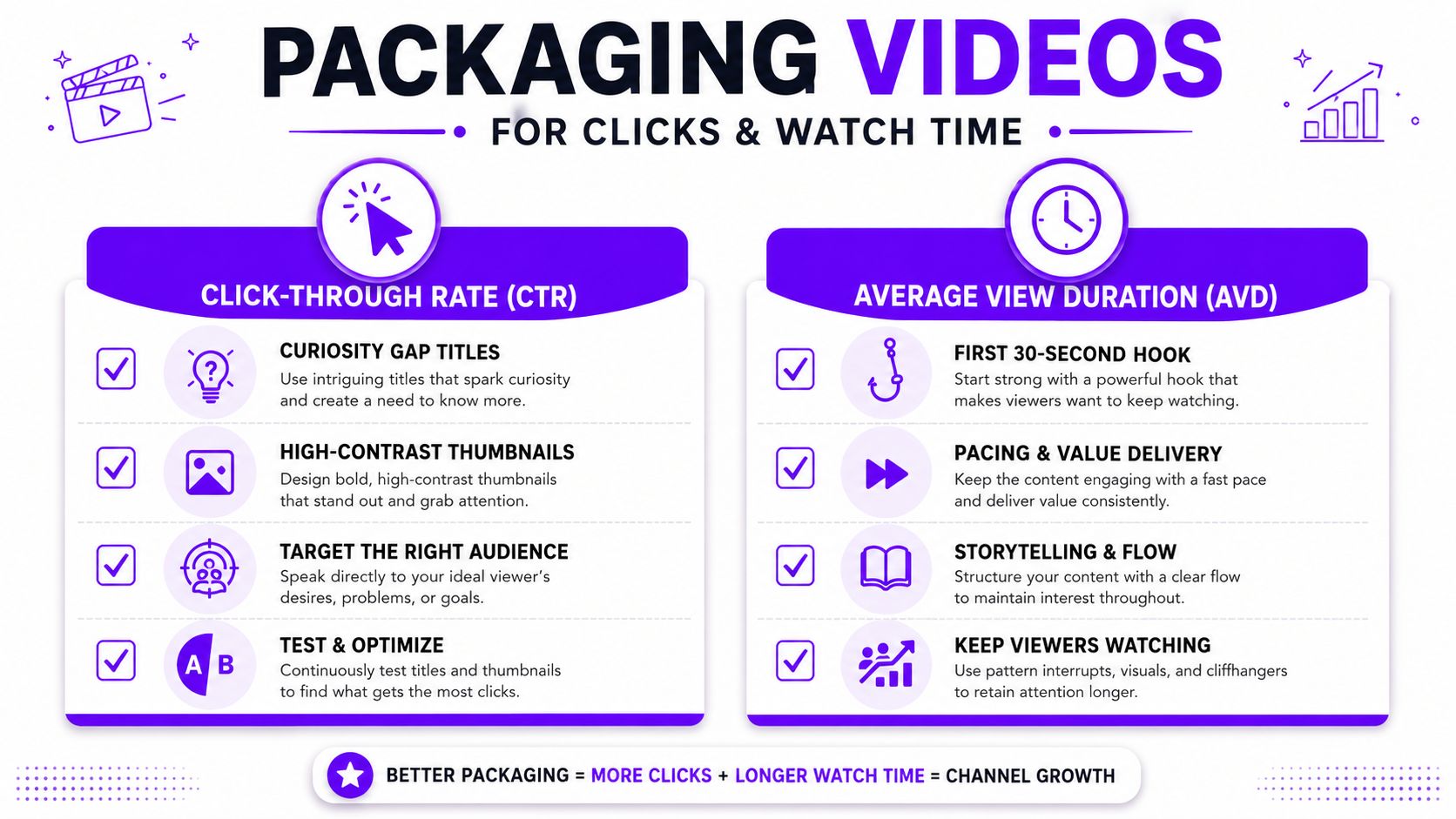
A good topic with weak packaging still dies in the feed. YouTube's own support guidance is blunt about the two forces that matter here, clicks and watch time YouTube Support. If the title and thumbnail don't earn the click, the video never gets its shot. If the first seconds don't hold attention, the next recommendation goes to someone else.
Titles and thumbnails need different jobs
The title should create curiosity without lying. The thumbnail should make that curiosity readable at a glance. I've seen too many new creators cram every keyword into the title and then bury the actual promise inside a cluttered image. That pair tends to look safe, not clickable.
For structure, one practical move is to write three title options for each upload, then pick the one that sounds most like the question a viewer would type after seeing the thumbnail. That keeps the title from sounding robotic. Another is to test one strong visual idea per thumbnail instead of stacking text, faces, arrows, and screenshots into the same square.
The first 3 seconds need a different approach. Open with the result, the mistake, or the tension, not a long greeting. If a viewer already clicked, don't ask them to wait for the point.
The hook should pay off the thumbnail fast. If it doesn't, the click was wasted.
For a useful outside example of packaging around audience expectations, Mogul's piece on artists' 2026 YouTube strategy shows how creators think about the same packaging problem in a music context. The format is different, but the logic is the same, the click has to match the opening.
A simple packaging checklist
- Curiosity gap title: make the promise clear, but leave one question unanswered.
- High-contrast thumbnail: keep the focal point obvious even on a small phone screen.
- Three-second hook: show the payoff, mistake, or transformation immediately.
- Tight pacing: remove anything that repeats the same point twice.
- Pattern follow-through: if the first upload in a format works, make the next one look and feel familiar.
A lot of creators over-edit instead of tightening. The best early videos usually feel direct, not polished to death. Upvote Club's YouTube like option can sit alongside packaging work when you're trying to get real early engagement on a post, but the upload still has to earn attention on its own.
Building a Sustainable Publishing Cadence
A schedule that survives the first month beats a sprint that burns out in the second. The channels I've seen gain traction early usually settle into a pace they can hold, then improve the packaging and topic mix as they learn what the audience responds to. Digital Marketing Institute recommends between one and two long-form videos per week, plus between zero and five Shorts per week Digital Marketing Institute. YouTube's own support guidance is more aggressive, suggesting 1 video daily or 4 to 5 per week and 1 to 2 Shorts daily at 15 to 30 seconds YouTube Support. Those targets are useful, but they point to different operating models, and that difference matters.
Choose a pace you can repeat
Choose a pace you can repeat consistently. If your setup cannot support high volume, do not pretend it can. A creator who burns out after eight uploads has less momentum than one who keeps a steadier pace for three months. Two solid long-form videos a week, with each one clipped into Shorts, usually beats a daily schedule that falls apart after the first burst.
Batching makes that pace realistic. Write multiple scripts in one sitting, record multiple videos in one session, then edit in a queue. That cuts the mental cost of switching tasks over and over. It also makes it easier to keep thumbnails, titles, and descriptions in the same style, so the channel starts to feel like a real library instead of a pile of isolated uploads.
The trade-off is simple. Higher frequency can create more surface area for discovery, but only if the work stays consistent enough to maintain quality. If the extra uploads push you into rushed scripting or sloppy packaging, the channel usually pays for it in weaker retention and fewer returning viewers.
Use one format to feed another
Long-form builds depth. Shorts can drive discovery, then move viewers toward the main videos. TubeBuddy's 2026 channel guide makes the same point about Shorts and long-form working together in the same discovery system TubeBuddy. You do not need separate content plans for each one if you are willing to slice the same idea in different lengths.
A simple weekly rhythm looks like this:
- Monday: script one long-form video.
- Tuesday: record that video and two Shorts.
- Wednesday: edit, add graphics, and make thumbnail drafts.
- Thursday: upload, optimize, and schedule the next post.
- Friday: review analytics and make the next topic list.
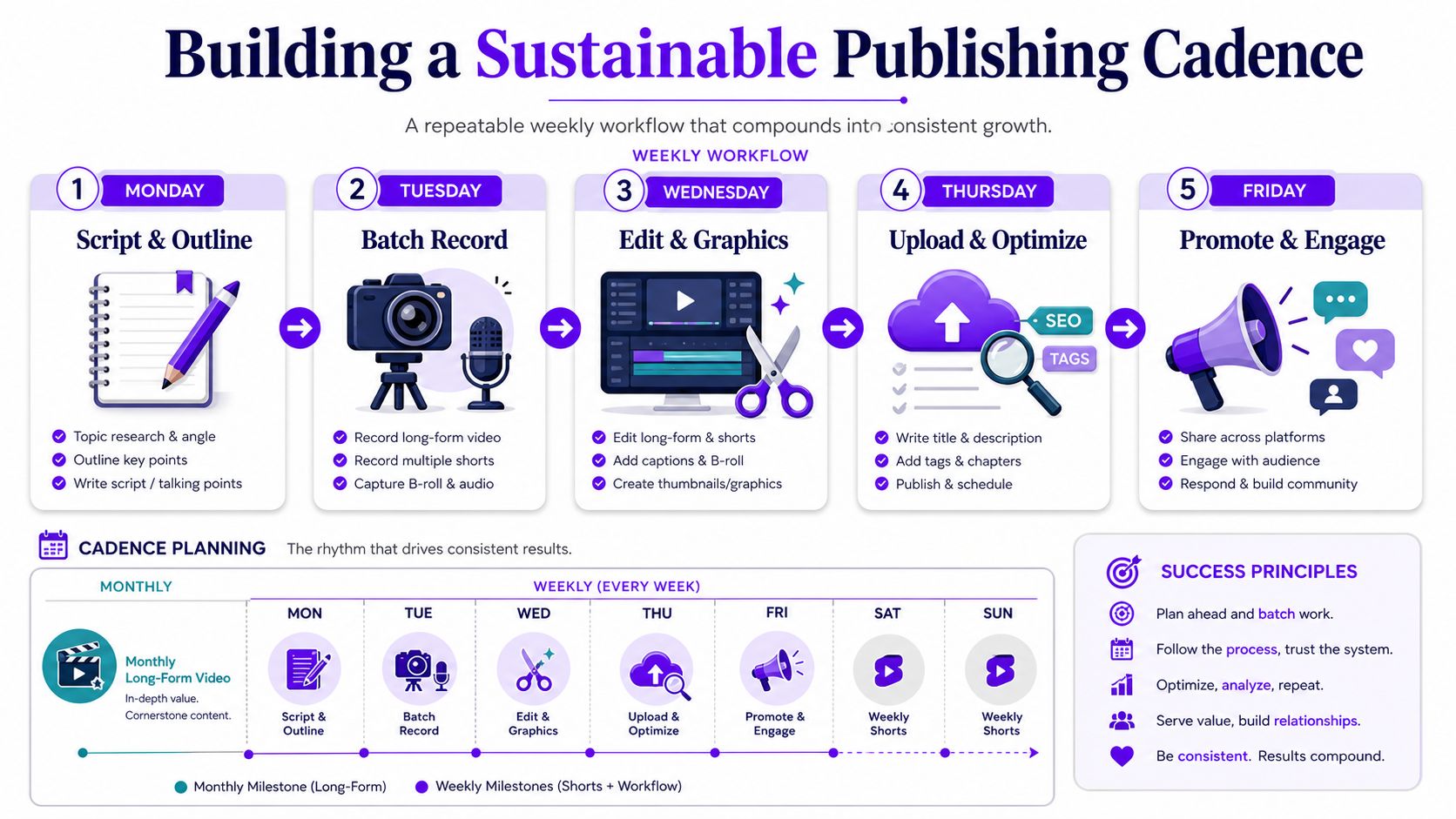
That cadence keeps the work moving without turning the channel into a content factory. It gives you enough repetition to spot which topics, hooks, and formats deserve another round. If comments start pointing to the same confusion or same payoff, use that signal quickly, then route the next upload toward it. Use a comment task loop only after the video itself has a clear angle and a clean promise, because engagement works best when the upload already gives viewers something specific to react to.
Leveraging Community Engagement in the Golden Hour
The first hour after publishing matters because that is when a video has its best chance at wider reach. The Golden Hour is simple in practice, early likes, comments, and reposts can help the upload gather momentum while YouTube is still deciding how to treat it. Creator teams use that window to give a post an initial signal, and the same logic applies to a small channel that needs proof of life fast.
Community-driven engagement can fit there, but only if it is tied to real accounts and real reactions. With Upvote Club, that can mean using a small burst of authentic engagement from other creators while your own audience starts responding. Keep the focus on the video itself, because engagement only helps when the upload already gives viewers a clear reason to click and react.
How to use the first hour well
A clean first-hour plan is more useful than chasing random activity. Publish, then send the video to people who already care about the topic, answer the first comments quickly, and pin one comment that asks a specific question tied to the video's payoff. If you want a structured way to keep comment activity moving, use a comment task loop after the upload has a strong hook and a clear promise.
I've seen creators waste this window by waiting too long to respond. The better move is simple. If someone asks a question in the first few minutes, reply fast, then use that reply to pull out a detail worth discussing in the thread. That keeps the comment section active without making it look manufactured.
Real engagement also works best when it matches the video's topic. A tutorial can get a question about the hardest step, a review can get a prompt about the trade-off, and a strategy video can get a prompt about what the viewer would try first. Those comments give the algorithm and future viewers a cleaner signal than generic praise.
If a creator also wants professional reach on another network, LinkedIn Likes is one of the available options, but the principle stays the same. Use engagement that looks like normal participation, then follow it with actual replies from the channel so the video thread feels alive instead of staged.
Tracking KPIs and Iterating Your 60-Day Plan
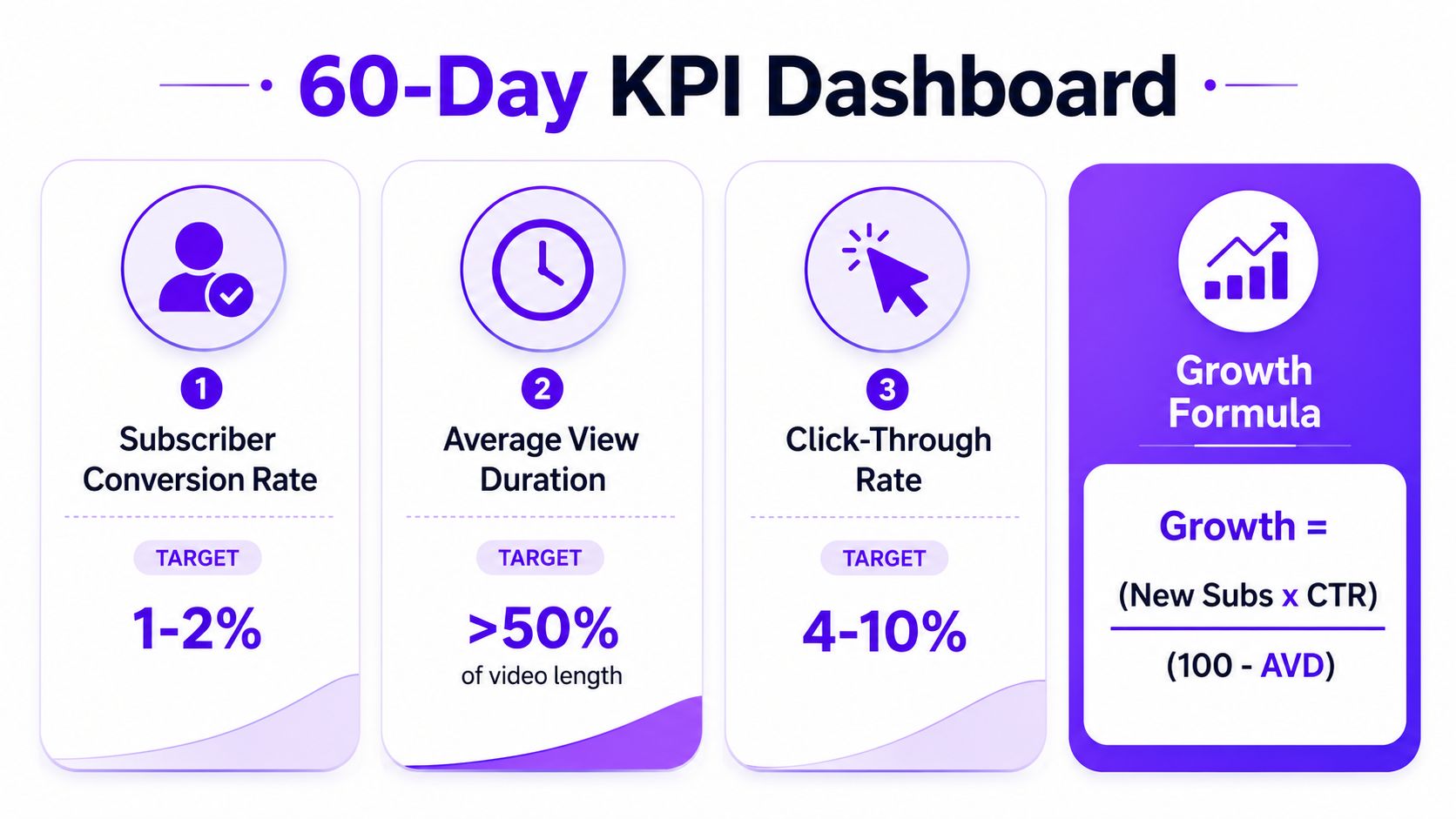
The first 60 days only matter if you measure what changed. The metrics I'd watch first are click-through rate, average view duration, subscriber conversion, and traffic source mix. Those four numbers tell you whether the topic is right, the packaging is working, and the content is holding attention long enough to earn another recommendation.
A simple review loop works better than staring at every metric. Look at which video brought the most subscribers, which thumbnail got the strongest click response, and which opening kept viewers longest. Then do more of the winning pattern and cut the weak one. The biggest mistake is changing five things at once and then not knowing which change mattered.
A practical 60-day checklist
- Week 1 to 2: publish 3 to 5 test videos in one niche.
- Week 3 to 4: compare comments, retention, and subscriber gains.
- Week 5 to 6: tighten titles, thumbnails, and first 30 seconds.
- Week 7 to 8: repeat the best format and stop weak ideas early.
YouTube's own support guidance says growth tends to start after 20 to 30 uploads YouTube Support, so the 60-day goal is not to “finish” the channel. It's to learn enough that your next 20 uploads are sharper than your first 20. That's where the compounding begins.
If you keep the niche tight, the cadence steady, and the packaging honest, the channel starts building its own proof. The first two months are still a grind, but they don't have to be random.
If you want a cleaner way to create authentic early engagement while you build your YouTube upload rhythm, visit Upvote Club. We offer a community-based way to earn real likes, comments, reposts, and followers from verified human accounts, without bots or password sharing. It fits the same early-growth mindset you've just read about, because it helps real videos get real activity in the Golden Hour.