Table of Contents
- What Are Promoted Tweets?
- How to Spot a Promoted Tweet
- Choosing Your Tweet Promotion Method
- Comparing Paid Ads vs Community-Driven Promotion
- Tweet Promotion vs Promoting Your Twitter Page
- The Community-Driven Advantage
- How to Boost a Tweet with X’s Promote Button
- Can You Promote a Tweet After It’s Published?
- Diving Into a Paid Promotion Campaign on X
- Setting Your Budget and Bids
- Building Real Momentum with Community Engagement
- A Community-Powered Alternative
- The Power of Social Proof
- Creating Tweets That Deserve to Be Promoted
- Crafting the Perfect Tweet Structure
- Strategic Use of Links and Hashtags
- Measuring Your Promotion and Refining Your Approach
- Community Growth Metrics
- Your Tweet Promotion Questions, Answered
- How Much Does It Cost to Promote a Tweet?
- Is It Safe to Use Services to Promote My Tweets?
- Which Method Is Better: Paid Ads or Community Amplification?
- Are Promoted Tweets Worth It?
When you want to promote a tweet for more reach, you have two main paths: pay for placement with X Ads (including the Promote / Boost button on an existing post), or earn an early wave of community engagement that can help the algorithm show your post more widely. This guide focuses on amplifying one tweet—not growing your whole Twitter page or account from scratch.
One path is about direct, targeted conversions and guaranteed impressions; the other is about sparking authentic conversation that can expand organic reach. Below you’ll learn what a promoted tweet is, how to use X’s Promote button, when full Ads Manager makes sense, and how community amplification fits in.
What Are Promoted Tweets?
A promoted tweet (often called a promoted post on X) is a regular post you pay to show to people beyond your existing followers. It looks and behaves like a normal tweet—people can like, reply, and repost it—but X distributes it to a targeted audience you choose, and the placement is labeled as promoted advertising.
Promoted tweets can appear in timelines (For You / Following), search results, and profile contexts, depending on the campaign. You typically pay through an auction for results such as engagements or link clicks, not a flat “price per tweet.” Use promoted posts when you need predictable reach for a launch, offer, or high-value update; use organic or community amplification when you want social proof and algorithm-friendly early momentum first.
How to Spot a Promoted Tweet
In the X interface, a promoted tweet looks like an ordinary post with a clear Promoted or Ad label near the account name or under the post. That label is how X discloses paid distribution. Aside from the label and the fact that non-followers may see it because of targeting, interactions work the same as on organic posts.
Choosing Your Tweet Promotion Method
Figuring out how to push your tweet forward comes down to your end goal. Are you after immediate sales and leads from a hand-picked audience? Or is the long game more your style—building credibility and convincing the platform your content is worth showing to more people?
Each route has its own playbook. For broader tactics on getting posts noticed over time, see our guide on how to boost Twitter posts. This article stays focused on promoting a specific tweet.
With X Ads, you’re in the driver’s seat. The platform’s native advertising tools let you slice and dice your audience with detail, targeting users based on demographics, interests, keywords, and even their physical location. It’s a powerful way to get your message in front of the right people, right now. This makes it perfect for big announcements, product launches, or anything with a deadline. Getting this right often means having a good handle on how to use X (Twitter) for small businesses.
The other approach is all about community-driven support. This strategy is less about brute force and more about finesse. The idea is to generate a surge of real human interaction—likes, comments, and shares—within the first hour of posting. This initial activity, often called the “Golden Hour,” acts as a powerful signal to the X algorithm, telling it that your content is connecting with people. In response, the platform is far more likely to serve your tweet to a wider, organic audience.
To help you visualize the trade-offs, here’s a quick breakdown of how these two methods stack up against each other.
Comparing Paid Ads vs Community-Driven Promotion
Paid ads buy immediate, targeted visibility, while community-driven promotion builds early engagement and social proof that may expand organic reach. Choose paid promotion for predictable delivery and conversions; choose community amplification when your priority is organic momentum and credibility.
| Feature | X Ads (Paid Promotion) | Upvote.club (Community Amplification) |
|---|---|---|
| Primary Goal | Direct conversions, lead generation, immediate reach | Organic visibility, social proof, algorithm boost |
| Targeting Method | Precise demographic, interest, and keyword targeting | Community of members who complete tasks with verified profiles where required |
| Cost Structure | Pay-per-impression/click (variable budget) | Points-based (earn by engaging, or purchase a plan) |
| Engagement Type | Can feel like an ad, may have lower organic feel | Likes, comments, followers, and saves from community members |
| Best For | Product launches, sales, time-sensitive offers | Building brand credibility, sparking conversation, early momentum |
| Algorithm Impact | Bypasses the algorithm to guarantee impressions | Works with the algorithm to trigger natural reach |
As you can see, it’s not about one being “better” than the other. They’re just different tools for different jobs. Paid ads buy you guaranteed visibility, while community support earns you algorithmic favor.
Tweet Promotion vs Promoting Your Twitter Page
Promoting a tweet means putting budget or community effort behind one post so more of the right people see that specific update. Promoting your Twitter page or account is a different job: growing followers, profile visits, and ongoing presence. X also offers account-level ad formats separately from promoted posts. This guide covers tweet-level reach. If your real goal is account growth, treat page promotion as a separate plan—and keep this article for when a single post needs a push.
The Community-Driven Advantage
This is exactly where a service built on genuine human interaction shines. With our Upvote.club service, we connect you with a community of people ready to give your content an initial push with authentic likes, comments, followers, and saves.
Our Upvote.club service works differently from other services. While other platforms let you buy likes, Upvote.club is built around participating in a community: you earn points by completing tasks, then spend points to create your own. You can learn more about how we approach building your Twitter presence with this method.
With our Upvote.club service, you can build engagement through a moderated community model. Members create tasks (within their available points and task slots) to receive likes, comments, saves, and followers. You earn points by completing tasks for others, unlock streak rewards every 5 completed tasks, and can invite friends for extra points after they complete tasks—creating a sustainable cycle of authentic interaction.
We built this with safety and transparency at its core. We will never ask for your social media passwords. Where verification is required, we use an emoji-based fingerprint on your public profile. Moderation and profile checks reduce abuse; we do not claim every interaction is guaranteed bot-free forever.
By getting that quick, early wave of engagement, you give your tweet the momentum it needs to catch on organically. It builds social proof and makes your content look credible right out of the gate, all without compromising the integrity of your account. In the end, both paid and community-driven methods have their place. The right choice just depends on what you’re trying to achieve.
How to Boost a Tweet with X’s Promote Button
The Promote button (also called Boost or Quick Promote) is X’s fast path to put money behind an existing post without building a full Ads Manager campaign from scratch. On desktop, look for a Promote control near the post; on mobile, open post analytics (the graph / activity icon) and choose the option to promote your post. Then pick a goal (such as more engagement or more link clicks), set a simple audience, choose a budget and duration, and confirm.
Availability can depend on account type and ads access—many users need a Professional profile and a payment method, and some Boost features are tied to X Premium or ads eligibility. If you don’t see Promote on a post, check those requirements first. Boost is best when you already have a strong tweet and want a quick, targeted push; use full X Ads Manager when you need deeper targeting, objectives, and reporting.
- Open the tweet you want to promote (ideally one that already has some engagement).
- Select Promote / Boost from the post or from post activity analytics.
- Choose a goal, audience basics (for example location and age), and a daily or total budget.
- Review the estimate, then create the promotion and track results in ads or post analytics.
Can You Promote a Tweet After It’s Published?
Yes. Boost / Quick Promote is designed for posts you’ve already published. You promote your own tweet after it’s live; you generally cannot promote someone else’s post. If a tweet includes certain links or policy-sensitive content, X may limit or block promotion—try removing the blocker or creating a compliant version before boosting.
Diving Into a Paid Promotion Campaign on X
If the Promote button is too limited, running a full paid campaign in X Ads Manager gives you more precision and control. This isn’t a “spray and pray” approach: you choose the objective, audience, creative, and bidding so your budget hits people who are likely to care.
It all starts with picking a campaign objective that lines up with your actual goal. Are you trying to drive traffic to your website? Get more views on a video? Or just juice the engagement on a killer tweet? Nailing this down first is important. Ads Manager also lets you promote an existing post or create promoted-only creatives that don’t appear on your profile the same way organic posts do.
Once you know what you want to achieve, the next step is deciding who you want to reach. The X Ads platform lets you stack different targeting options to zero in on your ideal audience. You can filter by the basics like age and location, or get much more granular by targeting people based on their interests, the keywords they’re tweeting, or even the specific accounts they follow. This kind of detail makes sure your budget is spent on people who are actually likely to care.
This flowchart can help you figure out if a paid, targeted campaign or an organic growth play is the right move for you right now.
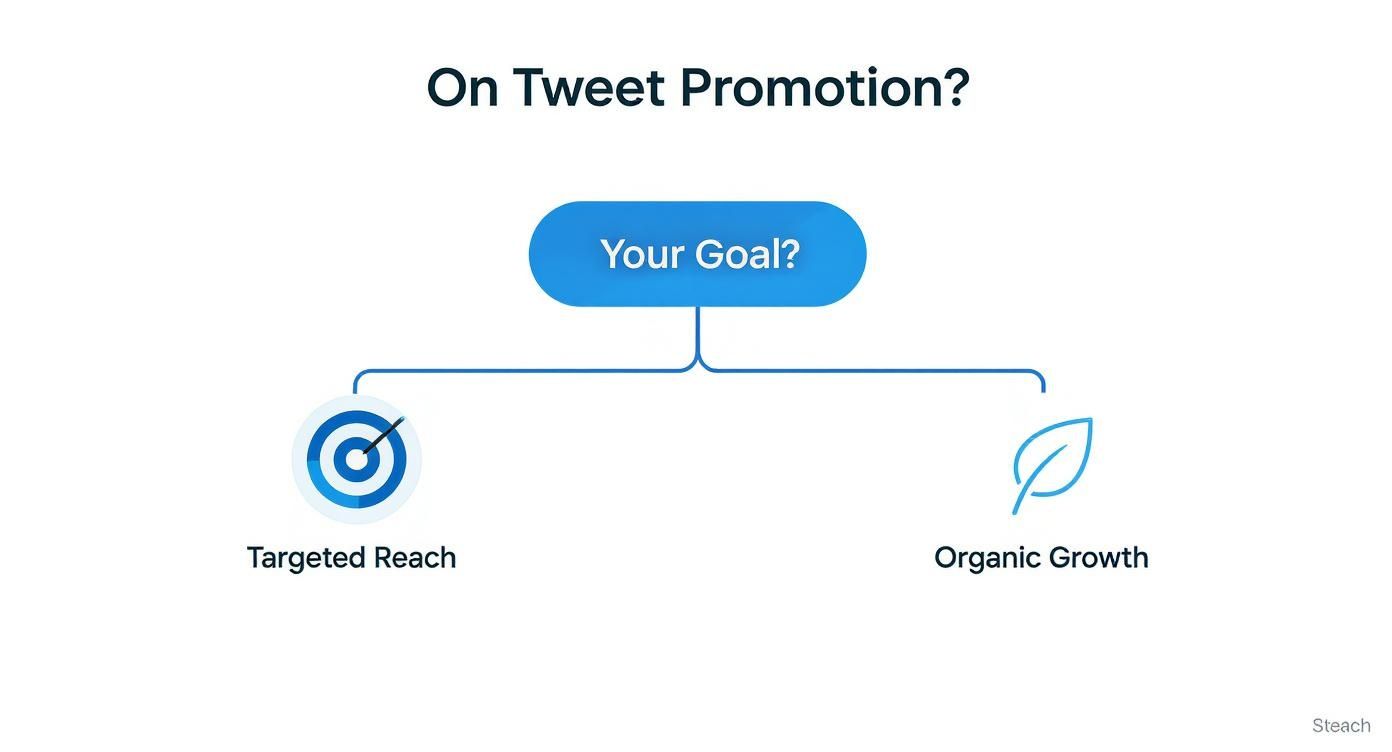
As you can see, if your goal is immediate and specific—like hitting a certain demographic for a flash sale—paid promotion is your most direct route. But if you’re playing the long game and building up social proof, an organic or community-driven strategy makes more sense.
Setting Your Budget and Bids
With your audience locked in, it’s time to talk money. You’ll need to set a budget and pick a bidding strategy. You can either set a daily budget to manage your spend day-to-day or a total campaign budget if you’re running it for a set period. X also gives you different ways to pay, like bidding for each link click (CPC) or for every thousand impressions (CPM).
For example, a small business launching a new product might set a total budget of $100 over five days. They could target users who follow their direct competitors and have recently tweeted about related keywords. It’s a focused tactic that makes even a small budget punch above its weight.
Despite all the recent platform shake-ups, paid advertising is still the engine that runs X. The platform’s ad revenue, which hit $4.46 billion in 2021, still made up over 75% of its total revenue in 2023. This just goes to show how central paid content is to the ecosystem for both the platform and its advertisers.
Beyond the basics, X is always tinkering with its features. Staying on top of updates, like Twitter’s new features for social commerce, can give your paid campaigns a serious edge.
Key Takeaway: A winning paid campaign on X comes down to aligning your objective, audience, and budget. Start with a clear goal, use the targeting tools to find the most relevant people, and set a budget you can track and tweak for the best possible results.
While paid campaigns give you a ton of control, sometimes you just need a little nudge to get the ball rolling. Getting some early traction can help build social proof before you put any ad spend behind a tweet.
Building Real Momentum with Community Engagement
Paid ads are one way to promote a tweet. Another is to let the community do it for you.
Instead of paying to force your tweet into people’s feeds, you can earn your visibility. This approach is all about creating genuine human momentum. It’s about showing the algorithm that real people are actually interested in what you have to say, which is the most powerful signal you can send.
This method taps into the core design of social platforms: they exist to show people what other people find engaging. A fast burst of likes, comments, and shares right after you post—especially within the first hour, the “Golden Hour”—tells the algorithm your content is worth showing to a much wider audience.

A Community-Powered Alternative
So, instead of fighting the algorithm, you can work with it. That’s the entire idea behind our Upvote.club service.
Our Upvote.club service operates on a community-based model where members help each other grow. Moderation and anti-abuse checks apply, and bot-style abuse is not welcome. When you join and complete tasks with a real account, you earn points—an internal currency you can spend to create your own tasks. In other words, by helping others, you earn the ability to get your own content seen.
How it works with our service:
When a user registers, they receive 13 free points and 2 task slots. These can be used to create the first task. For example, getting 2 likes on Twitter might cost 4 points (likes start from 2 points each). If more points are needed, the user must complete tasks for others. The first time a user completes a task, the system may ask them to verify their social media accounts. Each social network only needs to be verified once. No social media passwords are required—instead, we use an emoji-based verification fingerprint where required. If you need more capacity, paid plans can add daily task slots; higher plans such as MATE also include a large points allotment.
This creates a sustainable loop of authentic interactions. You can track task progress in your dashboard as completions come in.
The Power of Social Proof
That initial wave of real engagement does more than just kickstart the algorithm. It builds instant social proof.
When someone new comes across your tweet, they don’t see a ghost town. They see a conversation already in progress, making your content look more credible and interesting from the jump. A tweet with zero interaction is easy to ignore; one that’s already buzzing invites more people to join in.
At Upvote.club, we see it every day: a small, strategic nudge from a real community can ignite a tweet’s organic reach. By helping others, you earn the ability to get your own content seen, building visibility without ever compromising your account’s integrity.
This approach is powerful for creators, indie hackers, and brands who care about building a loyal following, not just chasing vanity metrics. It helps you get your message seen safely and effectively.
If you’re just looking for that initial spark, start with a few strategic Twitter likes or followers from the community to get your tweet’s momentum going.
Creating Tweets That Deserve to Be Promoted
Let’s be blunt: you can pour all the money or community effort in the world into promoting a tweet, but if the content is weak, you’re just supporting mediocrity. A great tweet has a shot at succeeding on its own. A promoted one needs to be exceptional enough to justify the push.
Before you spend a single dollar or a single community point, your tweet needs to be a scroll-stopper. It has to earn the interaction.
The fastest way to get noticed in a feed that moves at light speed is with strong visuals. Plain text is easy to ignore. A sharp image or a tight, compelling video? That grabs the eye instantly. This isn’t just a hunch; the data backs it up.

Crafting the Perfect Tweet Structure
The most effective tweet structure is simple: open with a strong hook, deliver the core message immediately, and finish with one clear call to action. Each part should help readers understand the value quickly and know exactly what to do next.
- Lead with a hook. Your first sentence is everything. Ask a provocative question, drop a surprising stat, or make a bold claim. Give them a reason to stop.
- Deliver the core message, fast. No beating around the bush. What’s the offer? What’s the news? Get straight to the point before their thumb keeps moving.
- Include a clear Call-to-Action (CTA). Tell people exactly what to do next. “Read the full story,” “Shop now,” “Share your thoughts”—don’t make them guess.
This formula—strong hook, direct info, clear next step—makes your tweet easy to digest and even easier to act on.
Strategic Use of Links and Hashtags
Even the small details, like where you put your links and hashtags, can make a huge difference. Most people tack the URL on at the very end, but data shows that placing a link mid-tweet can make it 26% more likely to be shared.
The same goes for hashtags—using them properly can boost the chance of a share by 33%. And don’t forget the visuals we talked about. Tweets with images don’t just get a little bump; they see 89% more likes and 150% more retweets. You can dig into more X statistics like these to really fine-tune your approach.
The goal isn’t just to be promotional; it’s to be helpful. A perfectly crafted tweet informs, entertains, or sparks curiosity. The promotion should feel like a natural next step because the content is just that good.
Even with the perfect tweet, that initial burst of engagement is what signals to the algorithm that you’ve got something worth showing people. This is where a service like Upvote.club comes into play. We help you get that first wave of interaction from community members in a moderated, points-based system.
That early traction tells the algorithm your content is connecting, opening the door to a much wider audience. If you want to give your best content the head start it deserves, see how our community can deliver more authentic Twitter likes.
Measuring Your Promotion and Refining Your Approach
Measure a tweet promotion by tracking impressions, engagement rate, link clicks, conversions, and cost per result. Compare those metrics with your campaign goal, then refine weak elements—such as the audience, creative, budget, or bid—and test the revised promotion again.
When you’re running paid campaigns through X Ads, the dashboard is your command center. You’ll want to keep a close eye on a few key numbers. These are your vital signs:
- Impressions: How many times your tweet was seen.
- Engagement Rate: The percentage of people who saw it and actually interacted.
- Cost Per Result: What you paid for each click, follow, or whatever action you were aiming for.
This data tells you, point-blank, if your budget is pulling its weight or just getting burned.
Community Growth Metrics
If you’re using a community-driven method, the metrics look a little different. You’re not just tracking direct ad performance. Instead, you’re watching for the ripple effect—the organic lift that follows the initial push from the community.
With a service like Upvote.club, you can track task progress in your dashboard as community members complete your tasks. Focus on whether the tweet’s impressions, engagement, and link clicks rise after the initial push. You can even check out our detailed guide on how saving tweets on Twitter signals activity to the algorithm. For a deeper dive into engagement math, see Twitter engagement rate.
The goal is to see how the initial, community-sourced engagement translates into broader organic reach. Look for increases in your tweet’s impressions and engagement in the hours after the promotion, as these are signs the algorithm is showing your content to more users.
This approach taps directly into how people actually use the platform. For instance, X Ads are often more cost-effective than other social platforms, and we know that direct message campaigns can generate 300% more clicks than email.
And since 80% of social media customer service requests happen on X, it’s a vital channel for connecting directly with your audience. You can find more information on building a Twitter marketing strategy guide on TweetArchivist.com.
Learning to read this data lets you refine your approach on the fly, tweak your content, and ultimately get much better results over time.
Your Tweet Promotion Questions, Answered
When you’re thinking about how to get more eyes on a tweet, a few questions always pop up. It usually boils down to cost, safety, and which method actually works. Let’s break those down so you can figure out what’s right for you.
How Much Does It Cost to Promote a Tweet?
There’s no single price tag—the cost really swings depending on the path you take.
If you go the route of X Ads, you’re in the driver’s seat. There’s no fixed universal price for a promoted tweet: spend depends on your auction bids, targeting, and competition. You can set a daily cap or a total budget for a campaign, and you typically pay for the results you choose, like clicks, impressions, or engagements. It’s a flexible option whether you have a tiny budget or a big one.
Community-driven promotion is a whole different ballgame. Take our service, Upvote.club, for example. You can get started for free. When you sign up, you get 13 free points and 2 task slots to kick off your first promotion. You earn more points by engaging with other people’s content, and then you spend those points to get engagement on your own tweets. It’s a system where you can promote your work without spending cash, just by being an active part of the community.
Of course, if you want to move faster, you don’t have to grind it out. Paid plans can add daily task capacity, and higher plans such as MATE include a large points allotment so you can create more tasks with less grinding.
This community model gives everyone a shot at promotion, trading active participation for what would otherwise cost you cold, hard cash.
Is It Safe to Use Services to Promote My Tweets?
This is a smart question, and the answer comes down to how a service works. Using platforms that lean on bots, fake accounts, or any kind of artificial engagement is a massive risk. Plain and simple, those methods break the rules and are a fast track to getting your account flagged, restricted, or even shut down for good.
You have to stick with services that use real human interaction and clear verification.
At Upvote.club, we treat account safety as a top priority. We will never ask for your social media passwords. Instead, where verification is required, we use an emoji-based fingerprint on your public profile to link accounts. This keeps your credentials private and avoids handing over login access.
On top of that, we moderate the community and apply anti-abuse checks—we do not promise a perfect no-bot guarantee. Engagement you request is delivered as likes, comments, followers, or saves through the task system. This approach aims to stay aligned with genuine community engagement rather than trying to game the system.
Which Method Is Better: Paid Ads or Community Amplification?
One isn’t “better” than the other. They’re just different tools for different jobs. The right choice really depends on what you’re trying to accomplish with a specific tweet.
-
Paid ads are your go-to for guaranteed, laser-focused reach. If you need to hit a specific demographic with a time-sensitive message—think a product launch or a flash sale—paid ads are the most direct way to get it done. They’re built for driving immediate, measurable actions like website clicks or app installs.
-
Community amplification, the model we use at Upvote.club, is all about building social proof and kickstarting the organic algorithm. When you get a quick burst of engagement from community members, it sends a strong signal to the algorithm that your content is worth showing to more people. That initial push can be all it takes to expand your tweet’s organic reach. Getting engagement within the first hour after posting matters: likes, comments, and early interaction help your content reach a wider audience. Our Upvote.club service makes this method accessible through points and task slots.
Honestly, the smartest play is often a hybrid approach. Use a service like ours to give a tweet some instant momentum and social proof so it looks credible right out of the gate. Once it has some legs, you can pour a little fuel on the fire with paid ads to push it out to an even wider, highly targeted audience.
Are Promoted Tweets Worth It?
Promoted tweets are worth it when a specific post has a clear job—drive clicks, spark replies, or put a launch in front of the right audience—and you can fund a small test with measurable results. They’re less worth it when the creative is weak, the audience is too broad, or you expect ads alone to fix a post nobody would engage with organically.
A practical rule: promote winners. Start with a tweet that already earns some engagement, use Boost for a quick test or Ads Manager for tighter targeting, and pair paid reach with early social proof if you want both guaranteed impressions and algorithmic momentum.
Ready to give your tweets the authentic boost they need to get noticed? Join the Upvote.club community today to start earning engagement through a moderated, points-based system. Get started for free with 13 points and 2 task slots, then see how early interaction can help a strong tweet travel farther. Learn more about our Twitter services.