Table of Contents
- The Direct Answer to a Common Twitter Question
- Why Twitter Intentionally Hides Your Profile Visitors
- Privacy is the point
- Even paid accounts don't get a secret list
- What You Can See Using Official Twitter Analytics
- What the dashboard is actually good for
- Where official analytics falls short
- The Dangers of Third-Party 'Profile Viewer' Apps
- Why the claim falls apart
- What these apps usually risk
- Shifting Focus from Views to Verifiable Engagement
- The real problem isn't visibility
- What to measure instead
- A Community-Based Approach to Real Growth on X
- Why community models work better than bought activity
- What a safer workflow looks like
- Why timing matters on X
- Your Next Steps for Authentic Account Growth

Users often ask can you see who visits your twitter profile because they want proof that their account is getting attention. That sounds logical, but it points you toward the wrong metric.
A profile visit is passive. A like, reply, repost, or follow is active. If you're trying to grow on X, active signals matter more because they're visible, attributable, and useful.
The Direct Answer to a Common Twitter Question
Can you see who visits your Twitter profile?
No. X does not show a named list of profile visitors, and there is no hidden setting, premium feature, or approved workaround that changes that.

That matters for one reason. It forces you to separate curiosity from measurable growth.
A profile click can signal interest, but it still tells you nothing about intent, fit, or future action. In practice, accounts grow because people engage in public ways that X can rank and other users can see. Likes, replies, reposts, and follows create proof. Anonymous visits do not.
I tell clients to treat this as a strategy filter. If X keeps a metric private by design, stop chasing it and work the signals you can verify. That means improving the profile, posting with a clear point of view, replying early, and creating the kind of engagement that pushes distribution. A structured Twitter growth community helps with that because the activity is visible, trackable, and tied to real accounts.
The privacy side is also straightforward. X protects visitor anonymity, and anyone serious about understanding privacy policies should expect that trade-off on a platform built for open browsing and public conversation.
What people usually want from a visitor list is still useful. They want to know who is checking them out before following, who might be comparing accounts in the same niche, or who is warm enough to convert after one more touchpoint. X does not hand you that list, so the practical move is to create more public signals from real users and judge momentum from those.
Why Twitter Intentionally Hides Your Profile Visitors
X hides visitor identities on purpose because the product is built for open browsing, fast account checking, and public conversation. If every profile visit triggered a named alert, people would browse less freely, compare fewer accounts, and hesitate before checking someone out after a reply or repost.

That trade-off is deliberate. LinkedIn treats profile discovery as part of professional networking, so showing who viewed you supports the product. X works differently. It rewards public interaction, not private browsing trails.
Privacy is the point
The practical rule is simple. X records that profile visits happened, but it does not expose a named visitor list to account owners.
| Platform approach | What the user gets |
|---|---|
| X | Aggregate profile visit data only |
| LinkedIn-style model | Identifiable visitor information with more context |
This matters for strategy. Anonymous profile visits are weak signals because you cannot qualify them, follow up with them, or learn which visitor was a good fit. Public engagement gives you far more to work with because it is visible, attributable, and useful for distribution.
Even paid accounts don't get a secret list
I still see creators assume X Premium or verification must reveal more data behind the scenes. It does not. The boundary stays the same across account types. You may get more features, but you do not get a private roster of who checked your profile.
That limitation frustrates people who want certainty, but it also points to a better growth model. Instead of hunting for hidden visitors, build more visible proof that your account is worth following. Replies, reposts, likes, and follows are the signals that shape reach and conversion on X. That is why community-driven promotion tends to work better than profile-viewer speculation. You can see the activity, verify it came from real accounts, and judge whether it moved your account forward.
If you work in social media, it's worth understanding privacy policies as product design choices, not just legal text. Once you view X through that lens, the smarter question changes from "Who visited?" to "How do I create more measurable engagement from the right people?"
What You Can See Using Official Twitter Analytics
You can't identify visitors, but you can still get useful direction from X Analytics.
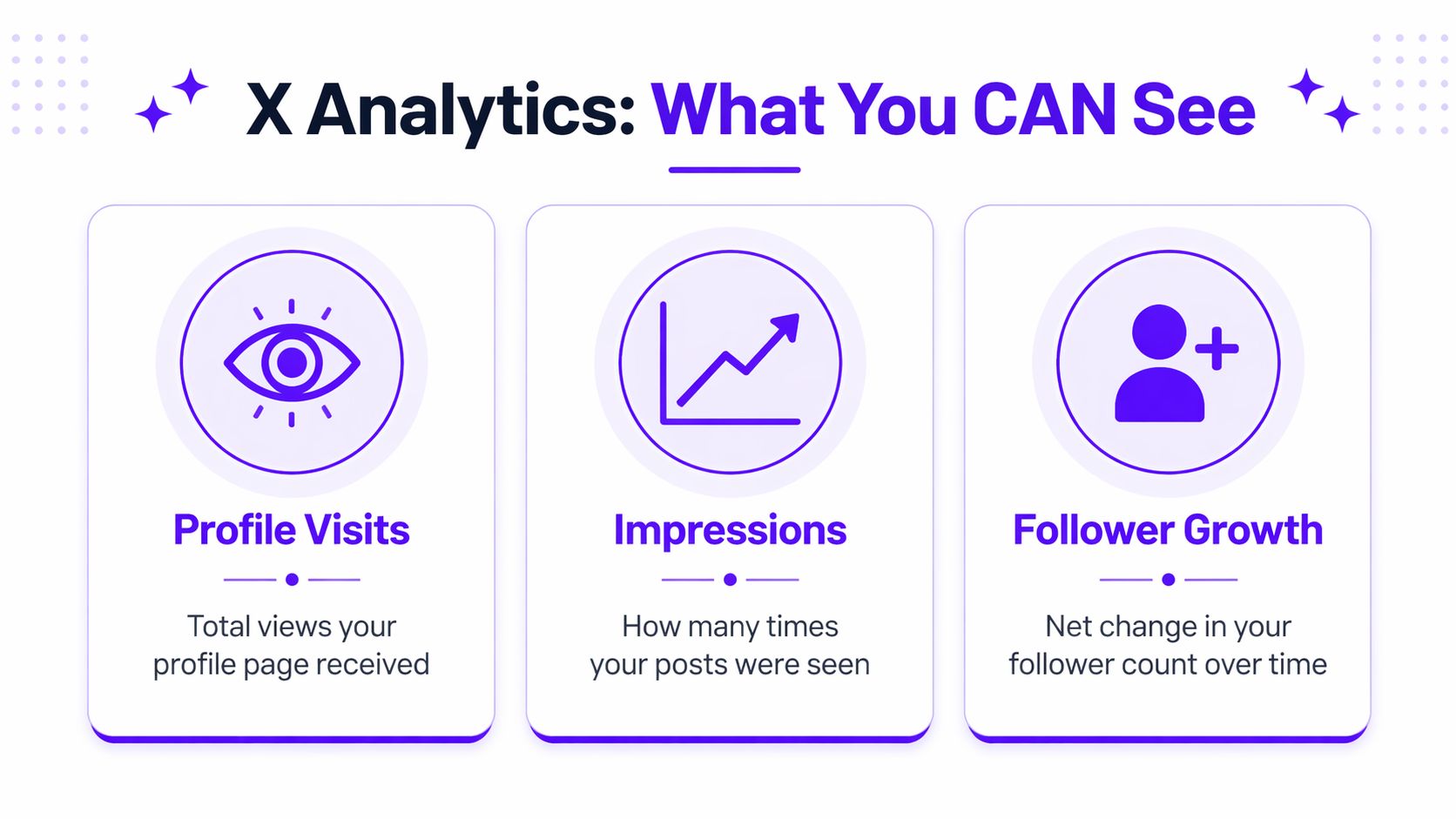
The main metric people care about here is Profile visits. That number shows how many times your profile page was viewed across the reporting window available in the dashboard.
What the dashboard is actually good for
If you're posting regularly, analytics can answer practical questions like:
- Did a post trigger curiosity and send more people to your profile?
- Did a reply strategy work well enough to increase profile checks?
- Did a profile rewrite help more visitors turn into followers?
Those are valid uses. The metric becomes more useful when paired with impressions, engagement on the post level, and follower movement over time.
A simple read of the hierarchy looks like this:
| Metric | What it tells you | What it doesn't tell you |
|---|---|---|
| Profile visits | People were curious enough to click | Who they were |
| Impressions | Posts got seen | Whether viewers cared |
| Follower growth | Some visitors converted | Which specific visit caused the follow |
Where official analytics falls short
Many marketers encounter a limitation. As noted in this discussion of Twitter Analytics limitations, the platform shows total profile visits and traffic sources, but doesn't segment visitors by follower status, engagement tier, or industry.
That gap matters a lot if you run B2B content, manage a founder account, or handle brand positioning. Not every visit has the same value. A click from a likely customer matters more than a click from a random account outside your market. X doesn't help you separate those cases.
Here are the questions the dashboard still can't answer cleanly:
- Was this traffic relevant? You don't get visitor segmentation by industry or professional context.
- Were they already followers? The dashboard doesn't break visits down by follower status.
- Did high-intent accounts convert better? You can't map visit quality with much precision inside native analytics.
If your goal is targeted growth, profile visits are only a partial signal. They show attention, not fit.
That's why experienced operators look beyond raw visit totals. They compare visit trends against public engagement, follower conversion, and the quality of people interacting in replies. Official analytics gives you a baseline. It doesn't give you audience clarity.
The Dangers of Third-Party 'Profile Viewer' Apps
If X won't show visitor identities, some app or browser extension will claim it can. That's where people get into trouble.
These tools don't have legitimate access to named profile-view data because X doesn't expose that information through official channels. So the app has to do something else. Usually it's guessing, faking, or trying to get access to your account.
Why the claim falls apart
The most important example is the recent Grok workaround. According to reporting on the Grok profile-visitor trend, users prompted Grok to identify accounts that frequently visit their profile, and Grok returned names with rates such as charlieINTEL with 20 visits per week, tdawgsmitty with 18, TheGhostOfHope with 16, and TheTacticalBrit with 14.
That sounds definitive until you hit the key detail. The same reporting states Grok was using engagement analysis as a proxy for profile visits, not actual named view data.
So even the most interesting workaround still isn't showing who viewed your profile. It's inferring likely interest from visible behavior patterns.
What these apps usually risk
Once you understand the data gap, the danger is obvious. If a tool can't access the data it promises, it has to create the appearance of value some other way.
Common risks include:
- Credential harvesting where the service asks you to sign in so it can capture account access
- Fake lists populated from recent engagers, followers, or random accounts
- Device risk from low-trust extensions or downloads
- Account trouble if you connect services that operate outside platform rules
A better mindset is to look for systems that prove there are humans behind the activity, not systems pretending to reveal hidden viewers. Work on Proof of Humanity is useful context here because it frames the core problem correctly. On social platforms, the hard part isn't exposing private browsing. It's confirming that an interaction came from a real person.
If you're weighing shortcuts like Twitter follower services, apply the same test. If the service can't explain exactly where the activity comes from and how it's verified, don't trust it.
Shifting Focus from Views to Verifiable Engagement
Once you stop chasing hidden profile visitors, the growth model gets simpler.
Public engagement is what you can verify. A like has an account attached to it. A reply has an account attached to it. A repost has an account attached to it. That makes these actions far more useful than anonymous visits when you're trying to judge whether your account is gaining traction.
The real problem isn't visibility
The harder problem is trust.
As explained in this analysis of the verification gap around Twitter profile views, X only shows aggregate profile visit counts over 28 days and provides no real-time verification mechanism for matching those visits to legitimate human activity. That creates a problem for creators using growth services. They may see movement, but they can't easily confirm whether it came from real people or junk traffic.
That tension is what I think of as the privacy-engagement paradox. X protects visitor anonymity, which is fine. But that same privacy wall makes it harder for users to verify whether growth activity is genuine.
What to measure instead
If you're serious about account growth, use metrics that tie back to identifiable action:
- Replies from relevant accounts because they show active interest
- Reposts and quote posts because they spread content into other networks
- Follower conversion after profile clicks because it tells you whether the profile does its job
- Engagement-to-visit relationship because it helps you judge whether attention is low-quality or meaningful
Good growth on X is visible in public. If you can't inspect it, audit it, or tie it to real accounts, treat it with caution.
For teams building a posting system, a practical social media playbook to grow engagement can help you organize content, replies, and conversion goals around that principle.
If your main aim is more likes from real users, focus on Twitter like strategies that lead to attributable interaction, not hidden visitor speculation.
A Community-Based Approach to Real Growth on X
There are only two dependable ways to grow on social media. Publish strong content consistently. Get engagement from real people.
The second part is where most accounts stall. Not because they don't have anything worth saying, but because early traction is hard to manufacture without crossing into spam, bots, or fake marketplaces.
Why community models work better than bought activity
A healthy engagement system is built around participation, not blind purchasing. That's the difference between a bot marketplace and a community model.
In a community-based setup, users help each other. One person completes tasks for others, earns internal credit, and uses that credit to request engagement on their own posts. That creates a loop based on reciprocal action rather than anonymous delivery.
The practical upside is clear:
| Approach | What usually happens |
|---|---|
| Bought engagement | Low trust, poor visibility into source accounts |
| Community participation | Clearer accountability because members complete actions inside a shared system |
This is also the only model that makes sense if you care about whether an interaction came from a person who logged in, completed a task, and can be checked.
What a safer workflow looks like
A good system for X growth should do a few things well:
- Verify accounts without asking for passwords so users aren't handing over sensitive access
- Show who completed tasks so engagement isn't anonymous inside the system
- Block bots aggressively so the network doesn't fill with junk actions
- Support common X actions such as likes, comments, reposts, and follows
That kind of transparency solves a real operational problem. When users can see task completion clearly, they stop guessing whether the spike came from bots or fabricated traffic.
The growth method matters as much as the result. Two accounts can show the same engagement count, but only one may have gotten it from real people.
Why timing matters on X
The most useful engagement is early engagement. On X, momentum builds when a post gets visible interaction soon after publishing.
Marketers often call this the Golden Hour. The label matters less than the behavior. If a post gets quick likes, replies, and reposts from actual users, it has a better chance of traveling beyond your existing audience. If it sits idle, reach usually stalls.
That is why community participation beats random waiting. You aren't begging the algorithm. You're giving a good post a better chance to prove itself in front of real users.
A practical setup usually looks like this:
- Publish a post worth responding to.
- Make sure your profile is ready for visitors who click through.
- Drive immediate engagement from real participants, not fake accounts.
- Watch which posts convert visits into replies, follows, and ongoing conversation.
Used well, this approach gives you something anonymous profile-view chasing never will. Action you can verify.
Your Next Steps for Authentic Account Growth
Ask a better question: what can you measure and improve on X today?
You cannot identify who viewed your profile. You can improve what happens after someone lands there, and that is what drives reach, follows, and ongoing engagement.
Start with the parts you control. Clean up your bio so it tells people why they should follow. Make your pinned post do a job, whether that is proving credibility, highlighting your best content, or directing people to your current offer. Then watch for signals you can verify through native analytics and public engagement.
Use this checklist:
- Post content that earns a click and a response
- Make your bio and pinned post clear within seconds
- Treat profile visits as context, not the main KPI
- Measure visible actions such as replies, reposts, comments, and follows
- Choose growth systems where participation is public and attributable
For follower growth, put more attention on visible actions like Twitter follow activity than on anonymous browsing. That gives you something you can inspect, test, and improve over time.
I recommend the same standard for any growth tool or community. If you cannot tell who completed the action, whether the account looks real, or whether the engagement happened in public, the result is hard to trust.
Upvote.club was built around that practical need. Our service uses a moderated, community-based system where members complete tasks with verified human accounts, earn points, and use those points to get likes, comments, reposts, and followers on their own X posts. New users get free points and task slots to test the workflow. Accounts are verified once through our emoji-based process. We do not ask for passwords. You can see task completion clearly, which is a key advantage here. X will not show you profile visitors, but you can still create early, visible engagement from real participants and give strong posts a fair chance to spread.