Table of Contents
- Table of Contents
- Why Getting More Followers Is the Wrong Goal
- Build a Follow-Worthy Profile
- Make the profile instantly clear
- Turn your pinned post into proof
- Develop Your Content Machine
- Pick a few topics and stay there
- Match format to message
- Master Proactive Engagement
- Use Community Signals for Initial Reach
- Why early engagement changes distribution
- How we use Upvote Club
- Measure What Matters and Maintain Quality
- Track behavior not vanity
- Keep your audience clean and active
You're probably doing this right now. You post on X, refresh after ten minutes, and see silence. Then you search for the best way to get Twitter followers and get the same recycled advice: use hashtags, post at the right time, write threads, add images, engage more.
That advice isn't useless. It's incomplete.
I've worked with enough creator and brand accounts to know that follower growth on X rarely fails because of effort alone. It fails because the account isn't clear, the content is too random, or the person is waiting for discovery instead of creating it. The fix is not to chase a bigger follower number. The fix is to build an account that attracts the right people, then give your posts enough early traction to get seen.
Table of Contents
- Why Getting More Followers Is the Wrong Goal
- Build a Follow-Worthy Profile
- Develop Your Content Machine
- Master Proactive Engagement
- Use Community Signals for Initial Reach
- Measure What Matters and Maintain Quality
Why Getting More Followers Is the Wrong Goal
Many users don't need more followers. They need better followers.
That's the part most growth advice skips. A lot of guides repeat the same tips around hashtags, timing, and posting habits, but they don't answer the harder question: how do you attract followers who reply, repost, and care about what you're saying? The stronger guidance on this topic points to niche targeting and content fit, not raw volume, in Ghost's write-up on getting more followers on Twitter.

If you run a business, write a newsletter, sell a service, recruit talent, or build in public, an empty audience doesn't help you. A large follower count with weak interaction is just a screenshot metric. I'd rather help an account get known by the right corner of X than pile up random follows that never turn into conversations.
Practical rule: Stop asking, “How do I get more followers?” Ask, “Why would my ideal follower care enough to come back tomorrow?”
That shift changes everything. Your profile becomes a landing page. Your content becomes positioning. Your replies become distribution.
Some people searching for growth shortcuts end up looking at options like Twitter follower services. My advice is simpler. Don't chase optics first. Build an account that makes a good follower feel like they've found exactly the right person to follow.
Build a Follow-Worthy Profile
Someone sees one smart reply from you, clicks your profile, and decides in seconds whether to follow or leave. That decision has very little to do with your follower count. It has everything to do with clarity.
If your profile feels vague, people bounce. If it feels specific, useful, and active, they follow.
Make the profile instantly clear
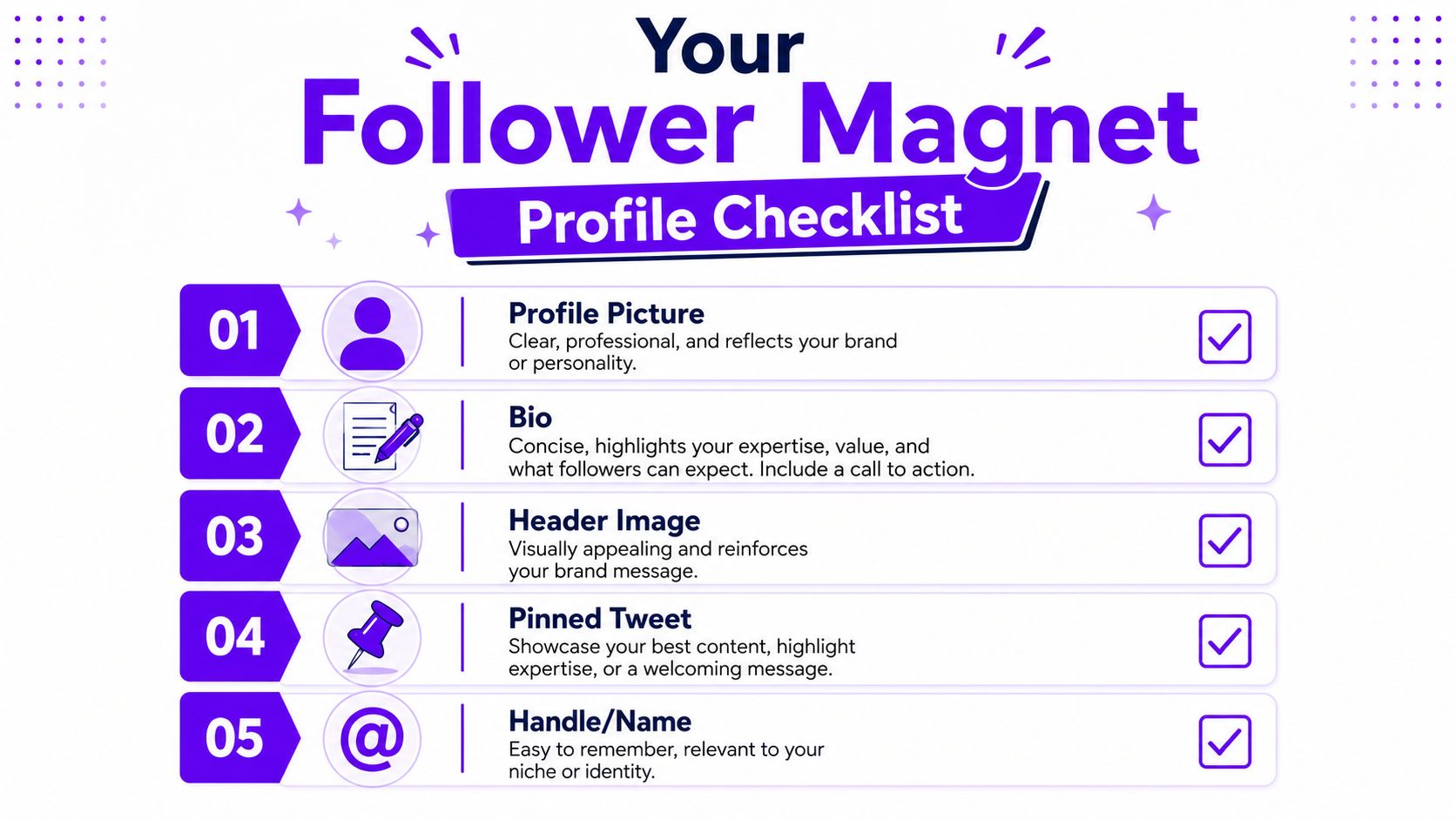
I use a simple standard here. A good profile answers three questions fast: who are you, what do you talk about, and why should this person stick around?
Use this checklist:
- Name and handle. Keep both easy to search, easy to remember, and close to your real identity or niche. Obscure handles make strong accounts look disposable.
- Profile photo. Use a sharp headshot if you are the brand. Use a clean logo if the company is the brand. At small sizes, busy images lose trust.
- Bio. Write one sentence with a clear audience and outcome. Then add a direct call to action. "Helping SaaS founders turn product lessons into posts" is stronger than a list of vague interests.
- Header image. Back up the bio with proof, positioning, or a simple promise. Your header should reinforce your topic, not distract from it.
- Link. Send visitors to one place that matches your current goal: newsletter, offer, waitlist, portfolio, or lead magnet.
I also want the profile to feel alive. A recent post, a relevant header, and a clear offer do more work than clever wording.
If video is part of your strategy, use tools that turn off-platform attention into profile visits. A simple example is BlitzReels' resource to add X follow CTAs to your videos. That works well when you publish clips elsewhere and want viewers to continue the conversation on X.
Turn your pinned post into proof
Your pinned post is your conversion asset. I treat it like the second half of the profile.
The bio makes a promise. The pinned post proves you can deliver.
Here are the pinned formats I recommend most:
| Pinned post type | When to use it | What it signals |
|---|---|---|
| Best-performing thread | You teach or explain | You know your topic |
| Intro post | You're building a personal brand | You're clear and worth following |
| Case breakdown or lesson | You advise clients or teams | You solve real problems |
| Resource post | You want clicks or signups | You give people a reason to act |
A weak pinned post wastes qualified traffic. A strong one turns profile visits from replies, reposts, and search into followers.
I also like to match the pinned post to the kind of engagement I want during the first hour after publishing. If we know a post is tied to a clear profile, clear promise, and clear pinned proof, it performs better when early visitors check the account. That is one reason I like using Upvote Club's Twitter community page for authentic early engagement signals. The Golden Hour only helps if the profile converts the attention you earn.
One silent question should be answered before anyone scrolls away: why follow this account instead of the next one?
Develop Your Content Machine
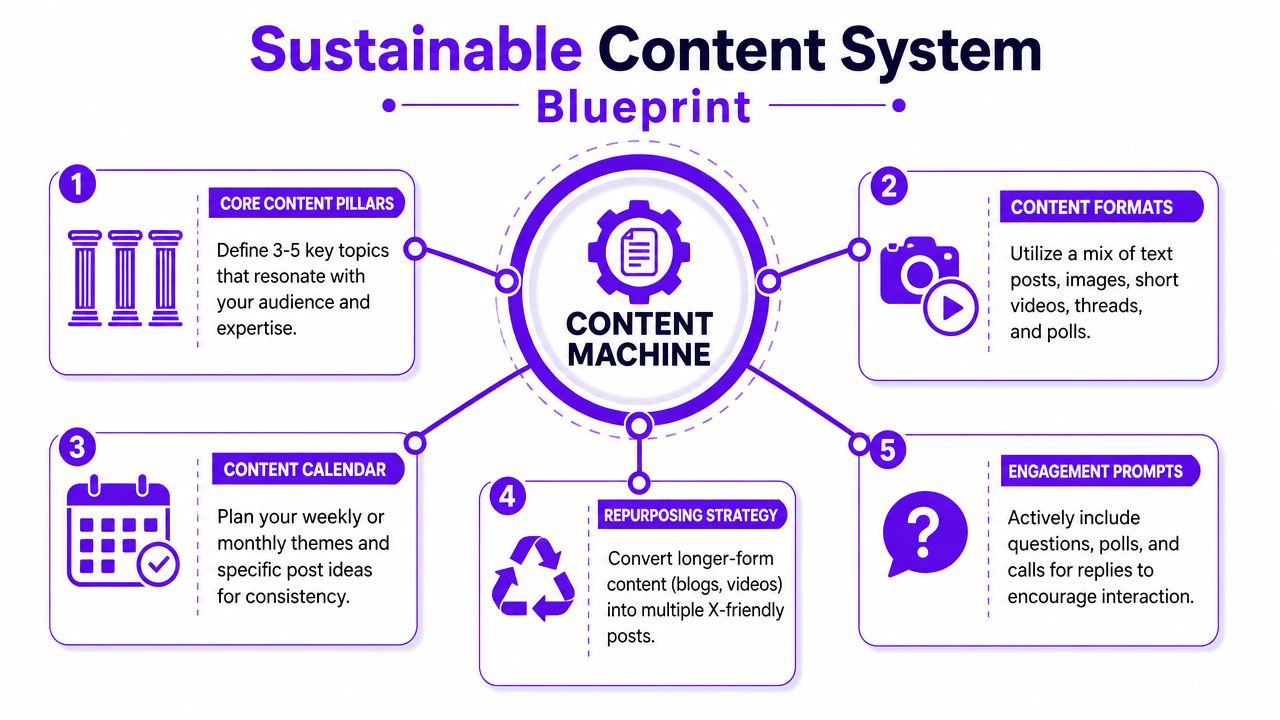
Many individuals don't need a giant content calendar. They need a repeatable system they can keep running without getting bored or disappearing for weeks.
The best way to get Twitter followers is not to post more random thoughts. It's to build a feed with a clear point of view.
Pick a few topics and stay there
I like a simple structure. Choose two or three core content pillars and keep returning to them.
For example, a developer founder might use:
Building in public
Product choices, mistakes, launches, tradeoffs.Technical lessons
Short builds, architecture decisions, debugging lessons.Founder distribution
What's working on X, Product Hunt, Reddit, or email.
That gives the account identity. A follower knows what they'll get. That's how you stop looking like a random feed and start looking like a specialist.
Here's the filter I use before posting:
- Does this fit one of my pillars
- Would my ideal follower care
- Does this sound like me
- Would I be happy if this became what I'm known for
If the answer is no, I don't post it.
Match format to message
Different post formats do different jobs. Don't force every idea into a thread.
- Short posts work for sharp opinions, observations, and simple lessons.
- Threads work when the reader needs context, sequence, or a story.
- Polls work when you want replies and opinion signals.
- Images or screenshots help when the proof is visual.
- Video clips work when your voice or demo carries the point better than text.
If you're using AI to speed up ideation, keep it on a short leash. I'll use it to generate angles, rewrite hooks, or repurpose a long piece into post drafts. I won't let it write my voice for me. If you want a grounded overview of what's useful and what's junk, Direct AI has a practical guide to social media AI tools.
Don't build a content system around output volume. Build it around repeatability.
I also like repurposing. A blog post can become a thread, three short posts, one contrarian take, and a poll. A podcast clip can become a quote post and a reply asset. If you already publish elsewhere, a property like our Medium support page is a reminder that your audience doesn't live on one platform. Pull ideas across channels, then adapt them to X's speed and style.
Master Proactive Engagement
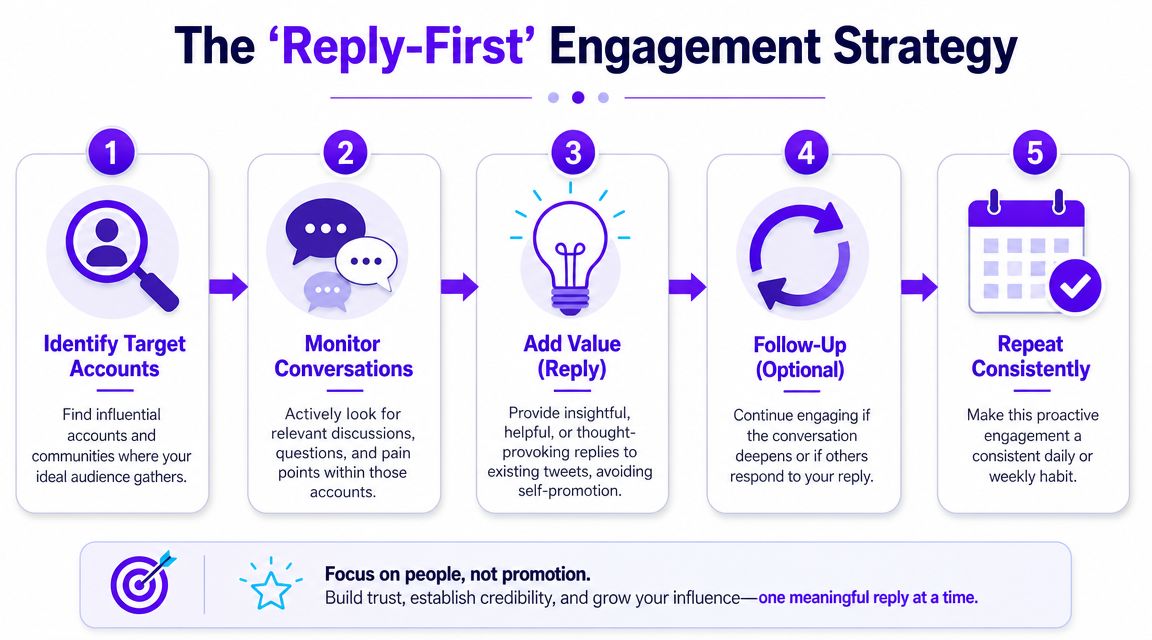
You publish a strong post, it gets a few likes, then nothing. Meanwhile, someone with half your expertise leaves one sharp reply under the right account and picks up profile clicks all day. That is how early growth on X works. Distribution starts in other people's conversations before it starts on your own timeline.
I push a reply-first system for small and mid-sized accounts because it works. We are not waiting around for the algorithm to discover us. We are putting our name in front of people who already care about the topic. If you want a broader view of platform-specific community behavior outside X, our guide to building audience signals across open social networks is useful context.
A good target list fixes half the problem.
Build a focused list of niche accounts that are bigger than you, active, and consistently attract the audience you want. I like a mix of respected peers, curators, operators, and writers who shape opinion in the space. Turn on notifications. Check who posts often enough to create regular openings. Ignore celebrity-scale accounts unless your niche is tiny, because the reply feed moves too fast and the audience is too broad.
I structure the list like this:
| Account type | What you want from them |
|---|---|
| Bigger peers in your niche | Audience overlap |
| Curators and commentators | Visibility inside active discussions |
| Operator accounts | Practical conversations |
| Media or newsletter writers | Reach into adjacent circles |
Now the part people get wrong. They reply to everything.
Reply selectively. You want posts that are gaining traction, invite discussion, and give you room to add something useful. If the original post is dead, your reply dies with it. If the post is hot but obvious, the thread fills up with noise. Your job is to spot the posts where a thoughtful second-layer point can stand out.
Your reply should do one of four things. Add context, bring proof, ask a good question, or state a clear disagreement.
Bad replies sound like this:
- “Great post”
- “Totally agree”
- “This”
- Emoji-only replies
Useful replies sound like this:
Add a missing angle
“I'd add one thing. This usually fails when the offer is still vague, even if the content is strong.”Bring a concrete example
“We saw this on launch posts. Framing the problem beat listing features.”Ask a sharp follow-up
“Would you give the same advice to niche B2B accounts that post less often but sell higher-ticket services?”Disagree cleanly
“I'd flip the order. Early growth usually comes from smart replies first, then stronger original posts once people know your name.”
That last one matters. Safe replies get ignored. Clear thinking gets clicks.
I also want you to write for the lurker, not the person you are replying to. The account owner may never answer. That is fine. The primary win is the silent reader who sees your comment, checks your profile, and decides you are worth following.
If you like systems, study how communities form around accounts and topics. ScrapeCreators has a Python tutorial for social data engineers that shows how conversation data can be structured and analyzed. I would not start there as a beginner, but it is useful once you want to map who drives attention in your niche.
This video gives a useful visual breakdown of the mindset behind reply-based growth:
One more rule. Do not stuff your replies with self-promotion. No pitch. No “I wrote about this here.” No awkward CTA. The reply is the proof. If it is smart, people click. If it is memorable, they follow.
That is the play. Show up early, add value fast, and repeat it often enough that your name starts to feel familiar before your own posts need to carry the full load.
Use Community Signals for Initial Reach
Manual engagement gets people to your profile. Early engagement on your own posts helps your content travel.
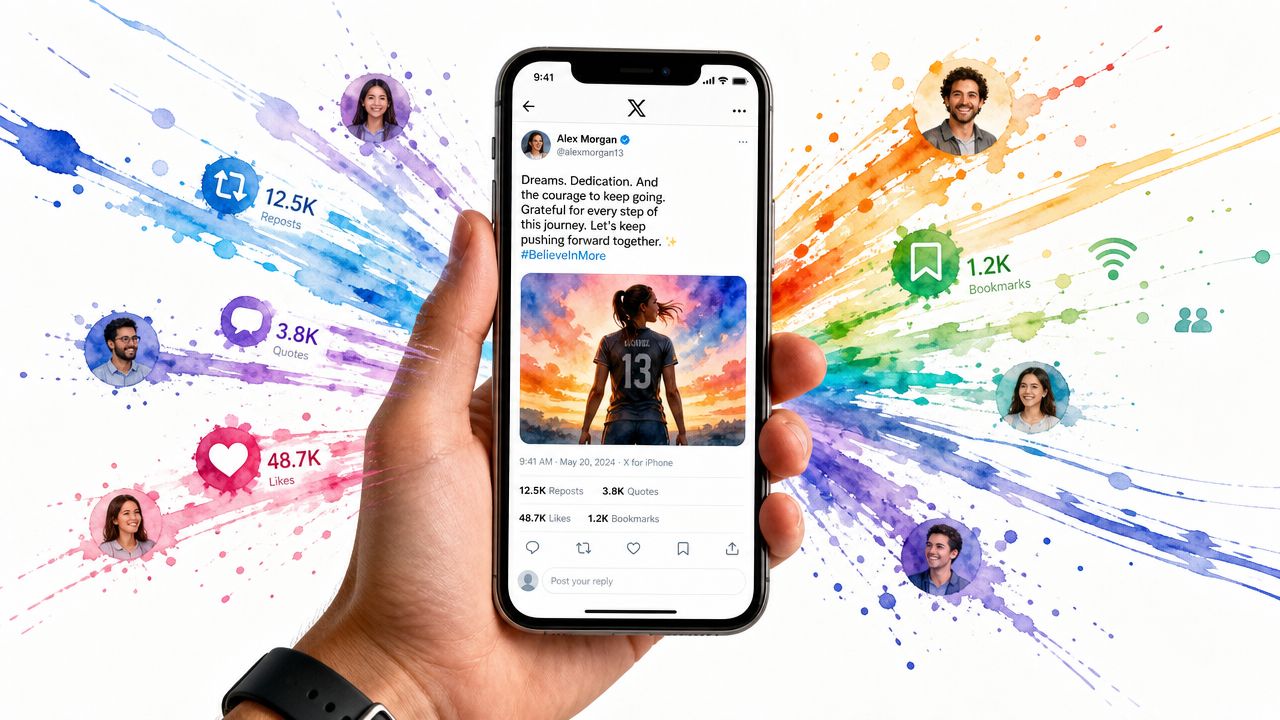
That first hour matters on X. If a post gets interaction quickly, it has a better shot at getting pushed wider. If it lands flat, it often dies before your actual audience even sees it. That's why I care so much about community signals right after publishing.
Why early engagement changes distribution
There are only two reliable paths to growth on social platforms. Publish posts worth seeing, and make sure those posts get engagement when they first go live.
That's why agencies have long organized around the first hour after posting. I use the same logic with smaller teams and solo creators. If you can get real likes, replies, reposts, and profile clicks early, you give a good post a real chance.
For people who like technical workflows, ScrapeCreators has a Python tutorial for social data engineers that shows how community data can be structured and analyzed. That's useful if you want to map conversations and identify who's active around your niche.
How we use Upvote Club
With our Mastodon and multi-platform community growth tools, we've built Upvote Club around a simple idea. It's not about buying engagement. It's about participating in a community.
Users complete tasks for other members using verified human accounts, earn points, then spend those points to create their own tasks for likes, comments, reposts, saves, and followers. When someone registers, they get 13 free points and 2 task slots. Each social account is verified once with an emoji-based system, and no passwords are required.
What I like about this model is the accountability. Members can create unlimited tasks, daily streaks add more rewards, invited friends can add points, and strict anti-bot moderation keeps the pool focused on real people. That gives smaller accounts a way to support the Golden Hour with authentic interaction instead of fake activity.
I'd still say this clearly. If the content is weak, community signals won't save it. But if the post is strong and the account is clear, early interaction can help the algorithm test it with a larger audience.
Measure What Matters and Maintain Quality
A follower spike can hide a weak account.
I judge Twitter growth by what happens after someone sees a post. Do the right people click through? Do they reply with something useful? Do they stick around and engage again? That is the scoreboard that matters.
Track behavior not vanity
Run a weekly review. Keep it simple and consistent.
Look at your recent posts and check which ones created real movement:
- Profile visits. These show whether your posts create enough interest to earn a closer look.
- Replies and reposts. These show whether people want to join the conversation and pass it along.
- Conversation quality. Check who is replying and what they are adding.
- Follower relevance. New followers should match your niche, role, or buyer profile.
I would rather grow a smaller account with strong profile clicks and thoughtful replies than a bigger account full of passive followers.
If people read a post, visit your profile, and do not follow, fix your positioning. If they follow and never interact, you attracted the wrong audience.
Keep your audience clean and active
Protect the account you are building. Low-quality followers and fake engagement distort your numbers and weaken your reach over time.
Use this checklist:
- Audit your pinned post. It should make your topic, credibility, and value obvious.
- Review your best replies. Reuse the formats that earn profile clicks and quality responses.
- Cut weak topics. If a content pillar keeps attracting the wrong crowd, stop publishing it.
- Stay human. Specific comments and direct conversations outperform generic automation.
This is the part many creators skip. They post, watch the number go up or down, and never examine audience fit. We do the opposite. We protect quality first, then scale what is already working.
If you want help with the early traction problem, Upvote Club gives individuals access to a community method we usually see in professional growth teams. You can use it to generate authentic engagement signals during the Golden Hour, with real users participating instead of bots or password-sharing schemes.