
Before you think about what to post, you need a game plan. So many brands jump straight into creating content without figuring out the why, who, and where first. This is a recipe for wasted effort and posts that just don't land.
Let's lay the groundwork. A solid foundation means every piece of content you create has a purpose, speaks to the right people, and shows up in the places they already hang out.
Establishing Your Social Media Foundation
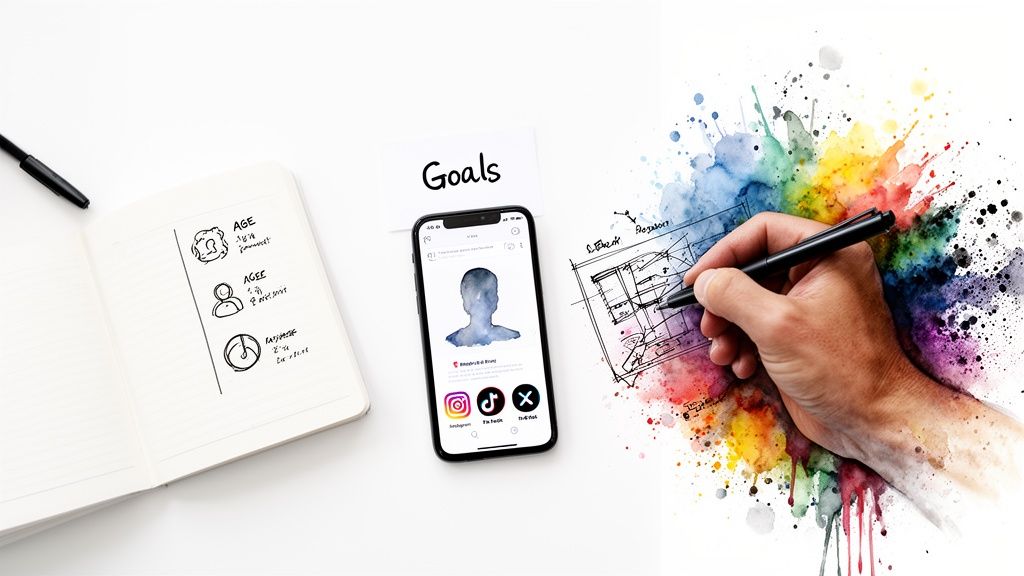
Skipping these first steps is like trying to build a house without a blueprint. You might get a few walls up, but it's not going to be stable.
To really get this right, you'll want to map everything out in a social media marketing strategy playbook. Think of it as your North Star for every decision you make down the road.
Before we get into the specifics of content creation, let's break down the core components that will form the backbone of your strategy. Each of these elements builds on the last, creating a clear and effective roadmap for your social media efforts.
Core Components of a Social Media Foundation
| Component | Objective | Key Action |
|---|---|---|
| Goal Setting | To give your social media efforts a clear purpose and a way to track success. | Define SMART goals (Specific, Measurable, Achievable, Relevant, Time-bound). |
| Audience Research | To understand who you're talking to so your content connects deeply. | Create a detailed audience persona, including their pain points and habits. |
| Platform Selection | To focus your energy on the networks where your ideal audience is active. | Analyze platform demographics and choose 2-3 core channels to master first. |
| Brand Consistency | To build a recognizable and trustworthy image across all chosen platforms. | Establish a consistent visual style, tone of voice, and profile information. |
This table summarizes the foundational work that prevents random acts of social media and ensures everything you do is intentional and aligned with your business objectives.
Define Your Primary Goals
First things first: what are you actually trying to accomplish? "Getting more followers" isn't a real goal; it's a vanity metric that doesn't tell you much. You need to get specific.
Are you trying to drive people to your website? Generate qualified leads? Build a community around your brand? Whatever it is, make it measurable. A much better goal would be something like, "Increase website referral traffic from Instagram by 15% over the next quarter." See the difference? Now you have a clear target to aim for.
Key Takeaway: Without clear goals, your social media activity is just noise. Define specific, measurable objectives to give your strategy direction and a way to measure success.
Identify Your Ideal Audience
You can't be everything to everyone. Trying to create content that appeals to the masses is a surefire way to connect with no one. Instead, get laser-focused on a single ideal person. This is often called an "audience persona."
Think about who this person is, inside and out:
- Demographics: How old are they? Where do they live? What do they do for a living?
- Interests: What are their hobbies? What other accounts do they follow? What YouTube channels are they subscribed to?
- Challenges: What keeps them up at night? What problems are they trying to solve that you can help with?
- Online Habits: Are they scrolling Instagram on their lunch break or browsing LinkedIn after work? Knowing when and where they're active is gold.
Once you have this person crystal clear in your mind, creating content for them becomes a million times easier.
Select the Right Platforms
Don't spread yourself thin trying to be on every single social media platform. That's a one-way ticket to burnout. Your audience research should have already told you where your people spend their time.
If you’re targeting B2B professionals, LinkedIn is a no-brainer. If you have a highly visual product, like handcrafted jewelry, you should be living on Instagram and Pinterest.
Pick two or three platforms to start and go all-in. For example, if you're building a following for a new app, X and Product Hunt could be your power combo.
Once you’ve picked your channels, nail down your brand consistency. Use the same profile picture, bio, and handle (if possible) everywhere. This helps people recognize you instantly, no matter where they find you. This is the stuff that makes your brand feel professional and trustworthy right from the start.
Crafting a Content Strategy That Connects
Alright, you’ve figured out your goals and who you’re talking to. Now for the fun part: deciding what you’re actually going to post. This is where a real content strategy comes into play, acting as the bridge between your brand and your audience.
Without a plan, you’re just throwing content at the wall and hoping something sticks. That rarely works. A solid strategy turns random posts into a focused effort to grab and hold attention, which is the whole game when it comes to building a lasting social media following.
Establish Your Content Pillars
First things first, you need content pillars. These are the 3-5 core topics or themes you’ll talk about over and over again. Think of them as the foundation of your content house; they keep everything structured and prevent you from wandering off-topic.
Let's say you're a fitness coach. Your pillars might look like this:
- Quick workout tutorials
- Healthy meal prep ideas
- Motivational client stories
- Mindset and recovery tips
Every single post you create should tie back to one of these pillars. This makes content creation way less intimidating because you’re never starting from a blank slate. You always know the general sandbox you should be playing in.
Plan Ahead With a Content Calendar
A content calendar is your best friend. Seriously. It’s the one thing that will save you from that 10 PM panic of, "Oh crap, I haven't posted today!"
It doesn't need to be fancy—a simple spreadsheet or a Trello board works perfectly. Just map out what you'll post, where, and when. Planning even a week or two ahead lets you batch-create higher-quality content and frees you up to actually engage with your community.
Key Takeaway: Consistency beats frequency every time. A content calendar helps you show up regularly, which signals to the algorithms that you're active and keeps your audience coming back for more.
Diversify Your Content Formats
Posting the same type of content day in and day out is a surefire way to make your feed feel stale. Different formats serve different goals and appeal to different people. Mix it up to keep things fresh.
- Images: Still powerful for showcasing products, behind-the-scenes glimpses, or a killer quote. A must for visual platforms like Instagram.
- Videos: Short-form video (Reels, TikToks, Shorts) is king for engagement right now. Use it for tutorials, telling a quick story, or just showing your personality.
- Stories: These are perfect for real-time, interactive content. Run polls, host a Q&A, or share quick updates. The temporary nature creates a nice sense of urgency.
- Text-Based Posts: Don’t sleep on the power of words, especially on platforms like X (formerly Twitter) and LinkedIn. A well-written post can spark incredible conversations.
If you're trying to grow on a specific platform like TikTok, for example, you need to understand its unique language. We've got a whole guide on how to improve your TikTok strategy that gives more detail on what works there.
Focus on Providing Real Utility
Here's a simple rule: every post should offer something to your audience. Before you hit publish, ask yourself, "Is this educational, entertaining, or inspiring?" If the answer is no, it's probably just noise.
A software company could post a short video tutorial (educational), a relatable meme about coding frustrations (entertaining), or a client success story (inspiring). This approach builds trust and gives people a concrete reason to follow you. They know they'll get something useful from your content.
With our Upvote.club service, you can give your best content an initial nudge to get seen. Our community-based model is built on real people helping each other grow. You earn points by completing small tasks, then use those points to get likes, followers, and comments on your own posts. It ensures every interaction is genuine, giving your quality content the kickstart it deserves.
Sparking Real Engagement to Fuel Your Growth

Putting out great content is only half the job. The other half is getting people to actually see it, and that’s where things get tricky.
Social media algorithms are designed to reward posts that get a flurry of interaction right after they go live. This window, often called the Golden Hour, is your best chance to prove your content is worth showing to a wider audience. A quick burst of likes, comments, and shares signals to the platform that you’ve posted something useful. Without that initial push, even the best content can get lost in the noise.
The Power of That First Hour
Think of early engagement as social proof for the algorithm. It’s the same strategy influencer agencies use—they give their clients’ posts an initial boost to get the ball rolling. When real people jump on your post right away, it tells the algorithm, "Hey, this is good. Show it to more people."
We built our Upvote.club service around this exact idea. Our platform is a community of real, verified users helping each other get that critical early traction.
With Upvote.club, you can set up tasks for likes, comments, and followers across all the major platforms like Instagram, TikTok, Youtube, and Twitter. This isn't about buying fake engagement; it's a give-and-take community where you earn genuine interaction from other human beings. That’s how you get your content performing better, organically.
Driving Interaction With Smarter Content
At the end of the day, engagement is what builds a lasting social media following. For smaller accounts—those with under 5,000 followers—a healthy engagement rate hovers between 2-5%.
The type of content you post matters. For instance, video content pulls in 2.3 times more engagement than a simple image. On X (formerly Twitter), threads and multi-tweet posts get 2.4 times more engagement than a single tweet. It’s not enough to just post; you have to be strategic about the format.
The data points to a clear strategy: you have to actively create content that invites people to interact.
- Ask a direct question. Don’t just announce your new product. Instead, try asking, "What's the first thing you'd do with our new product?" It’s a simple shift that makes a world of difference.
- Run polls and quizzes. Instagram, X, and Facebook Stories are perfect for this. They’re super low-effort for your audience to participate in and give you instant feedback.
- Create "saveable" content. Think infographics, checklists, or detailed tutorials. When people save your content to look at later, it sends a powerful signal to the algorithm.
To see real, sustained growth, you need to focus on strategies that build a genuine connection. It's about creating a positive feedback loop: your content encourages interaction, and that interaction gets your content seen by more people. For a deeper look, there are some great tips on how to improve social media engagement.
A Community-Based Approach to Growth
The biggest hurdle for most creators is getting that first wave of engagement. You could have the most incredible content, but if nobody sees it in the first hour, it’s probably not going anywhere. This is where a community-driven approach can be a game-changer.
At Upvote.club, we operate on a simple community model where users help each other succeed. It’s all based on reciprocity.
- Join the Community: When you register with us, you receive 13 free points and 2 task slots to get started right away.
- Earn Points: You get more points by completing simple tasks for others, like liking a post or following an account.
- Create Your Own Tasks: Use the points you've earned to ask the community for likes, comments, or followers on your own content.
This system creates a sustainable flow of real interaction from real people. We have strict moderation to keep bots out, and we added a unique emoji-based verification system to confirm every user is human—without ever asking for your passwords.
Our Method: By helping others in the community, you earn the ability to promote your own content. This ensures every interaction is authentic and contributes to genuine, algorithm-friendly growth for everyone involved.
You even get a free task slot every 24 hours. And for those who want to accelerate their growth, we have subscriptions that provide a large number of points and slots right from the get-go. It’s a method that works because it mirrors real user behavior and gives the social platforms exactly what they’re looking for.
Measuring Performance to Refine Your Approach
Posting content without ever checking your results is like driving with your eyes closed. Sure, you're moving, but you have no clue if you're actually headed in the right direction. To build a social media following that genuinely grows, you absolutely need a feedback loop—a simple system for measuring what works so you can do more of it.
This isn't about getting lost in endless spreadsheets. It's about paying attention to the right signals, making small tweaks, and consistently improving your strategy over time.
Looking Beyond Follower Counts
Let's get one thing straight: the follower count is often seen as the ultimate prize, but it's just one piece of the puzzle. A massive but unengaged audience is way less useful than a smaller, dedicated community that actually cares about what you're posting.
So, instead of obsessing over that one number, start focusing on the metrics that show real, genuine audience interest.
These are the numbers that truly tell you if your content is connecting:
- Engagement Rate: This is the big one. It's the percentage of your audience that interacts with your content through likes, comments, shares, and saves. A healthy engagement rate is proof that your content is hitting the mark.
- Reach and Impressions: Reach tells you how many unique accounts saw your post, while impressions are the total number of times it was seen. Think of it as a measure of how far your content is traveling.
- Website Clicks: If your goal is to drive traffic back to your site, this metric is your best friend. It’s a direct measure of how many people were compelled enough to leave the app and check you out.
- Video Views and Watch Time: For video, these are non-negotiable. They don't just tell you if people started watching, but if they actually stuck around. That's a huge signal.
Tracking these indicators gives you a much clearer, more honest picture of your performance than just watching the follower count tick up.
Using Built-in Analytics Tools
Every major social media platform gives you a free suite of analytics tools packed with a surprising amount of information. You don't need to shell out for expensive third-party software right away. These native tools are specifically designed to show you exactly how your stuff is performing on their platform.
For example, Instagram Insights will break down your follower demographics, show you which posts got the most saves, and even pinpoint the exact times your audience is most active. Similarly, X Analytics provides super-detailed data on every single tweet, helping you figure out what drives retweets and replies.
Make it a habit to pop into these dashboards at least once a week. Look for patterns. Which posts blew up? What topics completely flopped? This regular check-in is the bedrock of a smart, data-informed strategy.
Experimenting to Find What Works Best
Once you've got a handle on your baseline analytics, you can start running simple experiments to fine-tune your approach. This is often called A/B testing, and it's just a fancy way of saying you change one thing at a time to see what performs better.
Key Takeaway: Data takes the guesswork out of your strategy. Instead of assuming what your audience wants, you can use analytics to see their actual behavior and give them more of it.
You can test pretty much anything:
- Content Formats: Post a Reel versus a static image on the same topic. Which one gets more engagement?
- Posting Times: Try posting at 9 AM one week and 6 PM the next. See if there’s a noticeable bump in reach.
- Calls to Action (CTAs): Does asking a direct question get more comments than a simple "link in bio"?
- Caption Length: Experiment with short, punchy captions versus longer, more detailed stories.
Keep a simple log of your tests and the results. Over time, these small experiments will give you an incredibly clear understanding of what your specific audience responds to. This iterative process of testing, learning, and refining is how you turn a good strategy into a great one.
Time to Pour Some Gas on the Fire: Advanced Growth Tactics
Alright, you've got a solid foundation. Your content is connecting, and you've got a small but mighty group of followers. Now it's time to go from a slow burn to a wildfire.
This is where advanced tactics come in. Think of these as growth accelerators that can take you from just another account to a recognized name in your space. This isn't about working harder; it's about working smarter and more strategically to expand your reach without losing that authentic connection you've built.
Team Up with Other Creators
One of the fastest ways to get in front of a new, highly relevant audience is to collaborate with other creators in your niche. It’s a classic win-win: you get exposure to their community, and they get exposure to yours. The trick is to find someone whose audience overlaps with yours but isn't a direct competitor.
Imagine you sell handmade coffee mugs. Partnering with a popular coffee blogger for a joint giveaway or a co-hosted live Q&A is a no-brainer. This kind of cross-promotion feels organic and instantly lends credibility to both of you.
To pull these off successfully:
- Don't just send a generic DM. Reach out personally and explain exactly why a partnership makes sense for both of you.
- Get on the same page. Clearly define what each person will contribute, what the goals are, and how you'll measure success.
- Make it a two-way street. Ensure both of you are promoting the collaboration equally. Nothing sours a partnership faster than feeling like you're doing all the work.
Run Laser-Targeted Ad Campaigns
Organic reach is the dream, but let's be real—sometimes you need a more direct path to find the right people. Targeted social media ad campaigns let you put your best stuff right in front of a specific demographic. You can dial in your audience based on their location, age, interests, and even their online behavior.
Key Takeaway: Paid ads aren't just for pushing products. You can boost your best-performing organic posts to drive more engagement and attract new followers who are already primed to love your content.
For instance, a software company could run a LinkedIn campaign targeting professionals with specific job titles in certain industries. If that sounds interesting, you should check out our guide on how to grow your LinkedIn network. This level of precision ensures your ad spend is actually reaching people who care about what you do.
Go All-In on Community Management
This is what separates accounts with followers from brands with a true community. Active community management turns passive lurkers into loyal advocates. It's about starting conversations, not just posting content. When people see you consistently responding to comments and engaging with their posts, they feel seen and appreciated.
And I'm not just talking about dropping a "thanks!" here and there. Ask follow-up questions. Run polls asking what content they want to see next. Share user-generated content (and always give credit!). This back-and-forth builds a powerful bond that keeps people invested.
At Upvote.club, we've built our entire service on this principle of mutual support. Genuine interaction is what fuels growth. Our platform helps you get real likes, comments, and followers to kickstart those conversations and signal to the algorithm that your content is worth showing to more people.
Repurpose, Repurpose, Repurpose
Creating killer content is time-consuming. Don't let your best work die after a single post. Repurposing is the art of taking one great piece of content and spinning it into multiple formats for different platforms. This extends its lifespan and gets it in front of totally new audiences.
Here’s what that looks like in practice:
- You publish an in-depth blog post.
- You break down the key takeaways into an Instagram carousel.
- You film a quick video summary for TikTok and Reels.
- You pull a compelling statistic and share it as a text-based post on X.
This strategy keeps your content calendar full across multiple platforms without forcing you to constantly reinvent the wheel. It's about maximizing the impact of your best ideas.
Got Questions? We’ve Got Answers.
When you're mapping out a plan to build your social media following, a few questions always seem to pop up. Let's be honest, we've all asked them. Here are the most common ones I hear, with some straightforward answers to get you on the right track.
"So, How Long Until This Actually Works?"
I wish I had a magic number for you, but the truth is, it depends. Your industry, how consistent you are, and the sheer quality of what you're posting all play a huge role.
Generally speaking, you can expect to see some real, noticeable traction within 3 to 6 months of putting in dedicated, consistent effort. This isn’t just about tossing posts out into the void; it means you're actively engaging, learning from your analytics, and tweaking your strategy as you go.
This initial grind is exactly why we built Upvote.club. It's designed to give your content that first nudge of authentic engagement, which signals to the algorithms that people are interested. This can seriously shorten the time it takes to build that crucial momentum.
"How Often Should I Be Posting?"
The classic question! And the answer isn't as simple as "post more." Quality will always, always beat quantity. Focus on being consistently good rather than just being consistently on.
But you need a starting point, right? Here’s a rough guide:
- X and TikTok: These platforms are fast-paced. Posting 1-3 times a day is pretty standard and keeps you in the conversation.
- Instagram: Aim for 3-5 really strong posts per week. You can (and should) supplement these with daily Stories to stay top-of-mind.
- LinkedIn or Facebook: On these networks, you can get away with a bit less. 1-2 times per day is usually more than enough.
Look, it's far better to share three killer posts a week than seven that are just… meh. Your best bet is to experiment. Try a few different schedules, look at your analytics, and see what your specific audience actually responds to. That data is going to be way more useful than any generic advice you'll find online.
"Are Engagement Services… You Know… Safe?"
This is a big one, and you're right to be cautious. The answer is a hard it depends. A lot of services out there use bots and fake accounts, which is the quickest way to get your account flagged, penalized, or even shut down completely.
We saw this problem and built Upvote.club with a totally different philosophy.
Our platform is a community. It’s a network of real people with verified accounts who are all helping each other grow. We don't ask for your passwords, and we use a unique emoji-based verification system to ensure every single interaction comes from a genuine user. Because the engagement is generated by actual people, it's a safe and effective way to get that initial traction your content desperately needs to get seen.
Ready to give your content the authentic push it needs to break through the noise? Come join the community at Upvote.club and see how our user-driven network can help you grow safely and effectively. Start building your social presence today.
More articles
alexeympw
Published January 26, 2026