Table of Contents
- Building Your Foundation for Social Media Success
- Set Clear Objectives Aligned with Business Goals
- Define Your Ideal Customer Persona
- Choose the Right Platforms for Your Startup
- Choosing the Right Platform for Your Startup
- Nailing Your Lean Content Strategy
- Find Your Content Pillars
- Master the Art of Content Batching
- Stick to the 80/20 Rule to Build Trust
- Create Great-Looking Posts on a Shoestring Budget
- Gaining Early Traction with Smart Growth Tactics
- Find and Join Relevant Communities
- Engage Directly and Authentically
- The Power of the Golden Hour
- Using Community-Based Tools for Authentic Growth
- How Our Community-Based Model Works
- The Give-to-Get Economy
- Why This Method Drives Real Results
- Gauging Your Wins and Tweaking Your Game Plan
- Identifying the KPIs That Truly Matter
- Using the Tools Already at Your Fingertips
- The Rhythm of Review and Adjustment
- Common Questions from Founders on Social Media
- How Much Should a Startup Actually Spend?
- I'm Running Out of Content Ideas. Help!
- How Do I Handle Negative Comments?
- When Is the Right Time to Start Running Ads?
For a startup, social media isn't about posting aimlessly into the void. It’s about building a strategic presence with a clear purpose: to find your people, build a community, and grow your business.
Building Your Foundation for Social Media Success
So many startups make the same mistake: they jump straight into posting content without a plan. It’s like trying to build a house without a blueprint. You end up wasting time, money, and energy, all while your competitors are making real connections.
Getting this foundation right from the very beginning is what separates the startups that generate real traction from those just adding to the noise.
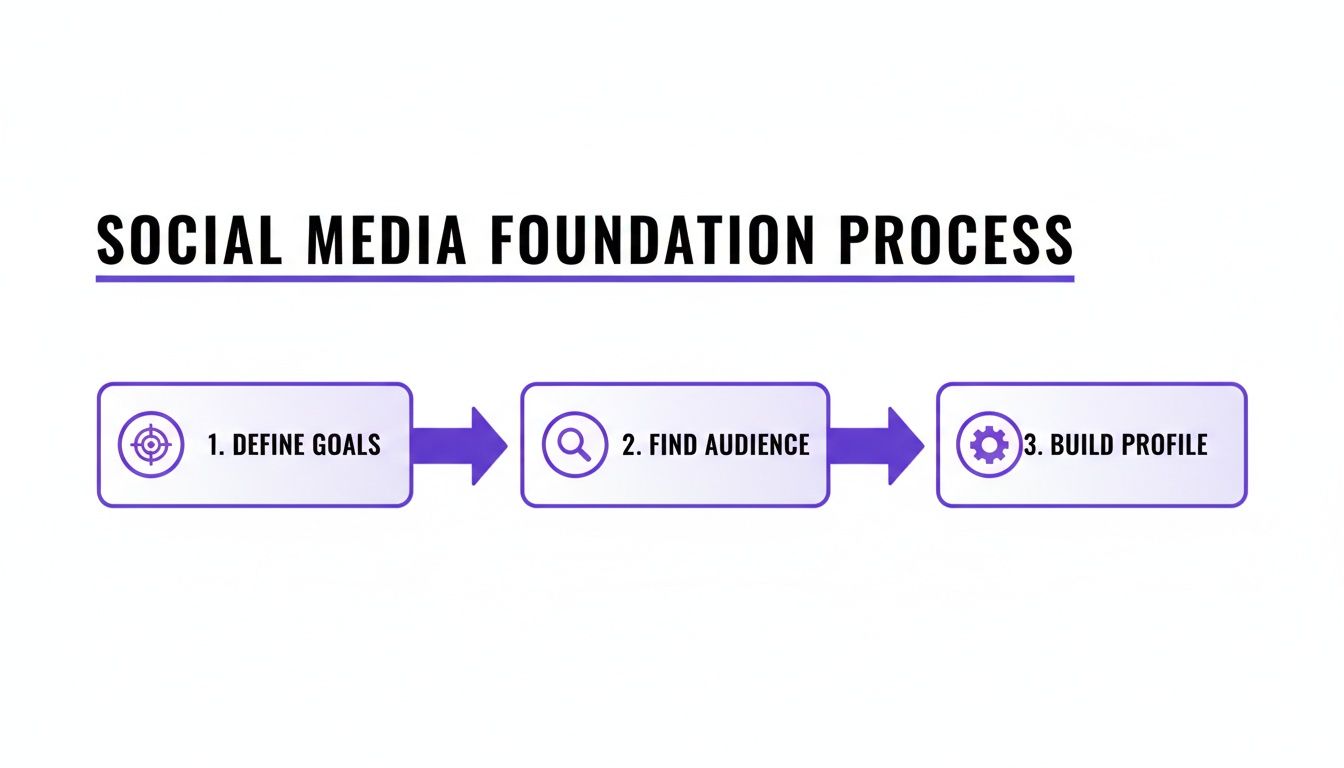
Think of it this way: strategy first, then tactics. This deliberate sequence is your key to making social media work.
Set Clear Objectives Aligned with Business Goals
Before you even think about what to post, you have to decide what you want social media to do for your startup. "Getting more followers" is a weak goal. It's a vanity metric that doesn't pay the bills.
Instead, tie your social activities to real business outcomes. Your goals need to be specific and measurable. For instance:
- Generate 50 qualified leads per month through LinkedIn content.
- Increase website traffic from social channels by 25% this quarter.
- Drive 100 sign-ups for our product demo using Instagram Stories.
When you set goals like these, your entire perspective shifts. Every piece of content you create suddenly has a job to do.
Define Your Ideal Customer Persona
You can't talk to an audience you don't understand. And I’m not just talking about basic demographics like age and location. You need to go deeper to create a persona that feels like a real person.
Ask yourself these questions to bring your ideal customer to life:
- What’s their biggest pain point that your product actually solves?
- Where do they hang out online? Are they scrolling TikTok for a laugh, networking on LinkedIn, or asking for advice in niche Reddit communities?
- What kind of content makes them stop scrolling? Is it quick videos, in-depth articles, or eye-catching graphics?
- What’s their tone of voice? Professional and buttoned-up, or casual and full of memes?
Knowing the answers helps you create content that genuinely connects. A B2B SaaS startup targeting project managers, for example, is going to find its home on LinkedIn, not TikTok. Our deep dive on using LinkedIn for business growth has more specific tactics if that's your crowd.
Choose the Right Platforms for Your Startup
This is a classic startup mistake: trying to be everywhere at once. It’s a recipe for burnout and mediocre results. Your limited resources get stretched thin, and you end up making no real impact anywhere. The real key is to pick just one or two platforms where your ideal customer is already active and engaged.
Don't chase every shiny new platform. Go where your audience already lives and build a real presence there. A deep connection on one platform beats a shallow presence on five, every single time.
This isn’t rocket science. If you have a visually-driven product like a clothing brand, Instagram and Pinterest are no-brainers. If you’re a fintech startup teaching people about investing, you’ll likely find a hungry audience on X (formerly Twitter) and YouTube.
Here's a quick cheat sheet to help you decide where to plant your flag:
Choosing the Right Platform for Your Startup
| Platform | Best For Audience or Goal | Primary Content Format | Key Metric to Track |
|---|---|---|---|
| B2B, professional services, thought leadership, lead generation | Text posts, articles, carousels, professional video | Qualified Leads, Profile Visits, Engagement Rate | |
| X (Twitter) | Tech, news, B2B, real-time engagement, community building | Short-form text, threads, memes, video clips | Replies, Retweets, Website Clicks |
| B2C, e-commerce, lifestyle, visual brands, influencer marketing | High-quality images, Reels (short video), Stories | Reach, Story Views, Website Clicks (from bio) | |
| B2C, local businesses, community building, broad demographics | Video, images, event promotion, group discussions | Post Reach, Clicks, Group Members | |
| TikTok | Gen Z/Millennial audience, B2C, brand personality, entertainment | Short-form, entertaining video | Video Views, Shares, Follower Growth |
| Niche communities, user-generated content, technical audiences | Text-based discussions, AMAs, memes, links | Upvotes, Comments, Community Karma |
Once you’ve picked your platform(s), it’s time to set up shop. Your profile is your digital storefront. Your bio needs to instantly tell people what you do, who you help, and why you’re different. And please, don't forget a clear call-to-action—send them to your website, your newsletter, or a demo page. This simple step turns your profile from a static page into a lead-gen machine.
Nailing Your Lean Content Strategy
As a startup, you don't have a giant content team or a bottomless budget. Every single thing you post has to count. A lean, efficient strategy isn't a "nice-to-have"—it's a survival mechanism for any startup trying to get noticed on social media.
The good news? You don't need to post ten times a day to make a dent. You just need a solid plan and a commitment to consistency.

Find Your Content Pillars
Stop scrambling for ideas every morning. Instead, build your entire strategy around content pillars. These are three to five core themes your brand will own and talk about over and over again. They should tie directly back to your audience's pain points and the problems your startup actually solves.
For instance, a startup building project management software could use these pillars:
- Productivity Hacks: Actionable tips for getting more done.
- Team Collaboration: Stories and advice on how great teams work together.
- Future of Work: Commentary on industry news and emerging trends.
- Product in Action: Showing how a specific feature solves a real-world problem.
These pillars become your North Star. Every post, video, and thread should fit neatly into one of these buckets. This keeps your message sharp, focused, and always relevant to the people you’re trying to reach.
Master the Art of Content Batching
One of the single best hacks for staying consistent without burning out is content batching. This is simple: block off a chunk of time—maybe four hours on a Monday—and create all your social media content for the next week or two in one go.
In a batching session, you can take one big idea, like a blog post or a customer success story, and atomize it into dozens of smaller pieces for different platforms.
One meaty piece of content can easily fuel an entire week of social media posts. A single blog post can be repurposed into a killer Twitter thread, a LinkedIn carousel, several short video scripts for TikTok or Reels, and a handful of quote graphics for Instagram.
This method is a game-changer for your time and mental energy. It removes the daily panic of "What am I going to post today?" and frees you up to work on other parts of your business. If you're a writer, you can find more strategies in our guide for growing your Medium presence.
Stick to the 80/20 Rule to Build Trust
Your social media feed can't be one long sales pitch. Nobody wants that. People follow accounts that entertain or educate them, not ones that just shout "Buy my stuff!" This is where the 80/20 rule is your best friend.
- 80% of your content should give your audience real use. Think educational tips, fun videos, interesting industry news, or a peek behind the curtain at your startup.
- 20% of your content can be promotional. This is where you directly talk about your product, run a special offer, or ask for the sale.
This balance is key for building trust and establishing your brand as a helpful expert. When you finally do ask for the sale, your audience will be far more open to it because you've spent most of your time giving, not taking.
Create Great-Looking Posts on a Shoestring Budget
You don't need a full-time graphic designer to make your posts look good. There are incredible, user-friendly tools out there that let anyone create professional-looking graphics, short videos, and animations.
These tools are packed with templates, stock media, and simple drag-and-drop editors. They make it easy to create a consistent visual style across all your channels, which is key for brand recognition. I recommend creating a few core templates for each of your content pillars to make your batching sessions even faster. The goal is clean, clear design that gets your message across.
Recent data shows just how important platform-native engagement is. An analysis of 70 million posts projects that by 2026, TikTok's engagement rate will hit 3.70%, dwarfing Instagram's 0.48%. This shows that platforms rewarding active interaction are goldmines for startups, as 41% of Gen Z now use social media for search. You can look into more information from the 2026 social media benchmarks report.
Gaining Early Traction with Smart Growth Tactics
Starting with zero followers can feel like shouting into the void. You’ve put in the work to build a great profile and map out your content, but getting those first few followers and interactions is often the toughest part of the entire social media journey. This is where manual, focused effort really shines.
Forget about going viral overnight. Early growth is about methodically finding your first true fans and building a small, engaged community. This group will be the seed for all your future growth.
Find and Join Relevant Communities
Your first customers are almost certainly gathered somewhere online, already talking about the very problems your startup is built to solve. Your job is to find them. Look for niche communities on platforms like Reddit, Facebook Groups, or even specialized forums in your industry.
The key here is to participate, not to pitch. Don't just show up, drop links to your product, and vanish. That's a surefire way to get ignored or banned.
Instead, try this:
- Answer questions: Genuinely help people by sharing your knowledge.
- Share your experiences: Talk about your own journey and the difficulties you've faced.
- Just listen: Pay close attention to the language people use and the frustrations they voice.
This approach builds your reputation as a helpful, authentic member of the community. When you eventually do share what you're working on, people will be far more receptive because they already see you as a source of good information. This is very effective for platforms like Product Hunt. If you're prepping for a launch, our guide on how to get more https://upvote.club/producthunt can make a huge difference.
Engage Directly and Authentically
In the early days, you can—and should—do things that don't scale. One of the most effective tactics is to actively engage with the content of your potential customers. Find accounts that fit your ideal customer profile and leave thoughtful comments on their posts.
A meaningful comment is always better than a simple "Great post!". Ask a question, add a related thought, or share a compliment about a specific detail. This shows a real person is behind your account.
This direct interaction not only gets your name in front of the right people but also builds real goodwill. Small collaborations, like sharing another small account's post to your stories, can also be a fantastic way to build relationships and cross-promote to each other's audiences.
The Power of the Golden Hour
There are two primary ways to grow on social media: consistently post great content and get people to interact with it. That second part is where most startups stumble. Social media algorithms love posts that get activity quickly after being published.
This is often called the "Golden Hour"—the first 60 minutes after you post. A flurry of activity in this window signals to the platform that your content is interesting, which can boost its reach to a wider audience. It's a strategy big agencies have been using for years to give their clients' content an initial push.
We saw this exact problem and built our own solution to make this powerful tactic accessible to everyone. With our Upvote.club service, you can get those vital early likes, comments, and reposts from real people to make the most of the Golden Hour.
We designed Upvote.club as a community where users help each other grow. It's not about buying fake engagement; it's about participating in a give-and-get ecosystem. Here’s how it works:
- You join for free and get 13 points and 2 task slots right away. For example, getting a couple of likes on a post might cost you 4 points.
- You earn more points by completing tasks for other members of the community. This creates a sustainable cycle where helping others gives you the ability to boost your own content.
- All accounts are real. We use a strict moderation process and a unique emoji-based verification system that doesn't require passwords, so bots are kept out.
This system drives real activity from verified human accounts, which is exactly what algorithms look for. It gives your content the initial momentum it needs to be seen by more people organically. While organic methods are the foundation of any good strategy, paid ads can provide a targeted push when you need it. You can examine the Benefits of Social Media Ads That Drive Growth to see how even a small, smart ad spend can accelerate your early results.
Using Community-Based Tools for Authentic Growth
In a world where everyone is (rightfully) suspicious of bots and fake accounts, genuine engagement is your most valuable currency. The catch-22 for startups is that social media algorithms need to see initial activity before they show your content to a wider audience. This is where community-driven growth tools can completely change the game.
Unlike sketchy services that sell you fake likes from bot farms—which can destroy your account's reputation and even get you penalized—community-based platforms are built on a simple idea: real people helping real people. It's not about buying engagement; it's about earning it by being part of a community.
How Our Community-Based Model Works
We built Upvote.club to solve this exact problem for founders and creators. The whole system runs on a simple, reciprocal model where our members help each other grow. We're serious about moderation, and bot accounts are strictly forbidden. When you join and complete tasks using your real social accounts, you become part of this supportive ecosystem.
Here’s a quick rundown of how it works:
- Get Started for Free: When you sign up, we give you 13 free points and 2 task slots to create your first task. For example, a task to get 2 likes on a Twitter post might only cost you 4 points.
- Earn More by Participating: Need more points? Just complete tasks for other members. The first time you do this, our system will ask you to verify your social media accounts.
- Secure, Password-Free Verification: You only have to verify each social network once. We will never ask for your passwords. Instead, we use a unique emoji-based verification system that confirms you own the account safely and securely.
This creates a self-sustaining cycle: by helping others, you earn the ability to get help for your own content. You get total transparency, too—you can see exactly which verified human accounts completed each of your tasks.
The Give-to-Get Economy
The entire principle behind our Upvote.club service is reciprocity. You earn an internal currency—we call them points—by completing tasks. You can then spend those points to create your own tasks for likes, comments, reposts, saves, or followers across a ton of different platforms.
We support growth on all the major players:
- Instagram & TikTok
- YouTube & Twitter (X)
- Facebook & LinkedIn
- Reddit & Medium
- Quora & Product Hunt
- And many more, including GitHub for all you developers out there.
Every 24 hours, you automatically get one free task slot. For startups needing to move faster, we have subscription plans that give you a bunch of points and extra task slots right off the bat. This makes it a flexible tool for solo indie hackers and growing teams alike. Our guide for indie hackers looking to grow lays out more specific strategies you can put into practice.
Why This Method Drives Real Results
At the end of the day, there are really only two ways to grow on social media: consistently post great content and get real people to engage with it. The "Golden Hour"—that first hour after you post—is the most critical window for your content to gain momentum. Likes, comments, and shares during this time signal to the algorithm that your post is worth showing to more people.
This is the exact strategy that major influencer agencies use to boost their clients' content. We've simply made this powerful method accessible to everyday creators and startups who need more reach.
This approach is very powerful right now. Global social media ad spend is projected to grow to $219 billion by 2026, making it an incredibly fierce and expensive battleground. For startups, just relying on ads is rarely sustainable.
By blending community-driven organic boosts with smart, targeted ad spending, you can achieve exponential growth without emptying your bank account. Look into more statistics and findings about social media marketing's massive scale to see the full picture. With our Upvote.club service, you can fuel that organic growth and build a credible, engaged presence from the ground up.
Gauging Your Wins and Tweaking Your Game Plan
There's an old saying: "What gets measured gets improved." But when it comes to social media marketing for startups, it's dangerously easy to drown in a sea of numbers that don't actually tell you if you're winning or losing. The real goal is to cut through the noise of vanity metrics and hone in on the data that fuels smart business decisions.
Think of tracking your performance not as a one-off task, but as a continuous loop: measure, learn, adjust, repeat. This data-driven approach is what separates a hopeful shot in the dark from a predictable growth engine.

Identifying the KPIs That Truly Matter
For a startup, not all metrics are created equal. Sure, likes and followers feel good—they're a nice little ego boost—but they don’t pay the bills. Instead, you need to be obsessed with the Key Performance Indicators (KPIs) that directly connect your social media grind to your business goals.
These are the numbers that tell you a story about how your audience is behaving and moving down the path to becoming a paying customer.
- Engagement Rate: This is the percentage of your audience that’s actually interacting with your content through likes, comments, shares, and saves. A high engagement rate is a strong signal that your content is hitting the mark and your audience is paying attention.
- Click-Through Rate (CTR): This one's simple. It measures the slice of your audience that clicked the link in your post. A solid CTR tells you that your call-to-action is compelling and your content is successfully pushing people toward your website or landing page.
- Conversion Rate: This is the ultimate test of your efforts. It tracks how many people who came from social media actually did the thing you wanted them to do—like signing up for your newsletter, booking a demo, or making a purchase.
By zeroing in on these core KPIs, you stop just tracking activity and start measuring real-world impact. It’s the difference between being busy and being productive.
Using the Tools Already at Your Fingertips
The good news? You don't need a hefty budget for fancy software to start gathering this data. Every major social media platform gives you a free, built-in analytics dashboard that's packed with good information.
Make it a point to get familiar with these native tools. They’re designed to give you direct feedback on what’s resonating and what’s falling flat.
- Instagram Insights: Look in here to find detailed data on your audience demographics, the best times to post, and which content formats—Reels, Stories, or static posts—are getting the most love.
- X (Twitter) Analytics: This tool gives you a fantastic post-by-post breakdown of impressions, engagements, and link clicks, helping you see which topics are sparking the most conversation.
- LinkedIn Analytics: For any B2B startup, this is gold. It offers information on your followers by job title, industry, and company size, so you can confirm you're actually reaching the right professional audience.
These dashboards are your first line of defense. They tell you who's seeing your content, how they're reacting, and what actions they're taking. Use them.
The Rhythm of Review and Adjustment
Data is completely useless if you don't do anything with it. The key is to build a regular rhythm for reviewing your performance and making adjustments. For most startups, a monthly review is a great place to start.
During this review, get critical and ask the tough questions:
- What was our single best-performing post this month, and why do we think it worked?
- Which content format drove the most clicks to our website?
- What specific day and time did we see the highest engagement?
- Are we attracting the right followers, based on our ideal customer profile?
The answers to these questions become your roadmap. If you see that short-form videos are getting 3x more engagement than static images, it’s time to double down on video. If posts at 8 AM are outperforming your 5 PM posts, adjust your schedule. It’s that simple.
We see this principle in action every single day with our Upvote.club service. A post that gets a quick burst of authentic engagement from our community during that initial "Golden Hour" often sees its organic reach explode. You can use our platform to test different content types and see which ones gain momentum fastest when given a little push. The data from a single boosted post can inform your entire organic strategy moving forward.
This cycle of action, measurement, and refinement is the heart of successful startup social media. A key part of this is learning how to measure social media ROI so you can justify your efforts with real results. This moves you from guesswork to a data-driven strategy, ensuring every ounce of effort you put in contributes to real, meaningful business growth.
Common Questions from Founders on Social Media
When you're building a startup, social media can feel like a huge, confusing beast. I get it. Founders and marketers ask us the same handful of questions all the time. Let's tackle them head-on with some straight-up, no-fluff answers.
How Much Should a Startup Actually Spend?
There's no magic number here. A common benchmark you'll hear is 10-15% of total revenue for marketing, but for a pre-revenue startup, that's useless advice. In the beginning, your "spend" is almost entirely time and sweat equity, not cash.
Think of your first dollars as experiments. Your goal isn't just sales; it's data. A small, hyper-targeted ad campaign to see which message gets clicks, or a tool subscription that saves you hours of manual work—that’s a smart spend. Every dollar should buy you a lesson.
I'm Running Out of Content Ideas. Help!
If content feels like a constant treadmill, you're thinking about it the wrong way. The secret isn't to be more creative every single day. It's to build a system that generates ideas for you.
- Listen to your customers. Every question in your DMs, comments, or support tickets is a content idea handed to you on a silver platter.
- Repurpose everything. That one great customer story? It can become a blog post, a Twitter thread, a LinkedIn carousel, and five different video clips. Don't create, atomize.
- Stick to your pillars. Focus on your 3-5 core themes. This constraint actually makes it easier to come up with ideas because it narrows the field of what's relevant.
Your sales team's call notes and customer support logs are a goldmine. The problems people are hitting right now are exactly what your future customers are searching for answers to.
How Do I Handle Negative Comments?
Getting a negative comment feels like a punch to the gut, especially when you’re pouring your heart into your startup. But how you handle it says everything about your brand. Ignoring it is the absolute worst move.
Always respond publicly, and always be professional. Acknowledge their point, show some empathy, and then offer to take the conversation private (DMs, email) to sort out their specific issue. This simple act shows everyone else watching that you listen and you care. A well-handled negative comment can build more trust than a dozen positive ones.
When Is the Right Time to Start Running Ads?
Don't even think about running paid ads until you have a solid grip on who your customer is and what message actually connects with them. Dropping money on ads before you have product-market-message fit is just expensive guesswork. It’s like setting cash on fire.
Start with organic content first. Get in the trenches, engage, and see what sticks. Once you have a post that takes off on its own—getting way more comments, shares, and DMs than usual—that's your signal. That's your proven winner. Boosting that specific post with a small ad budget is the smartest, safest way to dip your toes into paid ads. You're just pouring gasoline on a fire you already know is burning.
Getting that initial spark to find your organic winners can be the hardest part. Upvote Club is designed to solve exactly that problem. Our community of real, verified users gives your content the early engagement it needs to get noticed by the algorithm and seen by a wider audience. See how our community-first approach can light up your posts on platforms like Twitter by checking us out at https://upvote.club/twitter.