
Driving more traffic to your blog isn't about finding a magic bullet or secret hack. It's about building a solid, repeatable system. The whole process boils down to three core actions: creating great content that helps people, optimizing it so search engines can find it, and then promoting it to the right audience. With millions of new posts hitting the internet every single day, having a smart strategy is the only way you'll stand out.
Building a Foundation for Consistent Traffic Growth
Many bloggers think their job is done the second they hit "publish." But the truth is, that's just where the work begins. If you want to consistently bring in more readers, you need a framework you can rely on, covering everything from the initial idea all the way through to getting it in front of people. Without a system, your efforts will feel random, and the results will be disappointing.
Let's be real: the internet is incredibly crowded. There are over 600 million blogs out there, all fighting for the same eyeballs. What's even crazier is that an estimated 96.55% of all web pages get absolutely zero organic traffic from Google. That’s usually because they're missing a strategic focus on SEO or promotion. With platforms like WordPress seeing over 70 million new posts published every month, the brands that win are the ones who treat blogging like the structured, ongoing process it is. This disciplined approach is what can lead to 55% more website traffic over time.
The Three Pillars of Blog Traffic Generation
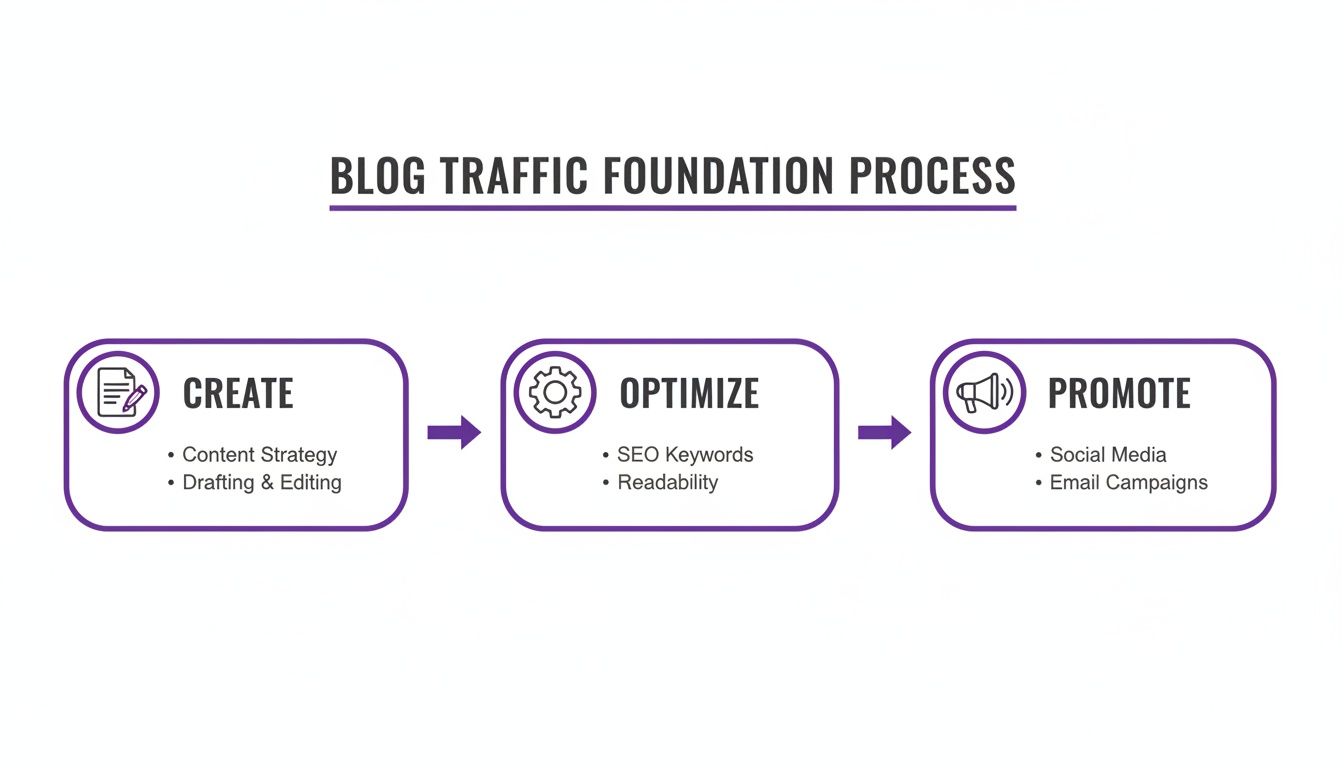
To make this simple, I've broken down the entire traffic generation process into three core pillars. Each one builds on the last, creating a cycle that fuels sustainable growth instead of just temporary traffic spikes.
This table gives you a quick overview of the framework:
| Pillar | Objective | Key Activities |
|---|---|---|
| Create | Develop high-quality, relevant content that solves a specific reader problem. | Keyword research, audience analysis, writing, content formatting. |
| Optimize | Ensure search engines can easily find, crawl, and understand your content. | On-page SEO, technical SEO, user experience (UX) improvements. |
| Promote | Actively distribute your content to your target audience and build authority. | Social media, email marketing, community engagement, outreach. |
By focusing on these three areas, you move from just guessing what might work to using a proven method that gets real results.
Here’s a simple flowchart that visualizes this foundational process:
Why Initial Engagement is Your Secret Weapon
One of the most powerful—and overlooked—parts of this framework is that initial promotion push. Modern algorithms on social media and even in search engines are smart. They pay close attention to what happens right after you publish. Early engagement signals like likes, comments, shares, and saves tell these platforms, "Hey, people are interested in this!"
This is exactly where a community can be a game-changer. With our Upvote.club service, you can get those early engagement signals from real, verified human accounts. The platform is based on a community model: you help other members promote their content to earn points, which you then use for your own blog posts. This is not about buying fake likes; it's about tapping into a community to generate authentic social proof that helps your content reach a wider audience.
Getting a burst of engagement within the first hour of posting is a powerful way to signal to platforms that your content is worth showing to more people. Top agencies call this the "Golden Hour," and it's a strategy you can use to give your content an immediate edge.
This initial boost is helpful for writers on platforms like Substack, who often depend on social media to grow their subscriber list. By sharing your latest newsletter on social media and using our Upvote.club service to boost it, you can drive more clicks right back to your publication.
And of course, to lay a strong groundwork, you need solid SEO fundamentals. This guide on how to increase organic traffic with proven SEO is a great place to start, as it breaks down the essential optimization techniques for long-term success.
Mastering Keyword Research and On-Page SEO
Before you even think about writing, you have to know what people are searching for. This is where keyword research comes in. It’s the process of figuring out the exact phrases your target audience is typing into Google. Get this right, and you've built the foundation for a post that brings in a steady stream of visitors for years. Get it wrong, and you're just writing for yourself.
The goal isn't to chase the most obvious, high-traffic terms. You'll get crushed. Instead, we’re hunting for low-competition, high-intent keywords. These are longer, more specific phrases—often called "long-tail keywords"—that tell you a user is ready to learn something specific, make a purchase, or take action.
For example, targeting "blog traffic" is a losing battle for most of us. A much smarter keyword would be something like "how to get blog traffic for a new website." See the difference? It's specific, and the person searching it has a real problem they need solved now.
Uncovering the Right Keywords
Your first move is to get inside the searcher's head. What do they really want when they type in that phrase? Are they after a quick definition? A deep-dive guide? A product review? A list of options? If your content doesn't match their intent, you have zero chance of ranking. It's that simple.
Here are a few of my go-to methods for finding keywords that actually convert into readers:
- Google Autocomplete: Just start typing a topic into the search bar and watch the suggestions pop up. These aren't guesses; they're what real people are searching for. It's a direct line into your audience's brain.
- The "People Also Ask" Box: This goldmine in the search results shows you all the related questions people have. Weave the answers to these questions into your article, and you can start ranking for a whole cluster of related terms.
- Niche Forums and Communities: Go into places like Reddit or Quora. The questions, complaints, and discussions happening there are pure content gold. You'll learn the exact language your audience uses and the real problems they're facing.
Once you have a list of ideas, you’ll need a tool to check their search volume and difficulty. You're looking for that sweet spot: a keyword with enough monthly searches to be worthwhile, but not so competitive that you're invisible.
Your On-Page SEO Checklist
Okay, you've picked your keyword. Now you have to structure your post so that search engines can easily figure out what it's all about. This is on-page SEO. It’s not about tricking algorithms; it’s about making your content clear and easy to understand for both robots and humans.
Here's the checklist I run through for every single post I publish:
- Title Tag: Your main keyword has to be in the title, ideally toward the beginning. But don't just stuff it in there. A great title like, "A Practical Guide to Getting More Blog Traffic in 2024," grabs attention and gets clicks.
- Meta Description: This is your sales pitch in the search results. It’s that snippet under the title. It doesn't directly affect rankings, but a compelling one convinces someone to click your link instead of the one above it. Include your keyword and a clear benefit.
- Proper Header Structure: Use one H1 tag for your post title. That's it. Then, use H2 tags for your main sections and H3s for the sub-points inside them. This creates a clean, logical flow that helps readers skim and search engines crawl.
- Smart Internal Linking: Link to other relevant articles on your own blog. This is huge. It helps Google discover more of your content and keeps people on your site longer—a strong signal that you’re providing something useful.
- Image Alt Text: Every image needs descriptive alt text. This helps visually impaired users understand the image and gives search engines another clue about your content. It’s a perfect, natural place to use your keyword.
Think of on-page SEO as giving search engines a clear map of your content. By optimizing these elements, you're not trying to trick the algorithm; you're simply making it as easy as possible for it to understand what your article is about and who it's for.
Alright, let's talk about how to structure your content. Now that you've got your keywords sorted, the next big hurdle is figuring out how to present all that great information. You can have the most brilliant ideas in the world, but if they're buried in a giant wall of text, people are going to hit the back button faster than you can say "bounce rate."
The way you lay out your post has a massive effect on how much traffic it can pull in. Seriously. Think about your own search habits. When you need an answer, you’re probably clicking on a "how-to" guide or a numbered list, right? There's a good reason for that—these formats get straight to the point and make information easy to scan.
This isn’t just a hunch; the data shows it. "How‑to" articles are the most popular format on the planet, with something like 76% of bloggers using them. Listicles are right behind them at 54%. But it’s not just the format that matters—it's the depth. People might say they want short posts, but Google's results tell a different story. Long-form content that pushes past 2,000 words consistently performs well, earning better rankings and more traffic.
Choosing Formats That Actually Work
Not every content format is built the same. Some are magnets for search traffic, while others are designed to get shared like crazy on social media. The trick is to match the format to your topic and, most importantly, what the searcher is looking for.
Here are a few formats that are pretty much always a good bet:
- Detailed 'How-To' Guides: This is the bread and butter of generating steady, organic traffic. You're directly solving someone's problem, walking them through a process from start to finish. A post like "How to Get More Blog Traffic" is a perfect example.
- In-Depth Listicles: Think "15 Ways to…" or "The Top 10 Tools for…" These are incredibly scannable and promise a clear, finite number of takeaways. That makes them ridiculously clickable in search results and on social media feeds.
- Case Studies: Nothing builds trust like showing your work. Case studies offer real-world proof of how a strategy or tool delivered a specific result. They're absolute gold for building a loyal, dedicated audience that sees you as an expert.
Your mission is to create the single best, most complete resource on the internet for your topic. When someone finishes your post, they shouldn't have to go back to Google for more. That's how you win.
Why Visuals Are Absolutely Non-Negotiable
In a world where attention spans are measured in seconds, visuals are your secret weapon. They’re how you keep people from getting bored and wandering off. A page of plain text is intimidating and, let's be honest, pretty dull.
Images, infographics, and videos break up the monotony. They illustrate your points and make the entire article more engaging and easier to digest.
The stats are staggering: articles with images get, on average, 94% more views than those without. That one number should be enough to make you a believer. But visuals do more than just get people to click; they boost comprehension and increase the time visitors spend on your page—a huge signal to search engines that your content is useful.
And then there's video. Embedding a YouTube video can take your engagement to a whole new level. It can explain a complex idea in a couple of minutes, holding a reader's attention in a way text just can't. Some studies show that pages with video can attract up to 50 times more organic search traffic. For example, in our own guide on growing a YouTube channel, we show how video becomes a powerful, standalone traffic source. When you embed those videos into your blog posts, you're creating a one-two punch for engagement and search visibility.
When you nail the right format, go deep on the topic, and sprinkle in compelling visuals, you create something that doesn't just rank. You create a genuinely great reader experience. That’s the blueprint for content that not only brings people in but keeps them coming back for more.
Give Your Content a Fighting Chance with Smart Promotion
Hitting "publish" on a new blog post feels amazing, but it's really just the starting line. What you do in that first hour after your content goes live is often the difference between a post that gets seen and one that fades into obscurity.
That initial period is what we call the "Golden Hour." It’s a key window where social media algorithms are paying extra close attention. When a new post gets a quick burst of engagement—likes, comments, shares—it signals to the platform that people are genuinely interested. This early action can trigger the algorithm to push your content to a much wider audience, well beyond your usual followers.

Making the Most of the Golden Hour
The real task is creating that initial buzz. Just dropping a link and crossing your fingers is a recipe for disappointment. This is where a community-powered approach can completely change the game. Influencer agencies have used this exact method for years to give their clients an immediate advantage, and now that power is available to everyone.
This is where our Upvote.club service comes in. We have built a community-driven growth service for Social Networks that helps users build real engagement without bots. Our platform lets members create unlimited tasks to receive likes, comments, reposts, saves, and followers from verified, human accounts. It's not about buying fake engagement; it’s about getting real social signals from real people that tell algorithms your content is worth showing to more users.
How Does This Whole Community Thing Work?
The system is built on mutual support. Our Upvote.club service works differently from other services. While other platforms let you buy likes, our service is not about buying engagement — it's about participating in a community. The system runs on a simple points system, which is our internal currency for getting your content promoted.
Here’s the breakdown:
- Earn Points: You start by completing simple tasks for other members, like liking a tweet, commenting on a LinkedIn post, or saving a thread on Reddit. By helping others, you earn the ability to promote your own content.
- Create Your Own Tasks: You then use those points to create tasks for your own blog posts. You can ask for likes, genuine comments, reposts, and more from other real, verified members.
- Drive Real Engagement: Your tasks get completed by actual human accounts, sending the authentic engagement signals that social platforms are looking for. We maintain strict anti-bot moderation and provide transparent visibility into who completes each task.
This creates a win-win cycle. To get you started, when a user registers, we give them 13 free points and 2 task slots. That's enough to create the first task and see for yourself how the community can give your content that initial push it needs.
The concept is simple but effective. Instead of buying sketchy likes from bots, you're earning them by participating in a genuine community. Every interaction comes from a verified human account, ensuring the engagement is high-quality and safe for your social profiles. We will never ask for your passwords.
Let's Walk Through Your First Promotion
So, let's put this into practice. You’ve just published a great blog post and shared it on Twitter. You need to get some eyeballs on it, fast.
With our Upvote.club service, you can create a task in a couple of minutes. For example, getting two likes on your tweet might cost 4 points. If you need more points, just complete a few quick tasks for other members. The first time you complete a task, our system will ask you to verify your social media accounts. Each social network only needs to be verified once. We use a unique emoji-based verification system—again, no passwords needed.
Every 24 hours, users receive 1 free task slot. For those who want to ramp up their growth, we have added subscriptions that provide a large number of points and free task slots right away. This makes it easy to consistently promote your content across multiple platforms, from Instagram, TikTok, and Youtube to LinkedIn, Reddit, and Quora.
This kind of strategic promotion drives immediate traffic, boosts your post's visibility, and gives your content the best possible shot at being discovered by a much larger audience organically.
Breathing New Life into Your Existing Content
Many bloggers fall into the trap of thinking the only way to get more traffic is to churn out new articles constantly. And yes, fresh content is definitely part of the game. But one of the most powerful moves you can make is hiding in plain sight: updating your old posts.
It’s easy to assume all the traffic gold flows to brand-new content. The reality? A huge chunk of organic traffic lands on older, established pages that have had time to marinate and build authority with Google.
Think about it from a search engine's perspective. They want to serve up the best, most current, and complete information. Instead of starting from square one and waiting months for a new post to get any love, you can get a much faster win by improving an asset that already has a bit of a foothold.
Identifying Posts Ripe for a Refresh
First things first, you need to figure out which articles are the best candidates for an update. Don't just pick one at random. You've got to use data to find the posts with the most untapped potential.
I always look for a few key signals:
- Posts ranking on Page 2 or 3 of Google: These are the low-hanging fruit. They’re so close to driving real traffic. A solid update is often just the nudge they need to jump onto page one, where all the action happens.
- High keyword impressions, but low clicks: This is a classic sign of a mismatch. Your post is showing up in search, but people aren't clicking. It could be a weak title or meta description, or maybe the content just isn't quite hitting the mark for what people are looking for.
- Outdated information: This one’s a no-brainer. Articles with old stats, broken links, or references to things that happened years ago are prime targets. Bringing them into the present instantly improves their worth.
The Content Refresh Checklist
Once you've picked your target, the goal is simple: make the article substantially better than it was before. This isn't about just touching up a few typos. Think of it as a full-blown renovation, not just a new coat of paint.
Here’s the playbook I follow:
- Add New, Relevant Information: Flesh out your original points. Have there been new developments on the topic? Can you add more examples or a whole new section that answers a related question? Digging through platforms like Quora is a fantastic way to find fresh angles. We actually have a great guide on how to use Quora for content ideas that can help with this.
- Update Statistics and Data: Swap out those stale numbers for the latest ones you can find. Citing current data makes your content more credible.
- Embed New Visuals: Add new images, create a simple infographic, or pop in a relevant video. Visuals break up the text, make the content more engaging, and can increase the time people spend on your page.
- Improve On-Page SEO: Go back to the basics. Can you make the title more compelling? Are your headings clear and logically structured? Can you weave in some new internal links to more recent articles you've published?
A content refresh isn't just about changing a few sentences. It’s about a complete overhaul to make the post more thorough, accurate, and engaging than any other resource on the topic.
This strategy is more than just a gut feeling; the data backs it up. A huge part of traffic growth today happens after you hit publish. In fact, bloggers who regularly update their older content are roughly 2.5 times more likely to report strong results.
Historically, companies that actively maintain their blogs attract 55–97% more inbound traffic and links, and refreshing old content is a massive part of that maintenance. You can dig into more blogging performance statistics on siegemedia.com to see the full picture.
And once you’ve done all the work, don't forget the final step: re-promote it! Share it across all your social channels and blast it out to your email list just like it's a brand-new article. This strategy delivers a faster, more efficient traffic boost than always starting from scratch.
Got Questions About Blog Traffic? I've Got Answers.
As you start putting these strategies into action, you're bound to have some questions. It's totally normal. Here are my straight-up answers to the ones I hear most often.

How Long Does It Realistically Take to See More Blog Traffic?
Let's be real: this is a marathon, not a sprint. While a well-timed social media push might give you a nice little traffic spike right away, building sustainable, organic traffic from Google takes time. There's no getting around it.
Most new blogs need a good 3–9 months of consistent effort just to get on Google's radar. To see that steady, meaningful traffic you're dreaming of, you're probably looking at a year or more. Why? Because Google needs time to find your content, understand it, and see that other sites trust it (that's where backlinks come in).
Patience and consistency are your best friends here.
Content Quality vs. Quantity: What Matters More?
Ah, the classic debate. My answer? Quality is the price of entry. It's the foundation for absolutely everything else.
You can’t just churn out a bunch of thin, low-effort articles and expect to rank. Google is way too smart for that now. It prioritizes content that is genuinely helpful, well-researched, and completely answers the searcher's question.
Start by creating the absolute best piece of content you can for your target topic. Once you've got that process down, then you can work on picking up the pace. One incredible, in-depth article will drive more traffic in the long run than ten short, superficial posts ever will.
The sweet spot is a blend of both. Aim for the highest quality you can possibly produce, then figure out a publishing schedule you can actually stick to. One amazing post a week crushes five weak ones.
Can I Get More Blog Traffic Without Building Backlinks?
It’s tough. Really tough, if you're in a crowded niche. Backlinks are one of the main ways Google decides who to rank, acting like votes of confidence from other websites.
But that doesn't mean you need to launch a massive, complicated outreach campaign on day one.
Your first job is to create "link-worthy" content—articles so good that people naturally want to share and reference them. Promoting your content in the right places also helps people discover it, which can lead to organic links. This is where a community can be useful; getting more eyeballs on your work increases the chances that another blogger or journalist will see it and decide to link to it.
For a deeper dive, there are plenty of other proven strategies that work to increase blog traffic you can look into as you get more advanced.
How Does a Service Like Upvote Club Actually Help with SEO?
It's a fair question. While our Upvote.club service isn't a direct SEO tool in the traditional sense, it supports your SEO efforts in a way that’s becoming more and more important: user engagement.
Think about it. When you publish a new article and our community members immediately give it some love with real likes, comments, and shares, it sends a strong signal to social media algorithms that your content is worth showing to more people. This kicks off a snowball effect.
That initial boost in distribution means more people see your post. More people see it, more people click through to your blog, and more people spend time reading what you wrote. These are all positive user signals—like higher click-through rates and longer time-on-page—that search engines pay attention to.
With our Upvote.club service, you’re getting a safe and effective way to generate these early signals. It's not about buying fake engagement; it's about being part of a real community where you help others, and they help you.
When you sign up, we give you 13 free points and 2 task slots to create your first task. This lets you see the effect for yourself, no strings attached. Every single interaction comes from a real person with a verified account, so the social proof you build is completely authentic and plays by the rules.
More articles
alexeympw
Published January 11, 2026