Table of Contents
- Why Your Connection Strategy Isn't Working
- You’re collecting names instead of building access
- The real goal is relevance
- Prepare Your Profile to Attract Connections
- Fix your headline first
- Your photo needs to look current and trustworthy
- Write an About section that starts conversations
- Find the Right People to Connect With
- Start with active users, not just relevant users
- Build lists by use case
- Use search with intent
- Crafting Connection Requests That Get Accepted
- Timing matters more than most people think
- Keep the message short or send it blank
- Write like a peer, not a petitioner
- Use comments as pre-request warm-up
- Nurture Connections After They Accept
- Send a light first message
- Show up when their posts are fresh
- Create goodwill in public before asking in private
- Advanced Tactics and Networking Etiquette
- Respect the limits or pay for it later
- Use underused warm paths
- Keep your etiquette clean
You’re likely employing a common LinkedIn strategy. You send requests, add a polite note, wait, and get silence. Then you assume networking on LinkedIn is random, saturated, or only useful if you already know everyone worth knowing.
That’s the wrong read.
If you want to learn how to make linkedin connections that lead to replies, intros, clients, interviews, and actual conversations, stop treating LinkedIn like a contact list. Treat it like a distribution system for trust. Every good connection changes who can see you, who can search you, and who’s one introduction away.
Why Your Connection Strategy Isn't Working
Most weak LinkedIn networking comes from one bad habit. People chase more requests sent, not better network design.
That creates a pile of low-fit contacts, ignored invites, and a feed full of people you’ll never talk to. Then your outreach feels cold because it is cold. There’s no shared context, no pattern, no reason for the other person to care.
You’re collecting names instead of building access
LinkedIn gets powerful when you stop thinking in first-degree terms only. Users can access 2nd-degree networks numbering in the millions from a standard account, and analysis showed that 500+ targeted connections could open access to 10-50% of the platform’s user base according to this LinkedIn network analysis.
That changes the job.
You are not trying to “look active.” You’re trying to connect with people who sit inside the industries, functions, companies, and circles you want to enter. One sharp connection can expose you to an entire cluster of marketers, founders, recruiters, operators, journalists, or engineers.
Practical rule: If a person doesn’t expand your access to the right conversations, they’re not a high-value connection.
That’s why random outreach underperforms. It ignores network shape. A useful network has density in the right places. If you work in SaaS marketing, 50 founders, demand gen leads, content heads, and partner managers beat 500 strangers with no overlap.
The real goal is relevance
A good LinkedIn network does three things:
- Improves discoverability by placing you closer to the people you want to reach
- Raises trust because mutual connections and repeated interactions reduce friction
- Creates compounding visibility when your comments and posts travel through connected circles
If your current method is “send requests whenever I remember,” fix that first. Set a theme for your network. Pick the industries, roles, and communities you want to be known in. Then build around that.
If you want more context on building an active LinkedIn profile around that kind of targeted growth, our guide on LinkedIn growth strategies is a strong next read.
Prepare Your Profile to Attract Connections
Before you send a single request, clean up the profile that people will inspect before they accept. Invite rejections often occur not because your note was bad. They occur because your profile gave them no reason to say yes.
Your profile has one job. It must answer, fast, who you are, who you help, and why connecting with you won’t be a waste of time.
Fix your headline first
Your headline is not a place to dump a job title and hope for the best.
Bad headline:
Marketing Manager at ABC Company
Better headline:
B2B SaaS marketer helping product-led teams turn content into pipeline
Another bad one:
Founder | Consultant | Speaker | Advisor
Better:
Founder helping early-stage SaaS teams tighten positioning and outbound messaging
The second version works because it tells people what box to put you in. That matters. Clear beats clever on LinkedIn.
Your photo needs to look current and trustworthy
You don’t need a studio portrait. You do need a photo that looks like someone a professional would answer.
Use this checklist:
- Face visible so people can identify you at a glance
- Simple background that doesn’t fight for attention
- Current image that matches how you look now
- Professional expression that looks approachable, not stiff
Skip cropped wedding photos, blurry conference shots, and heavy filters. LinkedIn is not Instagram. People make snap judgments here.
Your profile photo and headline work as a pair. If one says “credible” and the other says “unclear,” the unclear part wins.
Write an About section that starts conversations
Most About sections read like internal HR documents. They’re stuffed with buzzwords, broad claims, and no human voice.
A better structure is simple:
- Say what you do
- Say who you do it for
- Say what you care about
- Give people a reason to message you
Example:
“I help B2B software teams improve messaging, content distribution, and outbound workflows. I’m most interested in the gap between good strategy and actual execution. If you work in SaaS, creator-led growth, or demand gen, I’m always up for trading notes.”
That works because it sounds like a person, not a brochure.
If you’re trying to build relationships on LinkedIn, your profile should make the next step obvious. The best profiles create familiarity before the first conversation starts.
Find the Right People to Connect With
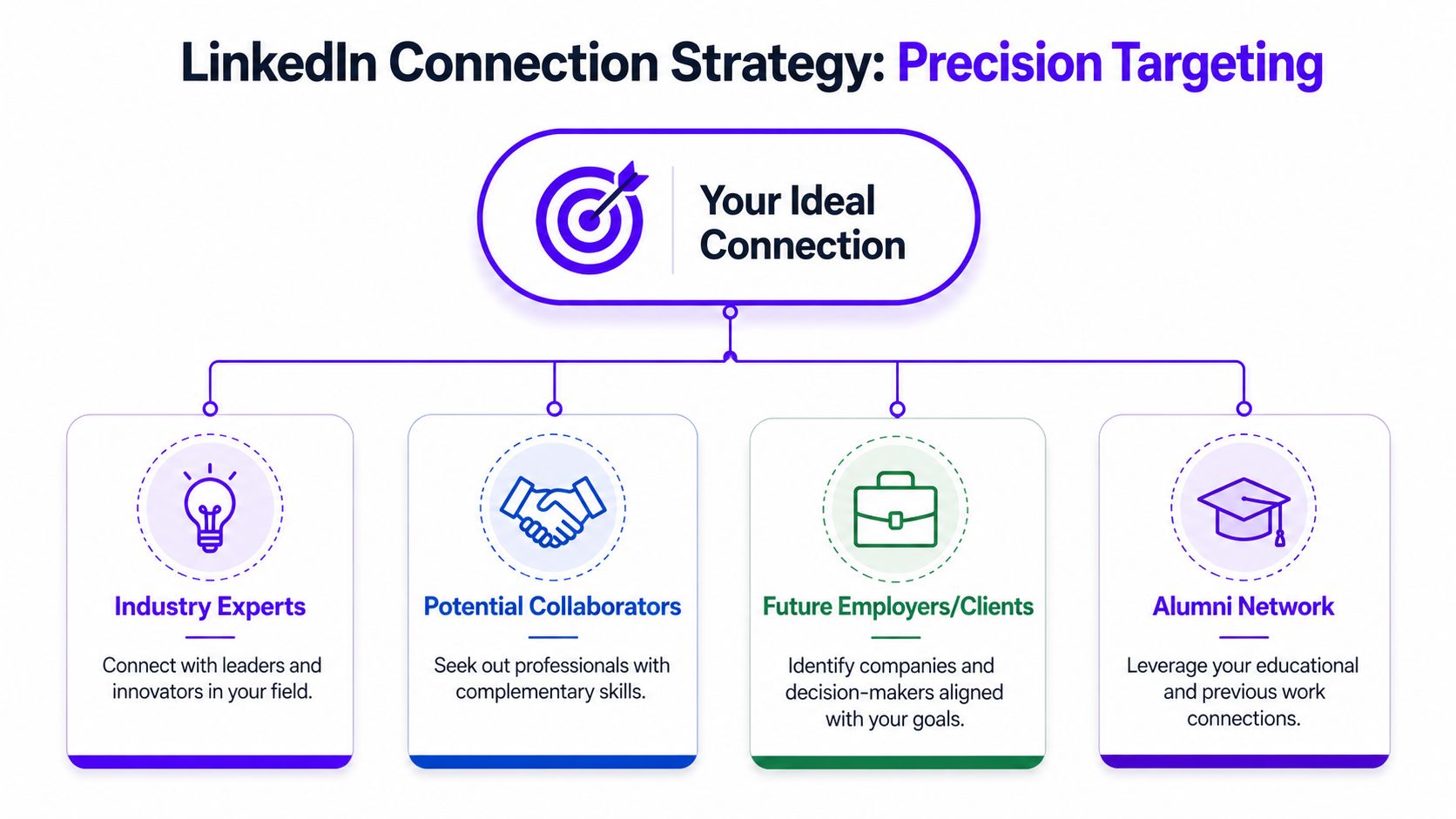
A decent request sent to the right person beats a polished request sent to the wrong one. This leads to most LinkedIn users wasting time. They search broad titles, send invites in bulk, and hope message quality saves weak targeting.
It won’t.
Start with active users, not just relevant users
The best filter on LinkedIn is simple. Target people who have posted within the last 30 days. Data shows this can move acceptance rates from a baseline of 12-15% to over 33%, with 40-50% as a strong operating target for well-targeted outreach, according to this acceptance-rate breakdown.
That makes sense. Active users do see notifications. Inactive users don’t.
Use this order when building your list:
- Recent activity first because response depends on visibility
- Role fit second so the connection still matches your goals
- Mutual context third such as shared connections, groups, alumni, or similar posts
- Company relevance last because company fit alone is weak if the person never logs in
Build lists by use case
Don’t create one giant “prospects” list. Split your targeting by reason.
| List type | Who belongs there | Why it works |
|---|---|---|
| Peer network | People in similar roles or one step ahead | Easiest to start conversations with |
| Opportunity list | Hiring managers, founders, clients, editors | Direct path to work and referrals |
| Signal boosters | Active commenters and posters in your niche | Strong visibility loop |
| Trust bridges | Alumni, former coworkers, mutual circles | Lowest-friction introductions |
That structure gives your outreach a purpose. It also makes your messaging cleaner because each list has a different angle.
Use search with intent
LinkedIn search gets better when you stop typing generic titles. Combine job title, industry, location, and signals from their recent activity. If you sell to SaaS marketers in California, search for that. If you want journalists covering AI startups, search for that. If you want investors, use niche directories to sharpen your shortlist before you ever open LinkedIn. For example, if you need to find US-based startup investors, start there, then check which names are active on LinkedIn before sending invites.
A lot of people also ignore followers as a warm-up layer. Sometimes following first is smarter than requesting right away, since repeated visibility can soften future outreach. If you want to use that tactic more intentionally, look at LinkedIn follow growth ideas.
Here’s a good walkthrough on list building and profile selection before outreach:
Don’t ask, “Who should I connect with?” Ask, “Who is active, relevant, and close to the conversations I want to join?”
Crafting Connection Requests That Get Accepted
Your connection request is not a cover letter. It’s a small prompt that should feel easy to accept.
That’s where people overdo it. They write long notes, force fake familiarity, or pitch too early. None of that helps. You want a request that feels light, specific, and timely.
Timing matters more than most people think
An analysis of over 16,000 connection requests found that 21% of all acceptances happen within the first 60 minutes, driven mainly by mobile notifications. The same research recommends sending during peak activity so your invite stays among the top three recent requests shown in the My Network area, as explained in this timing analysis.
That gives you a simple rule. Send requests when the person is likely to be online, not when your task list says “do outreach.”
Good timing beats perfect wording.
Keep the message short or send it blank
This is the part many people resist. A blank request can work very well when your targeting is strong and your profile is clear. If there’s already enough context from role overlap, shared circles, or familiar content, a note can add friction instead of reducing it.
Use a note when you have a real reason. Don’t use one because you feel guilty sending a blank request.
If your note sounds like networking theater, delete it.
Here are templates I’d use.
| Scenario | Message Template |
|---|---|
| You don’t know them | Hi [Name], I follow your posts on [topic] and thought it made sense to connect. |
| Mutual connection | Hi [Name], saw we both know [Mutual Name]. You’re doing interesting work in [area]. Happy to connect. |
| After an event | Hi [Name], good to see your take on [event/topic]. I wanted to connect and stay in touch here. |
| Same LinkedIn group | Hi [Name], we’re both in [Group Name]. I’ve been following the discussion around [topic]. Glad to connect. |
| Same niche, no note needed | Send a blank request if your profile already signals fit and they’re active in your niche. |
Write like a peer, not a petitioner
The tone matters. You are not begging for access. You are starting a professional connection. That means:
- Be direct and skip long setup
- Name the context if there is one
- Don’t pitch in the request
- Don’t stack asks like connect + call + feedback + intro
Bad example:
“Hello sir, I have been greatly impressed by your amazing journey and would be honored to be part of your network while also learning from your expertise.”
Good example:
“Hi Dana, I liked your post on onboarding friction in B2B SaaS. Thought it made sense to connect.”
Short wins because it sounds normal.
Use comments as pre-request warm-up
A smart move is to comment on a person’s post before you send the invite. Not fluff. A real comment. That creates familiarity, and when your request lands later, your name may already ring a bell. If you need ideas for writing better engagement before outreach, this guide on LinkedIn comment strategy is useful.
The best sequence is simple. See their post. Leave one thoughtful comment. Wait a bit. Send the request while they’re still active.
Nurture Connections After They Accept
Many users blow the relationship right after the acceptance. They either pitch instantly or disappear completely.
Both are mistakes.
A new connection is not a lead until there’s context. And context usually comes from small interactions, not one giant message.
Send a light first message
Your first message should continue the reason you connected. It should not switch to a sales script.
Use one of these approaches:
- Reference their content and add one short thought
- Ask one easy question tied to their work
- Offer a useful resource only if it fits
- Say nothing yet if your best next move is public engagement on their posts
Example:
“Thanks for connecting. I liked your point about shortening sales cycles through better qualification. Curious how your team handles that on inbound demos.”
That works because it opens a conversation instead of forcing one.

Show up when their posts are fresh
If you want people to remember you, interact with what they publish. Early engagement matters on every major social platform because the first wave of activity affects how far a post travels. On LinkedIn, that means being one of the first people to like, comment, or repost with an opinion.
That kind of consistency does two things. It keeps you visible, and it proves you didn’t connect just to harvest a contact.
A good rhythm looks like this:
- Connect
- Send a short thank-you or context message
- Engage with one recent post
- Reply if they respond
- Keep light contact through public interactions
Be the person who adds signal in the feed. That beats being the person who asks for a call too soon.
Create goodwill in public before asking in private
Public interactions carry more weight than most inbox messages. A solid comment on someone’s post can do more for the relationship than a generic “just checking in” DM.
If you want to stay visible, make your engagement useful:
- Add a perspective they didn’t mention
- Share a brief example from your own work
- Ask a smart follow-up that invites discussion
- Avoid empty praise like “Great post” and nothing else
If part of your strategy includes becoming more active with early post engagement, this resource on LinkedIn likes and engagement habits can help you think more intentionally about what to do in that first visibility window.
A strong network isn’t built in the inbox alone. It’s built in repeated, low-friction moments where people see your name attached to useful thoughts.
Advanced Tactics and Networking Etiquette
The common mistake at this stage is assuming scale means sending more requests. It doesn’t. On LinkedIn, dumb volume creates account risk and weaker results.
If you want to grow fast without wrecking your account, pacing matters.
Respect the limits or pay for it later
In 2026 projections, LinkedIn’s weekly connection request limits are around 100-200, and the same source recommends a sustainable pace of 20-30 targeted requests daily to reduce the chance of anti-spam restrictions, according to this write-up on LinkedIn networking limits.
That means your job is not “maximize sends.” Your job is “maximize good sends.”
Do this instead:
- Work in small daily batches so your pattern looks human
- Use second-degree paths where trust already exists
- Rotate targets across peers, clients, operators, alumni, and creators
- Pause weak segments if a group keeps ignoring invites
Use underused warm paths
The best advanced tactics are boring. They also work.
The Alumni tool is one of them. Shared school history gives you instant context. LinkedIn Groups can still work too, but only if you participate like a real member. Drop comments, answer questions, and become familiar before sending invites.
Another smart play is building visible activity outside LinkedIn. If someone checks your profile and sees you publish, comment, ship projects, or show up across platforms, your connection request feels safer. Social proof travels.
Keep your etiquette clean
A few rules separate good networkers from annoying ones:
| Do this | Avoid this |
|---|---|
| Reference real context | Fake intimacy |
| Follow up once if needed | Repeated nudges |
| Comment thoughtfully in public | Pitching under every post |
| Ask for small next steps | Asking for too much too soon |
A clean reputation compounds. So does a bad one.
If you want a better way to warm up your social profiles beyond LinkedIn, Upvote Club is built around real community participation, not fake engagement. With our Upvote.club service, you can create tasks for likes, comments, reposts, saves, and followers across platforms, complete tasks for others to earn points, and build steady engagement from verified human accounts without bots or password sharing. We’ve built it so creators, marketers, developers, founders, and teams can turn community activity into real traction, which makes your overall online profile stronger before you ever send the next connection request.