Table of Contents
- Build a Profile That Invites Connection
- Key Profile Sections for Maximum Effect
- Your Professional Story and Skills
- Finding and Qualifying Your Ideal Connections
- Using Advanced Filters to Pinpoint Prospects
- Vetting Profiles Before You Connect
- Crafting Connection Requests That Actually Get Accepted
- Explain the "Why" Behind Your Request
- Real-World Examples for Different Scenarios
- What Should You Actually Post on LinkedIn?
- The “Golden Hour” and Getting That First Push
- Turning Connections into Meaningful Relationships
- Nurturing New Connections Without Being Pushy
- Moving the Conversation Forward
- A Few Common Questions About LinkedIn Networking
- How Many Connection Requests Should I Send a Week?
- What's the Biggest Mistake People Make?
- What's the Best Way to Re-Engage Old Connections?
- Can I Use Services to Boost My LinkedIn Posts?
Before you ever send a single connection request, your networking on LinkedIn has already begun. The real first step is turning your profile from a dusty, static resume into a place people actually want to visit.
It all starts with your profile—your digital handshake. Get this right, and you'll find people are much more likely to accept your request before you even have to make your case.
Build a Profile That Invites Connection
Think of your LinkedIn profile as your personal landing page. It’s the first impression you make, and it can either open doors or slam them shut. A well-crafted profile doesn't just list your accomplishments; it tells a compelling story about your professional worth.
Your headline is the perfect place to start. Don't just settle for your job title. Instead, use it as a personal tagline that shows what you do. A "Marketing Manager" is fine, but "Marketing Manager Driving Growth for SaaS Startups" tells me exactly who you are, what you do, and who you help. That’s a person I want to know.
To give you a better idea of how to approach this, here’s a breakdown of the key sections and how I think about them for maximum effect.
Key Profile Sections for Maximum Effect
| Profile Section | What to Do | Why It Works |
|---|---|---|
| Headline | Go beyond your job title. State the result you deliver and for whom. | It immediately qualifies you to visitors and makes you more searchable for the right opportunities. |
| About Section | Write in the first person. Tell a story that connects your past experiences to your future goals. | It makes you relatable and approachable. People connect with stories, not just lists of jobs. |
| Skills & Endorsements | Add at least 5 relevant skills and get endorsements from colleagues. | This is a big credibility booster and helps LinkedIn's algorithm show your profile to the right people. |
| Experience | Don’t just copy-paste your resume. For each role, add 2-3 bullet points focusing on your biggest achievements. | It proves you don’t just do the job; you get results. Quantify with numbers whenever possible. |
Getting these sections right is non-negotiable. Your profile should instantly answer three questions for any visitor: Who are you? What do you do? And why should I connect with you?
Your Professional Story and Skills
Your 'About' section is your chance to connect the dots. Don't just list what you did; explain the "why" behind your career moves. Write like you're talking to someone over coffee, not like you're filling out a job application. Use the first person—it makes a world of difference.
Skills are another area people often overlook. Don't just list a few and call it a day. The data is clear: profiles with 5 or more skills get up to 17x more views. That's a massive increase in visibility from recruiters, potential clients, and peers.
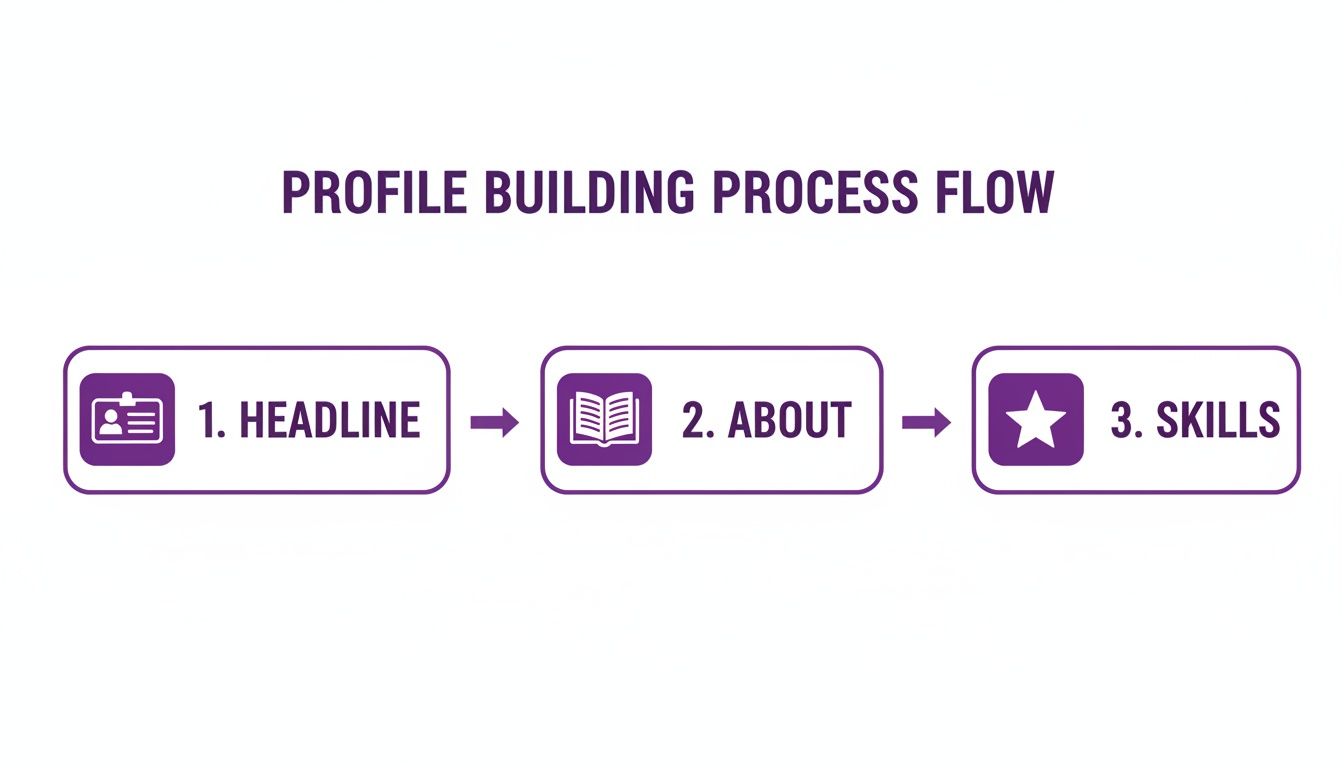
This simple process—nailing your headline, telling your story in the 'About' section, and backing it up with skills—creates a powerful professional identity that naturally attracts the right people.
A strong profile answers three questions for any visitor: Who are you, what do you do, and why should they connect with you? If you can answer these clearly, you're on the right track.
A polished profile is the foundation of every successful networking strategy. It’s not a one-and-done task; you should always be looking for ways to improve your LinkedIn profile.
Once your profile is sharp and your content is ready, getting that initial traction is important. LinkedIn’s algorithm favors posts that get early engagement. With our Upvote.club service, you can get a leg up. We built Upvote.club as a community-driven growth service where our members, who are all verified humans, provide the initial likes and comments to help your content get the visibility it deserves from the start.
Finding and Qualifying Your Ideal Connections
Let's be real: effective networking isn't about collecting connections like baseball cards. It's about building a curated group of professionals who actually align with your goals. The first step is to stop blindly mashing the "Connect" button and start searching with a strategy.
Forget just typing job titles into the search bar. You can get way more specific. I like to use Boolean search operators to narrow things down. For instance, if you search for "Marketing Manager" AND "SaaS" NOT "Director", you’ll get a much cleaner list than if you just searched for a generic title. It instantly filters out the noise.
Using Advanced Filters to Pinpoint Prospects
Once you’ve got a basic search running, it’s time to really drill down. This is where the "All filters" button becomes your best friend. It’s how you go from a broad list to a handful of perfect-fit people.
Don't sleep on these options:
- Connections: I almost always start by filtering for 2nd-degree connections. Why? You already have a mutual contact, which gives you an instant, warm way to start a conversation. It's a game-changer.
- Location: This is a must if you're targeting a specific geographic market. It helps you find local industry leaders, potential clients, or even just peers for in-person coffee chats.
- Current Company: Trying to get your foot in the door at a dream company? This filter is your secret weapon. It lets you find everyone from recruiters to the exact department head you need to talk to.
- Industry: This one is pretty straightforward, but it helps keep your outreach relevant. You’re making sure you’re talking to people in your professional world, which makes your request feel a lot less random.
Vetting Profiles Before You Connect
Okay, so you've found someone who looks promising. Don't hit "Connect" just yet. Take two minutes to actually look at their profile. This quick check tells you if they’re a good fit and, more importantly, gives you the ammo you need to personalize your request.
A quick profile check is what separates a genuine, personal request from a generic one that gets ignored. Look for recent activity, shared interests, and mutual contacts.
I always check their recent activity. Have they posted or commented in the last month? An active user is far more likely to see and respond to your request. Then I'll scan their "About" section and experience to double-check that they’re who I think they are. Finding a shared group or a common interest is gold—it’s the perfect conversation starter.
Timing matters, too. LinkedIn's user base is more active than ever, so posting and engaging during peak hours (usually Tuesday through Thursday mornings) helps you get seen. And remember, building a strong network also means making your own profile attractive to others. If you want to dive deeper into growing your own follower base, you should check out our guide on how to get more followers on LinkedIn.
Crafting Connection Requests That Actually Get Accepted
Sending a generic, empty connection request is like giving someone a limp handshake. It's forgettable, a little lazy, and almost always gets ignored. If you want to get good at networking on LinkedIn, you have to stop treating the connection request as a formality. Think of it as the opening line of a real conversation.
That default "I'd like to add you to my professional network on LinkedIn" message? It just won't cut it.
The best requests I've seen—and the ones I always accept—are short, direct, and most importantly, personal. Your only job is to show the person you've done a tiny bit of homework and have a real reason for reaching out. You're basically answering their unspoken question: "Why me?"
Explain the "Why" Behind Your Request
The secret sauce is finding one point of common ground and mentioning it right away. This simple act transforms a cold outreach into something that feels like a warm introduction. People are so much more likely to accept when they see you've shown some genuine interest.
Here are a few common starting points I use all the time:
- Shared Connections: "Hi [Name], I noticed we're both connected to [Mutual Connection's Name]. I'm growing my network of pros in the [Industry] space and would love to connect."
- Recent Activity: "Hi [Name], really enjoyed your recent post on [Topic]. Your point about [Specific Detail] was spot on. Would be great to connect and follow your work."
- Common Groups: "Hello [Name], I saw your great comment in the [Group Name] group. I'm also really interested in [Topic] and would appreciate the chance to connect."
- Company Interest: "Hi [Name], I've been following [Their Company]'s work in [Field] and I'm seriously impressed. As a [Your Role] myself, I'd be grateful for the chance to connect."
The best connection requests are never about you. They are about the person you are contacting—their work, their content, or your shared context. This simple shift in focus makes people much more open to connecting.
Real-World Examples for Different Scenarios
Let's see how this works in practice. Notice how each example is brief and gets straight to the point.
Reaching out to a potential client:
"Hi Alex, your company's recent project on sustainable packaging was impressive. As someone who specializes in eco-friendly supply chain logistics, I'd love to connect and follow your work."
Connecting with an industry peer:
"Hi Sarah, I saw your profile and noticed we both started our careers in digital marketing around the same time. It's always great to connect with fellow marketers. Hope we can connect!"
Contacting a recruiter for a specific role:
"Hello David, I recently applied for the Product Manager position at [Company]. My background in user-centric design and agile development seems to align well with the role, and I’m very interested in learning more about your team."
I'll be honest, writing these little personalized notes can feel like a lot of work at first. To help speed things up while keeping that personal feel, you might want to check out an AI writing assistant. But trust me, a handful of well-written, thoughtful requests will always beat a hundred generic ones. Every time.
Alright, your profile is polished and you’re starting to build your network. So, what’s next? If you really want to make LinkedIn work for you, you can't just connect and forget. It’s an active sport. Your network and your credibility really take off when you start participating in the conversation—posting content and engaging with what others are sharing.
Simply collecting connections won't get you very far. You need to show up in people's feeds consistently. This is how you stay top-of-mind and start to be seen as a knowledgeable voice in your industry. Think of every post and comment as a small deposit into your professional reputation bank.

What Should You Actually Post on LinkedIn?
The goal here is to share stuff that’s genuinely helpful, interesting, or informative for the people you want to reach. You don’t need to be a professional writer, but you absolutely have to be authentic. People can spot a fake a mile away.
Here are a few content ideas that work well:
- Share an industry article, but add your take. Don't just hit the share button. Add two or three sentences about why you found it interesting or what your main takeaway was. This simple step adds your voice to the mix and shows you’re thinking critically.
- Tell a personal career story. Did you solve a tough problem at work? Learn a hard lesson? Share it. From my experience, these personal, vulnerable stories are often the posts that get the most engagement.
- Mix up your post formats. Plain text posts can be incredibly powerful, but don't get stuck in a rut. Data shows certain formats just grab more attention. For instance, carousel posts can hit impression rates around 6.60%, which blows most other post types out of the water.
When you consistently share relevant content, you start building real authority. You're giving people a reason to follow you and, more importantly, to listen to what you have to say.
The “Golden Hour” and Getting That First Push
One of the most important things to understand about getting seen on LinkedIn is the Golden Hour. This is the first 60-90 minutes right after you publish a post. The engagement you get in this small window is a big signal to the LinkedIn algorithm about whether your content is worth showing to more people.
A quick burst of likes and comments is the rocket fuel your post needs. This is where so many people get stuck. They create great content, but it falls flat because it doesn't get that initial traction.
That first hour after you post is your best shot at going far. Getting real likes and comments quickly is the secret to unlocking a much broader reach.
This is the exact problem we built our Upvote.club service to solve. Our system works differently from other services because it's not about buying engagement—it's about participating in a community. With our Upvote.club service, you become part of a community-based model where users help each other grow. We maintain strict moderation and do not allow bot accounts. When you join, you earn points by completing tasks for other members, like giving likes or comments. You can then use those points to create your own tasks to get real engagement on your LinkedIn posts. This helps give your content the boost it needs during that important Golden Hour. We also have more tips on how to get more LinkedIn comments that expand on these ideas.
Turning Connections into Meaningful Relationships
This is where the real work begins—and where most people drop the ball. Hitting "accept" on a connection request is just the digital equivalent of a handshake. It's the starting line, not the finish.
Turning that new connection into a genuine professional relationship takes a thoughtful, human approach. It’s all about giving before you even think about asking. Your first few interactions need to be focused on offering something useful, with zero strings attached. This is how you build trust and show you’re interested in them as a person, not just as a prospect.
Nurturing New Connections Without Being Pushy
Your first message after connecting sets the entire tone. Whatever you do, don't jump straight into a sales pitch or ask for a favor. It’s the fastest way to get ignored.
A simple, "Thanks for connecting, [Name]. Glad to have you in my network," is a perfect, no-pressure start. From there, your job is to find organic ways to add to the conversation.
- Share a great article: Stumble upon a post you know they'd find interesting? Send it over with a quick note. "Saw this piece on [Topic] and immediately thought of you."
- Play matchmaker: If you spot an opportunity where they could benefit from knowing someone in your network, offer to make an introduction.
- Engage with their content: A thoughtful comment on their post is a fantastic way to publicly show your support and engage with what they care about.
The goal is to evolve from being a random name in their connection list to a familiar, valued presence in their feed. Consistency and a give-first attitude are what get you there.
When I first started on LinkedIn, I was guilty of just collecting connections like they were baseball cards. My mindset shifted when I started focusing on conversations instead, and it changed everything. I remember connecting with a project manager and later saw her post about a new software she was testing. I sent her a link to an in-depth review I'd found helpful. She was genuinely grateful, and it kicked off a real conversation about trends in our industry.
Moving the Conversation Forward
After you've had a few of these light, no-pressure interactions, you can start thinking about the next step. This could be a virtual coffee, a quick call, or a more direct chat about professional goals.
Knowing when to make this move is more of an art than a science. You'll feel it when your back-and-forth feels less like a formal check-in and more like a natural professional friendship.
When you're ready to ask for a call, be crystal clear about your purpose. A vague "let's chat sometime" is easy to ignore. Instead, try something direct that respects their time.
Here’s an example I’ve used:
"Hi [Name], I've really been enjoying our chats about [Topic]. I actually have a few ideas about [Specific Subject] that I think you'd find interesting. Would you be open to a quick 15-minute call next week to dive in?"
This approach shows you value their schedule and have a clear reason for meeting, making it much easier for them to say yes. As you build these relationships, having your own active and engaging posts becomes even more powerful. You can find more strategies on this in our guide on how to get more LinkedIn reposts.
A Few Common Questions About LinkedIn Networking
As you get deeper into networking on LinkedIn, a few common questions always seem to pop up. I get asked these all the time, so let's tackle them head-on with some straight-to-the-point answers.
How Many Connection Requests Should I Send a Week?
People always want a magic number here. Honestly, if you're sending between 20 and 50 personalized requests each week, you're in a great spot. That’s a pace you can actually sustain without just blasting out generic invites or tripping LinkedIn’s activity alarms.
But forget the number for a second. The real focus should always be on who you're connecting with. A single, thoughtful request to the right person is worth more than a hundred generic "I'd like to connect" messages. Look for people in your target industry, at companies you respect, or folks who are active in the same professional groups as you.
What's the Biggest Mistake People Make?
Hands down, the most common mistake is making the first interaction all about you. Networking is a relationship, not a transaction. The classic blunder is sending a connection request and immediately following up with a sales pitch or a request for a job. It’s an instant turn-off.
Think about it this way: you have to build the relationship first. Offer something of use, share an article you think they'd find interesting, or just show you've actually read their profile and have a genuine interest in what they do. The opportunities will come, but only after you've laid a foundation of mutual respect.
Your primary goal should be to offer something of use before you ever ask for anything. This simple shift from "taking" to "giving" changes the entire dynamic of networking.
What's the Best Way to Re-Engage Old Connections?
The key is to gently get back on their radar without being awkward. A simple, low-pressure way to do this is to just interact with their recent posts. Like or comment on something they shared, or congratulate them on a work anniversary or new role.
This warms things up. After that first touchpoint, you can slide into their DMs with a message that has some context. Something like, "Hi Jane, I saw your post on marketing trends and it reminded me of our chat about that project last year. How have you been?" It’s casual, relevant, and opens the door for a real conversation.
Can I Use Services to Boost My LinkedIn Posts?
Yes, but you have to be incredibly careful. My advice is to stay far away from any service that uses bots or fake accounts. That stuff can get your account flagged and do serious damage to your professional reputation. It's just not worth the risk.
With our Upvote.club service, you can boost your posts safely. We do things differently. Our Upvote.club platform is a community-based system where real, verified users help each other out. When you register with us, you receive free points and task slots to get started. You can use these to create your first task, for example, getting a few likes on your new LinkedIn post. To earn more points, you complete tasks for other members. We have added a unique emoji-based verification system that confirms your social media accounts without ever asking for your passwords. This process ensures all engagement is from real people.
This gives your content an authentic push during that important "Golden Hour," signaling to the LinkedIn algorithm that it's worth showing to more people. You’re not faking the numbers; you’re tapping into a community to get real eyes and real engagement on your content.
At Upvote.club, we’ve built a community-driven way to get the initial traction your content needs to take off. You earn points by helping others, and then you can use those points to promote your own posts. Learn more about how our system works on Upvote.club.