Table of Contents
- Why Your Headline Is So Much More Than a Job Title
- The Power of a Strong First Impression
- Building the Foundation of a Winning Headline
- Define Your Target Audience
- Select Your Strategic Keywords
- The "Role | Value Proposition" Formula
- The "Skill-Focused Expert" Formula
- Other Proven Headline Formulas
- LinkedIn Headline Formula Comparison
- Headline Examples for Different Professions
- For Developers and Engineers
- For Social Media Managers
- For Content Creators and Strategists
- Get More Eyes on Your New Headline
- Giving Your Posts That Initial Push
- Got More Questions About Your LinkedIn Headline? Let's Clear Them Up.
- How Often Should I Update My Headline?
- What Should My Headline Be if I Am Unemployed?
- Can a Good Headline Really Get Me Noticed by Recruiters?
Think of your LinkedIn headline as your digital handshake. It’s the first thing people see, that single line of text that frames your professional brand. This is not just about your job title; it's a 220-character pitch that needs to tell recruiters, clients, and potential connections exactly who you are and what you bring to the table.
Get this right, and you can boost your visibility and pull in the right kind of opportunities.
Why Your Headline Is So Much More Than a Job Title
Your headline is the prime real estate on your profile. With over a billion members scrolling the platform, just putting "Marketing Manager at XYZ Company" is a massive missed opportunity. It’s generic. It tells people nothing unique about you, and it will not stop them mid-scroll.
Remember, your headline follows you everywhere on LinkedIn—popping up in search results, next to your name on connection requests, and every time you drop a comment on a post.
A smart, strategic headline does a few things well:
- It gets you found. Recruiters are constantly searching with keywords. Your headline is one of the most important places for those keywords, heavily influencing how you rank in LinkedIn's search results.
- It shows your worth. In a split second, it should answer the question: "Why should I click on this profile?"
- It acts as a filter. A specific, well-written headline attracts the people and opportunities you want, while gently pushing away the ones that are not a good fit.
The Power of a Strong First Impression
There's real data to back this up. A compelling headline has a direct impact on how many people view your profile. One analysis of 1,000 profiles from professionals who got hired found that candidates with well-filled-out profiles have a 71% higher chance of landing an interview. That first impression sets the tone for every single interaction you have on the platform.
Once your headline is polished, the next piece of the puzzle is getting your profile active and seen. With our Upvote.club service, you can give your content a nudge. We have built a community-driven growth service designed to give your posts real likes and comments from human accounts right out of the gate, signaling to the algorithm that your content is worth showing to more people. By driving consistent, real engagement that aligns with platform algorithms, we help you increase reach and organic growth—without sharing passwords or risking account integrity.
Combining a powerful headline with consistent engagement is a reliable recipe for standing out.
Building the Foundation of a Winning Headline
Before you write a single word, you need a game plan. A powerful LinkedIn headline is not just a random collection of buzzwords; it’s a targeted message built on a solid foundation. This all starts with getting clear on your own professional goals and exactly who you're trying to reach.
Think about your primary objective right now. Are you actively on the job hunt, trying to catch the eye of recruiters? Maybe you're a consultant looking to reel in new clients. Or perhaps your goal is to build a strong network of peers in your industry. Your answer here changes everything about how you'll write your headline.
Define Your Target Audience
Once you know your goal, you can zero in on your audience. It sounds obvious, but a headline written for a technical recruiter will look different from one aimed at a potential marketing client.
- For Recruiters: You need to think like them. They live inside LinkedIn Recruiter, searching for specific, tangible skills and job titles. Your headline should be packed with terms like "Full-Stack Development," "Python," or "Machine Learning."
- For Clients: This is all about the results you deliver. Ditch the jargon and focus on the benefit. Think along the lines of, "Helping B2B Brands Grow with SEO" or "Creating Content That Converts."
- For Collaborators: Here, you want to highlight your unique area of work and what makes you an interesting person to connect with. Something like "AI Ethics Researcher" or "Open-Source Contributor" works great.
Select Your Strategic Keywords
On LinkedIn, keywords are the bridge connecting you to your target audience. The platform’s search algorithm leans heavily on them, and your headline is prime real estate. Choosing the right ones is non-negotiable.
Start by brainstorming a list of keywords that are relevant to your industry, your skills, and the role you want. A great trick is to look at job descriptions for positions you're interested in and pull out the terms that pop up again and again. For a "Software Developer," this might include hard skills like "React," "Node.js," or "AWS," along with the job title itself.
Your headline has to pull double duty: it needs to be compelling enough to stop a human from scrolling, but also precisely optimized to show up in the right algorithm-driven searches.
When you craft a headline that speaks to both people and search engines, you make sure you're not just showing up in the right search results, but also making a memorable first impression. For a deeper look into formulas and best practices, this guide on crafting a winning LinkedIn headline for job seekers is a fantastic resource.
Of course, once your LinkedIn profile is dialed in, the next step is getting real engagement on your posts to boost your visibility. With our Upvote.club service, you can get genuine likes and comments from our community, which signals to the algorithm that your content is worth sharing. Our community-driven model works because users help each other grow. You earn points by completing tasks for others, and you can use those points to create your own tasks for likes, comments, and followers. This same strategy can work on other platforms, too; you can see how we help users grow their Twitter engagement with our tools. It's all about building real interaction without ever needing to share your passwords.
Alright, let's move from theory to action. Knowing your goals, audience, and keywords is the foundation, but now it's time to actually write the thing. Instead of just winging it, you can lean on a few proven formulas that are designed to grab attention and play nice with LinkedIn's search algorithm.
These are not rigid templates, but rather frameworks that help you structure your worth in a way that people get it, fast.
The "Role | Value Proposition" Formula
This is a classic for a reason. It's direct, it's clear, and it immediately tells someone who you are and what problem you solve. This one is my go-to for professionals who want to show "this is the direct impact I make" from the rooftops.
The structure is simple: state your job title, then explain the tangible benefit you bring to the table. This simple shift moves the focus from what you do to the results you deliver.
Let's look at the difference it makes:
- Before: Marketing Manager
- After: B2B SaaS Marketing Manager | Driving Lead Generation & User Acquisition for Tech Startups
See the difference? The "After" version is loaded with keywords ("B2B SaaS," "Lead Generation," "User Acquisition") and even calls out its target audience ("Tech Startups"). There’s zero confusion about what this person does or who they do it for.
This is where all your prep work—defining goals, understanding your audience, and picking keywords—comes together in a single, powerful statement.
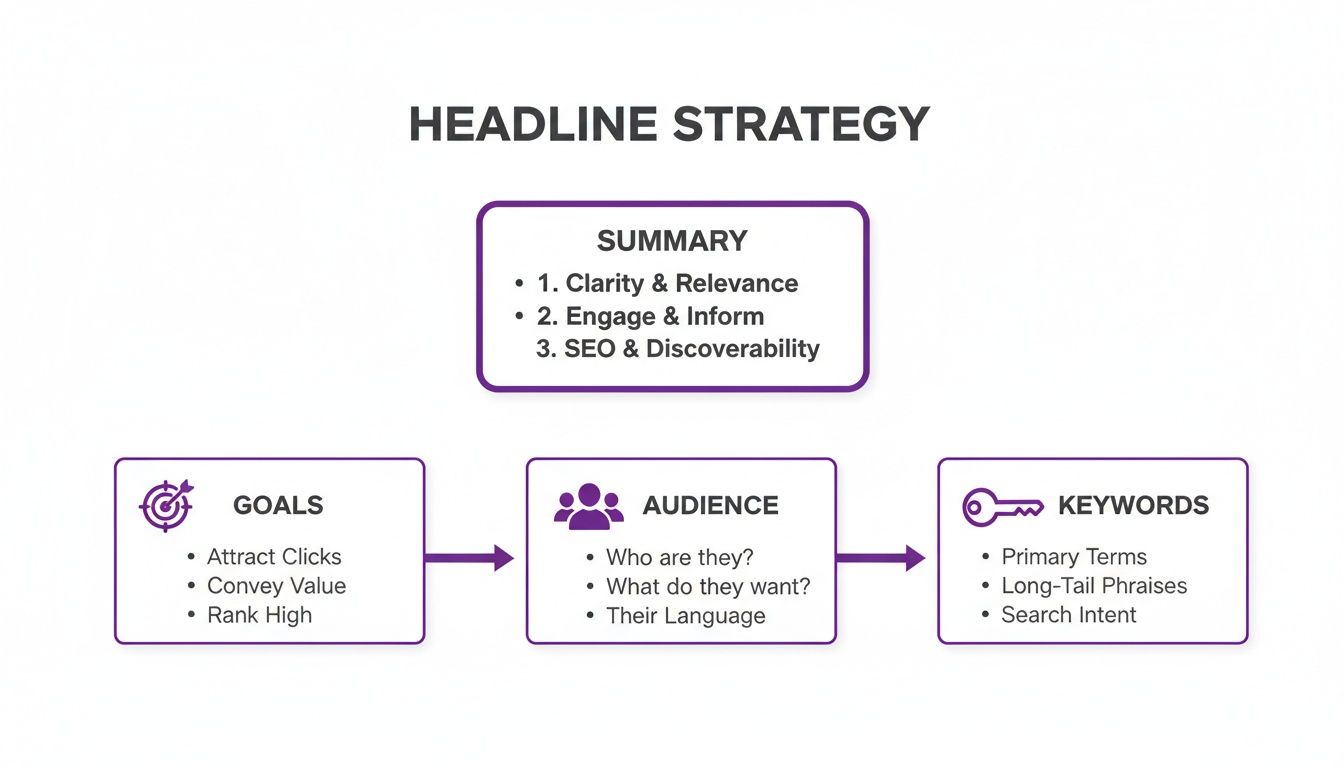
As you can see, it's all connected. Your goals, audience, and keywords have to work together. Getting this alignment right is what turns a boring job title into a magnet for the right kinds of opportunities.
The "Skill-Focused Expert" Formula
Here's another great one: the "Skill & Skill Expert | Outcome" formula. This is perfect for specialists, tech professionals, or anyone whose worth is tied to specific, in-demand abilities. It’s a powerful way to signal your ability right away.
Let's see it in action:
- Before: Software Developer
- Strong Example: Python & Machine Learning Expert | Building Scalable Data Solutions That Drive Business Decisions
This headline does so much more than just state a job. It puts high-value skills front and center and ties them directly to a business outcome ("Drive Business Decisions"). A recruiter searching for specific technical talent is going to notice this one immediately.
Other Proven Headline Formulas
The two formulas above are fantastic starting points, but they're not the only options. Different structures work better for different goals, whether you're a freelancer trying to attract clients or a founder building a brand. I've put together a quick comparison to give you a few more ideas.
Here's a breakdown of some other effective headline formulas I've seen work well.
LinkedIn Headline Formula Comparison
| Formula Type | Best For | Example |
|---|---|---|
| Role + Keyword String | Maximizing SEO and discovery for a specific role or industry. | Senior Product Manager |
| "I Help X Do Y" | Consultants, coaches, and freelancers who serve a clear niche. | I Help SaaS Founders Scale to $1M+ ARR with Paid Acquisition |
| Achievement-Focused | Professionals with impressive, quantifiable results to showcase. | Award-Winning Content Strategist |
| Mission & Title | Founders, executives, and mission-driven professionals. | Building the Future of Remote Work @ Outrank |
Don't be afraid to mix and match elements from these formulas. The goal is to find a structure that feels natural to you and effectively communicates your professional story.
A great headline is not just a label; it's a 220-character story about your professional identity and the worth you create. Choose a formula that tells your story most effectively.
Headline Examples for Different Professions
Alright, let's put theory into practice. Sometimes the best way to grasp what makes a LinkedIn headline click is to see a few great ones in the wild.
I've pulled together some examples for common fields, breaking down exactly what makes them effective and pointing out the classic mistakes I see all the time.
Pay attention to how each one weaves together the person's role, their specific skills, and the worth they bring to the table. They’re all designed to catch the eye of a particular audience using the language that audience understands.
For Developers and Engineers
If you're a developer, your tech stack is your secret weapon. Technical recruiters are not searching for "Software Developer"; they're searching for "React," "Node.js," or "Python." Your headline is prime real estate to get found.
- Strong Example: Senior Full-Stack Engineer | Building Scalable Web Applications with React & Node.js
- Why It Works: This is packed with the exact keywords recruiters are plugging into their searches. It does not just list technologies; "Building Scalable Web Applications" shows the impact and level of their work. It's a magnet for the right kind of opportunities.
- Common Mistake: Just putting "Software Developer at [Company]." This is a huge missed opportunity. You're forcing recruiters to dig through your entire profile to find out if you have the skills they need. Most will not bother.
And if you're active in open-source, that’s another layer of credibility to add. For instance, with our Upvote.club service, we see countless developers build a personal brand by showcasing their community contributions. You can learn more about promoting your projects with our GitHub community tools.
For Social Media Managers
For social media pros, the headline needs to do a delicate dance between creativity and business results. You have to show you can craft a great post and that you understand the strategy behind it.
- Strong Example: Social Media Strategist | Growing B2C Brands on TikTok & Instagram | Content Creation & Community Management
- Why It Works: It gets super specific. We know they focus on "B2C Brands" and master "TikTok & Instagram." This immediately tells a certain type of company, "This is your person." It also lists core, in-demand skills right upfront.
- Common Mistake: Fluffy titles like "Social Media Guru" or "Content Ninja." They sound fun, but they mean nothing to a hiring manager. Stick to professional language that clearly outlines what you actually do.
When you're in a creative field, your headline has to bridge the gap between your art and the bottom line. It needs to signal that you don’t just create—you create with purpose and for results.
For Content Creators and Strategists
As a content creator, your headline needs to scream strategy. It has to show you're not just a writer but a storyteller who understands the mechanics of SEO, lead generation, and conversions.
- Strong Example: Content Strategist & Storyteller | Creating SEO-Driven Content That Converts for SaaS Companies
- Why It Works: This is a masterclass in positioning. It’s loaded with power words like "SEO-Driven Content" and "Converts," but the real genius is naming a specific, high-value niche: "SaaS Companies." Any SaaS founder or marketing lead scrolling through LinkedIn is going to stop dead in their tracks.
- Common Mistake: A simple "Writer and Editor" title. This is a classic undersell. It ignores the strategic worth and the tangible business results that a top-tier content professional delivers.
Get More Eyes on Your New Headline
So, you’ve spent the time crafting the perfect LinkedIn headline. That’s a huge first step, but it's only half the battle. Now, you need people to actually see it.
Simply updating your profile and walking away won't cut it. You need to send signals to the LinkedIn algorithm that you're active and that your content is worth showing to people. This is where a little bit of strategy comes into play.
Think of it this way: when you publish a new post, the first hour is golden. The likes, comments, and shares you get in that initial window tell the algorithm your post is interesting. In return, it pushes your content out to a much wider audience, which naturally drives more traffic back to your shiny new profile.
Giving Your Posts That Initial Push
I've been there—you post something you're proud of, and it just… sits there. Crickets. It’s frustrating. That initial burst of engagement can feel impossible to get.
This is exactly why we built Upvote.club. We operate on a community-based model where you can create a task for your new LinkedIn post and get real likes and comments from other verified users in our community. This gives your content the momentum it needs during that "Golden Hour" to start gaining organic traction. Getting engagement in the first hour after posting is what influencer agencies use to boost their clients' content. We make this method accessible to everyone. You help others, and they help you.
It's a method that works wonders beyond just LinkedIn. Many of our users see the same kind of boost when they grow their Medium presence with community support, too.
A great headline gets people to click, but consistent, algorithm-friendly engagement is what gets your profile in front of them in the first place.
And getting in front of people is more competitive than ever. LinkedIn now has over 1.2 billion members, with 8.72 million job applications submitted every single day. Your headline is your first—and often only—chance to stand out.
While profiles with five or more skills get up to 17 times more views, it all starts with a headline that makes people want to learn more about those skills.
It also helps to get smart about how recruiters find you. Understanding how Applicant Tracking Systems work, including concepts like the ATS filter 90/10 rule, can give you a massive edge. It helps you tweak your entire profile, headline included, to sail through those automated filters and land in front of a real person.
Got More Questions About Your LinkedIn Headline? Let's Clear Them Up.
Even after you've tweaked and polished your headline, a few questions always seem to pop up. It makes sense—this is one of those areas where the tiny details can have a massive impact.
Let's walk through some of the most common questions I hear. Getting these right will help you avoid the classic mistakes that can accidentally weaken your professional brand.
How Often Should I Update My Headline?
Think of your LinkedIn headline less like a tattoo and more like your daily outfit. It needs to change with the seasons of your career. It is not a "set it and forget it" part of your profile.
My rule of thumb? Revisit it anytime something changes in your professional life.
You should be updating your headline when:
- You're officially on the job hunt. This is a key time. Your headline needs to pivot hard toward the roles you're targeting, loaded with all the right keywords.
- You get a promotion or a new gig. Do not let your headline lag behind your reality. Your new title and responsibilities need to be front and center.
- You earn a key skill or certification. Just finished your PMP? Become a certified AWS expert? That's prime real estate for your headline and a huge signal to recruiters.
- You're changing career paths. If you're moving from, say, marketing to product management, your headline has to lead the charge and start telling that new story immediately.
A stagnant headline can make you look like your career is standing still. Keeping it fresh shows you’re engaged, ambitious, and moving forward. It’s a small tweak with a huge payoff.
What Should My Headline Be if I Am Unemployed?
This is a big one, and I see people get it wrong all the time. The answer is simple: focus on the worth you offer, not your employment status.
Never waste those 220 characters on phrases like "Unemployed" or "Seeking new opportunities." I promise you, recruiters are not typing those words into their search bar. They’re searching for skills, titles, and abilities.
Your headline is your billboard. Keep it focused on your professional identity. For signaling your availability, use LinkedIn’s "Open to Work" feature. That’s exactly what it was designed for. The green photo frame tells recruiters you're available without you having to sacrifice your most valuable marketing space.
Here’s how to do it right when you're between roles:
- Senior Software Engineer | Building Scalable Backend Systems with Java & AWS
- Digital Marketing Manager | Driving Growth with SEO & Paid Media Strategy
- Corporate Controller (CPA) | Scaling Audit-Proof Accounting Functions
See the difference? These headlines are confident and packed with keywords. They tell a recruiter what you do, which is infinitely more powerful than telling them what you don't have.
Can a Good Headline Really Get Me Noticed by Recruiters?
Yes. A thousand times, yes. Your headline is one of the most heavily weighted fields in LinkedIn's search algorithm, right alongside your job title.
When a recruiter is looking for their next hire, the words in your headline are a massive factor in whether your profile even shows up in their search results. A keyword-optimized headline is what makes you discoverable in the first place.
Think about it from their side: Recruiters are scrolling through hundreds, if not thousands, of profiles a day. Your headline is their very first filter. It has to instantly scream, "Hey, I'm the person you're looking for!" A generic headline gets you scrolled past. A sharp, compelling one earns you that all-important profile click.
Once your profile is perfectly tuned and pulling in views, you need a way to keep that momentum going. With our Upvote.club service, we’ve created a community to give your LinkedIn posts that initial boost of engagement they need. When you register, you receive free points and task slots to get started. You can get genuine likes and comments from real people, which signals to the algorithm that your content is worth showing to a wider audience. This drives more traffic right back to your profile, making sure your killer new headline gets the visibility it deserves. Learn more about our community-driven LinkedIn engagement.