Table of Contents
- What Is a Social Media Algorithm?
- The Three Pillars of Algorithmic Curation
- Core Ranking Signals at a Glance
- The Universal Signals That All Algorithms Speak
- Engagement Signals: The Active Votes
- Relationship Signals: It’s About Who You Know
- Content Signals and Negative Feedback
- How Major Platform Algorithms Actually Differ
- TikTok: The Content-First Discovery Engine
- Instagram: A Multi-Algorithm Approach
- X (Formerly Twitter): The Conversation Catalyst
- LinkedIn: The Professional Relevancy Filter
- Platform Algorithm Priorities
- Why the First Hour of Engagement Is So Important
- The Shift to Algorithmic Feeds
- Making the Golden Hour Work for You
- Growing Safely With Community-Based Engagement
- Community Power Over Purchased Clicks
- A Secure and Transparent Process
- Busting Common Social Media Algorithm Myths
- The Algorithm Isn't Hiding Your Content
- Your Top Algorithm Questions, Answered
- How Fast Do Algorithms Judge My Content?
- Can I Reset How the Algorithm Sees My Account?
- Is a Service Like Upvote.club Actually Safe?
Ever wonder why your social media feed feels like it's reading your mind? You can thank the algorithm.
Simply put, a social media algorithm is the system platforms use to sort through the firehose of content and show you what it thinks you'll find most interesting. Instead of just a chronological list of everything, it curates a personalized feed based on who you interact with, what you've liked before, and what's happening right now. The whole point is to keep you scrolling longer by making your experience as relevant as possible.
What Is a Social Media Algorithm?

Think of the algorithm as your personal content DJ. Millions of posts, videos, and stories get published every single minute. It would be completely overwhelming to see everything from every account you follow. The algorithm’s job is to sift through that mountain of noise and predict what you, specifically, will want to see first.
This is a huge shift from the early days of social media. Back then, feeds were purely chronological—newest post at the top. But as these platforms exploded in popularity, that simple approach just didn't work anymore. Our feeds became cluttered and chaotic. This all changed when Facebook introduced its pioneering EdgeRank algorithm back in 2007, kicking off the algorithmic era we live in today.
The Three Pillars of Algorithmic Curation
Most modern algorithms, whether you're on Instagram, X, or TikTok, are built on three foundational pillars that work together to decide what you see.
Interest: The algorithm is constantly learning from your behavior. It looks at the topics and formats you've liked, commented on, or shared in the past. If you're always engaging with cooking videos, you can bet it will serve you more recipes.
Relationship: It's not just what you engage with, but who. The system prioritizes content from friends, family, and creators you interact with frequently. A post from your best friend will almost always rank higher than one from an account you follow but never engage with.
Timeliness: Freshness matters. Newer posts generally get a boost over older ones because the algorithm assumes you want to see what's happening now. This is true in the first few hours after something is published.
These factors explain why your feed is completely unique—it's a custom-built experience tailored to your habits. Grasping these basics is the first step in any real content strategy. For a deeper look into how this plays out on a specific platform, check out this guide on decoding the YouTube algorithm.
To make this crystal clear, here’s a quick breakdown of the core signals across most platforms.
Core Ranking Signals at a Glance
Algorithms are complex, but they all boil down to tracking specific user actions to measure interest. This table summarizes the main signals they're looking for.
| Signal Type | What It Measures | Example Action |
|---|---|---|
| Active Engagement | How much users interact directly with your post. | Likes, comments, shares, saves, clicks, replies |
| Passive Engagement | How much time users spend on your content. | Watch time, dwell time, looping a video, re-watching |
| Creator Signals | The authority and consistency of your account. | Posting frequency, niche relevance, follower engagement |
| Content Signals | Information about the post itself. | Keywords, hashtags, video transcripts, image recognition |
| Relationship Signals | The user’s connection to you. | How often they engage with you, mutual connections |
| Timeliness Signals | The recency of the post. | When it was published, current trend relevance |
Understanding these signals shows you what the algorithm values most: content that people genuinely connect with.
The primary goal of an algorithm isn't to hide your content; it's to keep users engaged by showing them what they are most likely to enjoy. Your job is to create content that sends the right signals.
And that's where our Upvote.club service comes in. We help you send those positive signals during that key initial window after you post. By joining our community, you get real engagement from real people, which tells the algorithm your content is interesting and deserves to be shown to a wider audience, building that all-important organic momentum.
The Universal Signals That All Algorithms Speak
Even though every platform has its own secret sauce, they all listen for the same fundamental signals to figure out what content is a hit. Think of it like a universal language for quality. If you can learn to speak it, you'll create content that the algorithms can't help but push to more people.
At the highest level, these signals fall into three big buckets. Each one tells the platform something different about how real humans are reacting to your content. Get these right, and you’ve got a solid foundation that works just about anywhere.
Engagement Signals: The Active Votes
Engagement signals are the most obvious way a user tells the algorithm, "Hey, I like this!" They're conscious, deliberate actions that show someone is paying attention. But not all engagement is created equal. Platforms weigh these actions differently based on how much effort they take.
Here's a quick rundown of the typical hierarchy, from weakest to strongest:
- Likes: The simple tap. It's the most basic form of approval, like a polite nod. Good to have, but it carries the least weight.
- Comments: This takes more thought than a simple like. A comment tells the algorithm your content was interesting enough to actually start a conversation.
- Shares/Reposts: Now we're talking. When someone shares your post, they're stamping their own name on it and showing it to their network. That's a massive vote of confidence.
- Saves: This might just be the king of all engagement signals. A save means your content is so good or entertaining that someone wants to come back to it again and again. It signals long-term value to the platform.
Getting a good mix of these signals—shares and saves in particular—is like shouting at the algorithm that you've just dropped something amazing. With our Upvote.club service, we help kickstart that initial wave of real engagement. You can set up tasks for genuine likes, comments, and reposts from real people in our community, sending all the right signals right when it counts the most.
Relationship Signals: It’s About Who You Know
At the end of the day, social media is social. The algorithms are built to reinforce connections by showing you more stuff from the people you already have a relationship with. The system is always watching how often you interact with certain accounts.
If a user frequently comments on your posts, replies to your stories, or DMs you, the algorithm learns that your account is important to them. What happens next? Your content gets bumped to the top of their feed. This creates a powerful feedback loop: the more they engage, the more they see your stuff, which encourages them to engage even more.
An algorithm doesn't just judge a single post; it's constantly measuring the strength of the relationship between your account and every single person who follows you. Consistent interaction builds algorithmic trust over time.
This is the social media algorithm in a nutshell: it prioritizes content from people you already have a bond with. That's why building a loyal, interactive community is just as important as trying to create one viral hit.
Content Signals and Negative Feedback
Finally, the algorithm actually looks at the content itself. It scans the keywords in your captions, the hashtags you use, and even analyzes the objects, faces, and text in your images and videos. Using relevant keywords helps the platform categorize your post and show it to people who have already shown interest in those topics.
But just as important are the negative signals. These are the actions people take when they don't like what they see:
- Hiding a post: A very direct signal that the content was irrelevant or just plain bad.
- Reporting content: This is a huge red flag for the algorithm.
- Scrolling past quickly: While it's more subtle, a user who always flies past your content without a second glance is teaching the algorithm that your posts aren't attention-grabbing.
Avoiding these negative signals is absolutely key. This is exactly why buying fake engagement is so dangerous—bot accounts don't build real relationships, and their artificial activity can eventually trigger these negative flags, tanking your reach. If you're serious about growing a real following, learn more about our approach to building real Instagram engagement the right way.
How Major Platform Algorithms Actually Differ
So, we know algorithms look for engagement, relationship, and content signals. But here’s where so many creators and marketers go wrong: they treat every platform like it's the same. A one-size-fits-all strategy just doesn't work.
Think of it this way: each social network has its own personality, its own goals. What works on TikTok might completely bomb on LinkedIn, and vice versa.
The key is to stop fighting the system and start understanding what each platform wants to see. If you can tailor your content to align with a platform's specific priorities, you're halfway to winning. Let’s break down the unique quirks of the big players.
TikTok: The Content-First Discovery Engine
TikTok's algorithm is legendary for one reason: discovery. It's built on a content graph, not a social graph. In plain English, that means the algorithm cares way more about the quality of your video than who you are or how many followers you have.
You don't need a huge following to get seen on TikTok. You just need to make a great video.
The platform's main goal is brutally simple: keep people on the app for as long as possible. To do that, its algorithm obsesses over these signals:
- Watch Time: How long do people actually watch your video?
- Completion Rate: What percentage of viewers stick around until the very end?
- Re-watches: Did someone watch your video again? This is a massive win and a huge positive signal.
Sure, likes, comments, and shares still matter, but they take a backseat to these core watch-time metrics. This is exactly why short, snappy videos that grab you in the first second and refuse to let go perform so well.
Looking to get a leg up? We've got a guide on how Upvote.club can help with TikTok growth by building those key early signals.
Instagram: A Multi-Algorithm Approach
Here’s a common misconception: people talk about the “Instagram algorithm” as if it’s one single entity. It’s not. Instagram uses several different algorithms, each one fine-tuned for a specific part of the app. How you get discovered on Reels is a totally different ballgame than how your content shows up in the main Feed or Stories.
- Feed and Stories: These are all about who you know. They prioritize content from accounts you already interact with—friends, family, and your favorite creators. Recency is also a huge factor here.
- Reels: This is Instagram's discovery engine, and it acts a lot like TikTok. It's designed to serve you entertaining, short-form videos from accounts you don't even follow, based on your viewing history.
- Explore Page: This is pure discovery. It’s a personalized mood board curated by the algorithm, showing you content it thinks you'll love based on what you’ve liked, saved, and commented on before.
To succeed on Instagram, you have to play multiple games at once. You need to nurture your existing community for the Feed and Stories while also creating broadly appealing videos for Reels.
The hierarchy of these signals generally looks something like this, with direct engagement usually being the most powerful signal you can send.
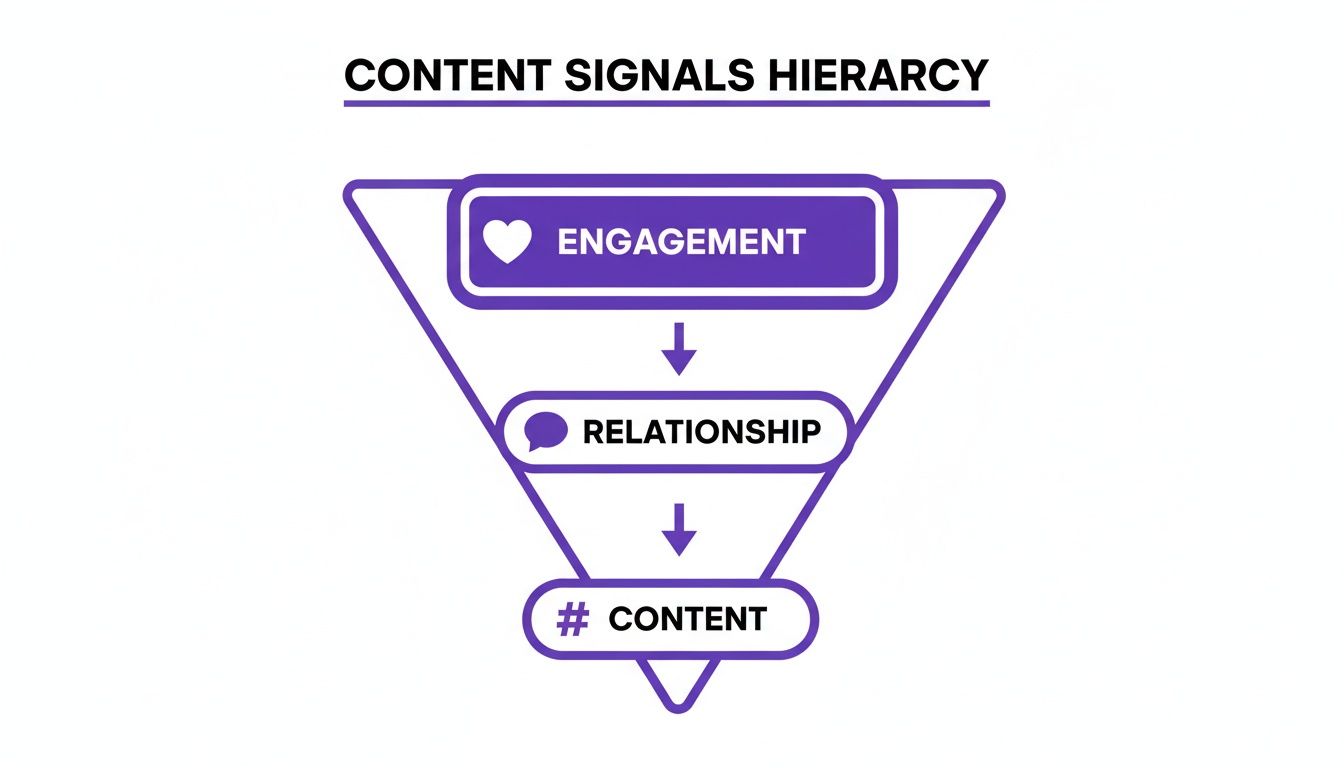
This just reinforces that active signals like comments and shares often carry more weight than passive ones like keywords.
X (Formerly Twitter): The Conversation Catalyst
The algorithm on X is all about one thing: sparking conversation in real-time. The "For You" feed is a mix of tweets from people you follow and stuff the algorithm thinks will get you talking.
If you want to win here, you need to get people to interact. The most powerful signals on X are actions that keep a conversation going:
- Replies: When people reply to your tweet, it tells the algorithm your content is worth discussing. This is huge.
- Quote Tweets: This is another powerful signal that your tweet was interesting enough to make someone add their own two cents.
- Likes and Reposts: These are still important, but they don't carry the same weight as actions that start a real dialogue.
Because X is so focused on what's happening right now, timeliness is everything. Breaking news, live events, and trending topics get a massive boost.
LinkedIn: The Professional Relevancy Filter
Forget viral entertainment. LinkedIn’s algorithm is a professional gatekeeper. Its job is to connect professionals with relevant industry content, job opportunities, and network updates.
The algorithm is looking for content that is:
- Niche-Specific: It scans for industry keywords to match your content with the right professional audience. Vague content gets buried.
- From Trusted Connections: Content from your direct connections gets priority, especially if you’re both active in the same field.
- Generates Thoughtful Comments: A long, insightful comment is worth far more than a hundred "great post!" replies. The algorithm can tell the difference.
The whole system is designed to surface content that helps people get better at their jobs. Low-quality, spammy, or overly promotional posts get demoted fast. The way to win on LinkedIn is to establish yourself as an authority within a specific professional community.
This table gives you a quick side-by-side look at what each platform is really after.
Platform Algorithm Priorities
| Platform | Primary Goal | Key Ranking Signals |
|---|---|---|
| TikTok | Maximize watch time | Watch time, completion rate, re-watches |
| User-specific engagement | Varies by surface (e.g., Reels favors watch time, Feed favors likes/comments from connections) | |
| X (Twitter) | Drive real-time conversation | Replies, quote tweets, recency |
| Surface professional value | Niche relevance, thoughtful comments, connection strength |
Understanding these fundamental differences is the first step. When you know what game you're playing on each platform, you can stop guessing and start creating content that's built to succeed from the ground up.
Why the First Hour of Engagement Is So Important

Think of every post you publish as having a short audition. Time decay is always ticking in the background, but not all minutes are created equal. The first 60 minutes after you hit “post” are, without a doubt, the most important window for your content's future.
In this initial period, algorithms are watching closely. What they're looking for is engagement velocity—basically, how fast your post starts racking up interactions.
A quick flurry of likes, comments, and shares sends a powerful message. It tells the platform, "Hey, this is timely, relevant, and people are loving it." In return, the algorithm is far more likely to push it out to a wider audience, moving beyond just your immediate followers and creating a snowball of visibility.
This initial test is what many in the industry call the "Golden Hour." If a post sits there with little to no traction early on, the algorithm often assumes it’s a dud and throttles its reach.
The Shift to Algorithmic Feeds
Why is this early momentum so vital? It’s a direct result of how social media has grown up. A decade ago, most feeds were simple and chronological. But as these platforms exploded with users, that model became a firehose of noise. There had to be a better way to sort through the chaos.
By 2016, the algorithmic feed was the new standard. Platforms like Instagram and Twitter made the switch to prioritize what they deemed most relevant, not just what was most recent. This was a seismic shift for creators. Just posting content wasn't enough anymore. You now had to win the algorithm's favor, and that meant getting that early traction.
Professional agencies have known this secret for years. They understand that a coordinated push from a core group right after posting can convince the algorithm that a piece of content is catching fire organically. It’s a battle-tested strategy for kickstarting growth.
Making the Golden Hour Work for You
So, how do you harness this? Success on social media really boils down to two things: creating great content consistently and getting immediate engagement on it. A good starting point is understanding when your audience is actually online and active. For a deeper look on how timing can make or break your reach, check out this guide on the best times to post on YouTube for maximum views.
This is exactly why we built Upvote.club. We wanted to give everyday creators the same kind of power to trigger that early engagement.
With our Upvote.club service, we help you get real people to engage with your content during that important Golden Hour, signaling to the algorithm that your post is worth showing to more people.
Here’s how we pull it off:
- Community-Based Interaction: Our Upvote.club service is not about buying engagement. It's about participating in a community where members help each other grow. You complete tasks to earn points, then use those points for your own content.
- Real Human Engagement: We are serious about keeping it real. We have added strict anti-bot moderation to our Upvote.club service, and our unique, password-free verification system ensures every like, comment, and share comes from a genuine, verified account.
- Earning Your Growth: With our Upvote.club service, you earn points by interacting with other members' content, which you then spend to create tasks for your own posts. It’s a self-sustaining cycle of real activity.
Imagine you've just joined. We give you free points to create your first task—maybe a few quick likes on a new tweet to get the ball rolling. By participating, you help others while earning the juice to boost your own content when it matters most. To see how this works for a specific platform, take a look at our guide on how to get more engagement on https://upvote.club/youtube.
At the end of the day, that first hour is your content's big shot. Give the algorithm strong, positive signals right out of the gate, and you dramatically increase its chances of being seen by the world.
Growing Safely With Community-Based Engagement

The pressure to get traction fast tempts a lot of creators to take shortcuts. The most common pitfall? Buying likes, followers, or comments. Trust me, this approach almost always backfires.
Social media algorithms are incredibly sophisticated now. They’re built to sniff out inauthentic activity from miles away.
When a platform spots engagement from bots or fake accounts, it can hit you with serious penalties. Your reach gets throttled, you might get shadowbanned, or in the worst-case scenario, your account gets suspended. These systems aren't just looking for obvious bots; they're analyzing behavior patterns that just don't feel human.
There’s a much smarter way to build momentum without risking your account. It all comes down to generating real activity from real people—the kind of genuine engagement that algorithms are designed to reward.
Community Power Over Purchased Clicks
This is where our approach at Upvote.club is fundamentally different. This isn't about buying engagement from some sketchy, anonymous source. It's about joining a real community of creators and professionals who are all helping each other grow the right way.
We run on a community-based model, meaning every single interaction comes from a real, verified person. Our moderation is incredibly strict, and we have a zero-tolerance policy for bots. This obsession with quality ensures every like, comment, or share you get is legitimate and sends all the right signals to the algorithms we've been talking about.
At Upvote.club, we don’t sell likes or followers. We provide a platform for a community to exchange real engagement, ensuring every action aligns with platform guidelines and contributes to healthy, organic growth.
The whole thing works on a simple points-based system. You earn points by completing tasks for other members—like dropping a thoughtful comment on their post or sharing a tweet. Then, you spend those points to create your own tasks, getting the community to engage with your content in return. It’s a give-and-take ecosystem.
A Secure and Transparent Process
Account security is our number one priority. We know you’re protective of your accounts, and you absolutely should be. That’s why we will never ask for your social media passwords.
To make sure every user is a real person, we developed a unique emoji-based verification system. It's a dead-simple, secure way to confirm you own your social accounts without ever handing over sensitive login details. Your accounts stay 100% secure and under your control.
Here’s a quick look at how it all works:
- You start with free points: When you register, we give you 13 free points and 2 task slots right out of the gate. You can use these immediately to create your first task, maybe to get a few likes on a new post.
- You earn by participating: To get more points, you just need to complete tasks for other users. This keeps the community fair and balanced—everyone contributes, and everyone benefits.
- You get free task slots daily: Every 24 hours, the system gives you another free task slot, so you can keep promoting your content consistently without spending a dime.
- You control your growth: You decide exactly what kind of engagement you need—whether it’s likes, comments, reposts, or saves—across platforms like Instagram, TikTok, LinkedIn, and more.
For creators who want to move a little faster, we do offer subscription plans that give you a bigger batch of points and task slots from day one. But even with the paid option, the core principle is the same: all engagement comes from real people inside the community.
If you’re trying to grow on a platform like Reddit, where community genuineness is everything, this approach is powerful. You can see it in action by learning more about our Reddit growth strategies. By focusing on real, community-driven interactions, you can safely build the momentum your content needs to break through.
Busting Common Social Media Algorithm Myths
Let's be real: there's a ton of bad advice out there about how social media algorithms work. Following it is a great way to spin your wheels and get nowhere. So, let's clear the air and bust a few of the most persistent myths so you can focus on what actually works.
One of the biggest I hear is, "posting too much hurts your reach." This isn't quite right. The algorithm doesn't punish you for frequency; it punishes you for posting junk that no one interacts with. If you post three amazing pieces of content, you'll get more reach than if you post one. If you post three duds, you'll tank. Consistency in quality is far more important than sheer volume.
Then there's the classic: "hashtags are the secret to going viral." While hashtags are definitely useful for categorizing your content and helping people find it, they're just one small piece of a much larger puzzle. An amazing post with zero hashtags will always outperform a terrible post stuffed with 30 trending tags. They help, but they won't save bad content.
The Algorithm Isn't Hiding Your Content
A lot of creators feel like the algorithm is actively working against them, a digital boogeyman hiding their posts from their own followers. This comes from a fundamental misunderstanding of what these systems are built to do. An algorithm’s one and only job is to keep users glued to the platform by showing them content they'll probably enjoy.
It’s not personal; it’s all predictive. If your content isn't getting much reach, it's usually because it didn't generate enough positive engagement signals early on to convince the system it's worth showing to a wider audience.
The algorithm isn’t a gatekeeper trying to block you. It’s a matchmaker trying to connect the right content with the right audience. Your job is to make that match as easy as possible.
This is precisely where a community-driven tool like Upvote.club comes into play. We make it incredibly simple to get that initial burst of genuine engagement from real people who are part of our club.
With our Upvote.club service, you can set up tasks for real likes, comments, and shares, which tells the algorithm that your content is high-quality right out of the gate. We help you send all the right signals during that key "Golden Hour," ensuring your posts get the attention they deserve. It's a community-based approach to growth that works with algorithms, not against them. We give you the tools to show the system your content is worth seeing.
Your Top Algorithm Questions, Answered
Even with a solid grasp of the basics, some specific questions always pop up. Let's tackle a few of the most common ones I hear to clear up how these systems really work day-to-day.
How Fast Do Algorithms Judge My Content?
That initial push is everything. The first few hours after you hit "publish" are absolutely key. Think of it as the algorithm's first impression—it's using those early engagement signals to decide if your content is even worth showing to a wider circle.
But the judgment call doesn't end there. A single viral hit is great for a temporary boost, but it's the steady drumbeat of quality content over weeks and months that truly builds your account's authority. Consistent quality is what teaches the system to trust you and give your future content a head start.
Can I Reset How the Algorithm Sees My Account?
You can, but it's less of a "hard reset" and more of a gradual retraining. If your content is consistently falling flat, it's a clear sign you're sending mixed or weak signals to the algorithm.
The fix? Get laser-focused. By narrowing down your niche and consistently creating content that gets strong, relevant engagement, you're essentially teaching the algorithm what you're really about. Over time, it will stop showing your posts to a random audience and start delivering them to people who are genuinely interested.
Is a Service Like Upvote.club Actually Safe?
Absolutely. We built Upvote.club with account safety as our number one priority. Because every single like, comment, and share comes from a real, verified person in our community, our methods are perfectly in line with what platforms want to see. They're trying to stop bots and fake activity, and so are we.
We'll never ask for your passwords or sensitive login details. Our unique emoji-based verification system confirms you own your account without ever putting it at risk. We've structured our entire community around generating genuine human engagement—which is the very thing algorithms are designed to find and reward.
Ready to stop guessing and start giving your content the authentic push it needs to get noticed? Join the Upvote.club community and begin sending the right signals to the algorithm today. Get real engagement from real people and watch your visibility grow. Check out our tools for Twitter (X.com) to get started.