Table of Contents
- What Social Media Engagement Services Really Are
- The line most sellers avoid
- Engagement service models compared
- Red flags you should treat seriously
- How A Community-Based Engagement System Works
- The engine is reciprocity
- Why this model fits how people actually use platforms
- What makes the model safer
- The part people underestimate
- The Golden Hour and Why Immediate Engagement Matters
- What the algorithm is looking for
- Fast engagement only works if the content format fits the platform
- How to use the Golden Hour without gaming yourself
- What this changes in practice
- A Checklist for Choosing a Safe Engagement Service
- The non-negotiables
- The long-term question matters more than the launch-day bump
- What I’d reject immediately
- What I’d approve
- Measuring Your Growth and Return on Investment
- Use the metric that reflects actual visibility
- What to measure after a campaign
- How to judge whether the service is helping
- Use Cases For Different Professionals
- The blogger pushing a fresh article
- The marketing manager launching a campaign asset
- The developer launching in public
- The B2B operator building authority on LinkedIn
- Frequently Asked Questions About Engagement Services
- Can my account get banned for using a social media engagement service
- Is this the same as buying likes
- How much work does it take
- Should I use it for every post
- What should I track after using one

Most advice about a social media engagement service is wrong because it treats all engagement as the same thing. It isn’t. A bot blast, a fake follower package, and a real person manually liking or commenting on a post are not the same action, not the same risk, and not the same signal.
That distinction matters more now because platforms are better at spotting junk patterns, while users are better at sniffing out empty numbers. If you want reach, clicks, replies, and actual momentum, you need a system built around real activity from real accounts. Anything else is vanity with a fuse attached.
I’ve spent enough time around growth teams to know what moves posts. Good content matters. Timing matters. Early interaction matters. And yes, organized engagement matters too. The smart question isn’t “Should I use a social media engagement service?” The smart question is “What kind of system am I stepping into?”
What Social Media Engagement Services Really Are
A social media engagement service is any tool, network, or platform that helps you get more actions on your content. Those actions can include likes, comments, reposts, saves, follows, and clicks.
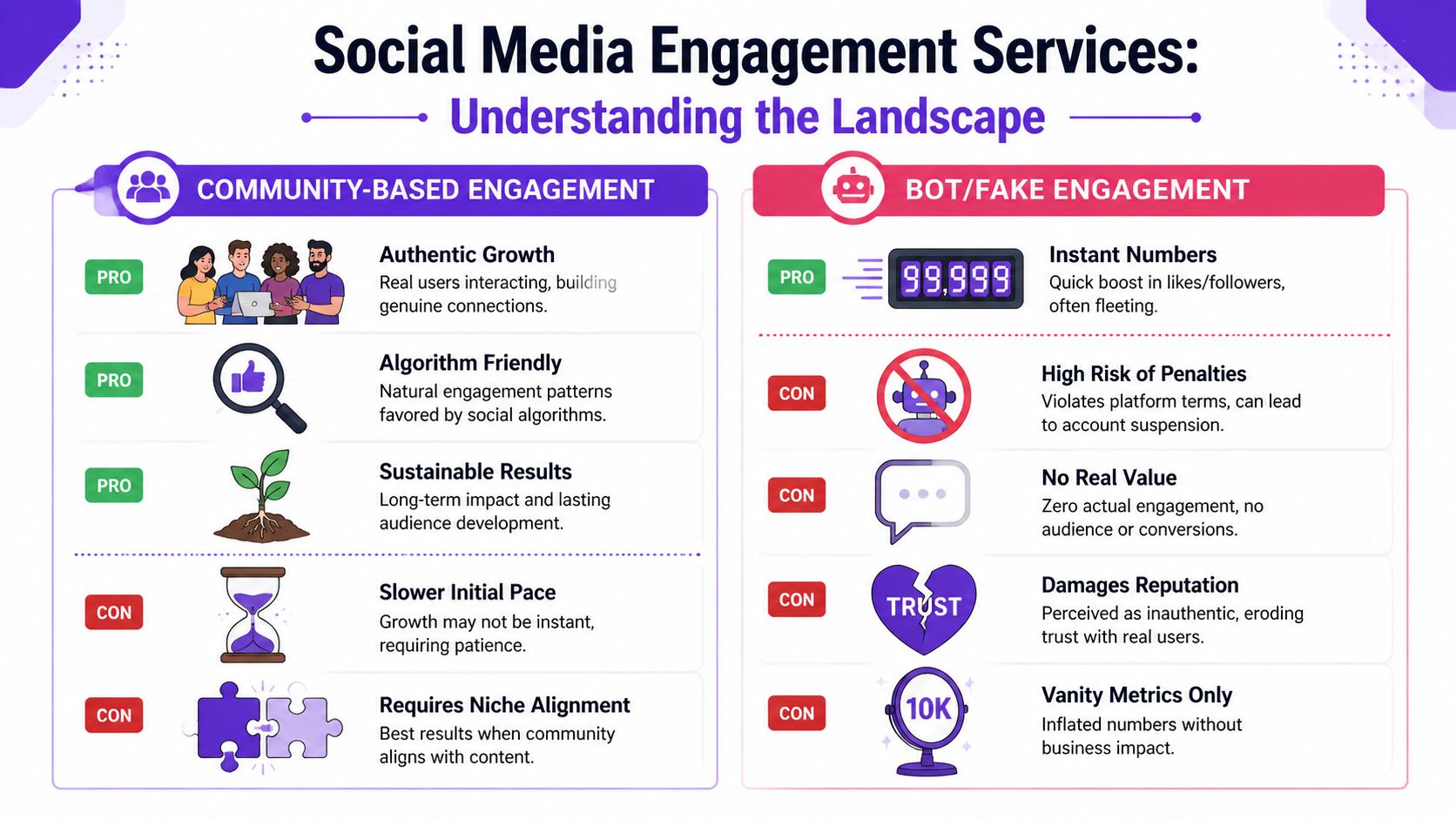
That broad label hides a hard truth. There are really only two models that matter. One is fake and risky. The other is human and structured.
The fake model sells numbers. You pay, your metrics jump, and nothing real happens underneath. No community. No real interest. No useful feedback. No dependable traffic. This is the junk drawer of social growth.
The other model works more like a participation network. People complete tasks for each other, accounts are checked, moderation matters, and the activity comes from humans rather than scripts. That’s a very different thing.
The line most sellers avoid
A lot of vendors blur the difference on purpose. They’ll talk about “growth,” “boosts,” or “promotion” while hiding how the interactions happen.
That’s where buyers get burned. The unresolved question in this market is still platform-specific safety and compliance. One of the big gaps in current guidance is exactly this issue: people want to know whether verified human engagement triggers flags differently from bots, and most content doesn’t answer it clearly, as noted in this review of social media growth strategy gaps.
If a service can’t explain where engagement comes from, assume the answer is bad.
Engagement service models compared
| Feature | Bot-Based Services | Community-Based Services (like Upvote.club) |
|---|---|---|
| How actions happen | Automated or low-quality fake activity | Manual activity from human users |
| Account trust | Weak. Often hidden behind vague claims | Stronger when users are verified and visible |
| Platform risk | High | Lower when activity patterns stay human |
| Business value | Mostly vanity metrics | Better fit for comments, saves, reposts, and real traction |
| Feedback quality | Empty | Useful, because real users are involved |
| Long-term use | Fragile | More practical if moderation is strict |
The smart way to judge a service is simple. Ask whether you are buying fake signals or joining a system where people help each other grow.
Practical rule: If the service sounds like a vending machine for likes, walk away.
Red flags you should treat seriously
You don’t need a forensic audit. You need a short list of deal-breakers.
- Password access: If a platform wants your social password, leave.
- Instant volume claims: If it promises a flood of engagement with no explanation, that’s a warning.
- No moderation language: Real communities need rules. Fake services don’t bother.
- No user accountability: If you can’t see who completed actions, there’s no trust layer.
- Single-metric obsession: If the whole pitch is just “more followers,” it’s shallow.
If you want a better framework for thinking about real participation and reply habits, this guide to social media community management strategies is worth reading because it focuses on how communities behave, not just how counters move.
On Instagram, that distinction matters a lot because shallow activity fades fast. If you’re evaluating a human-driven option for that platform, start by looking at a service built around actual participation rather than fake delivery, such as Instagram engagement tasks.
How A Community-Based Engagement System Works
Upon hearing “engagement service,” there’s often an assumption of hidden automation under the hood. In a real community model, there doesn’t need to be. The system works because users trade effort, attention, and timing.
That’s the part many marketers miss. The strength of this model isn’t mystery. It’s structure.

The engine is reciprocity
With our Upvote.club service, we built the system around a simple exchange. You help other members by completing tasks. You earn points. You spend those points to create your own tasks and get engagement on your posts from verified human accounts.
That changes the whole feel of the product. You’re not ordering fake activity from a warehouse. You’re participating in a network.
Here’s the basic flow:
You register and start with a small balance
We give new users 13 free points and 2 task slots so they can test the system without needing a password handoff or a big upfront commitment.You create a task
You can set up a request for likes, comments, reposts, saves, or followers, depending on the platform and the goal.You complete tasks for others
That earns points inside the system. Those points become your working currency.You verify accounts once per network
We use an emoji-based verification method, not password access. That matters because it keeps account control with the user.You repeat the cycle
Every time you contribute, you gain the ability to promote your own content again.
That loop is why community-based growth can keep working over time. It has a built-in reason for participation.
Why this model fits how people actually use platforms
The strongest engagement platforms tend to be the ones where people show up for actual interaction, not passive scrolling. That’s visible in platform-level performance. In 2025, LinkedIn had an average engagement rate of 6.50%, ahead of Facebook at 5.07% and TikTok at 4.86%, while Instagram dropped to 0.61%, according to Dreamgrow’s 2025 engagement data. The plain reading is that platforms built around more substantive interaction tend to produce stronger engagement.
That’s why a community system makes sense. It leans into the kind of behavior platforms already reward: actual people doing actual actions.
Communities beat shortcuts because they create patterns that look like real use. That’s what they are.
What makes the model safer
A real social media engagement service should reduce hidden risk, not add new risk while pretending to help.
With our Upvote.club service, we made a few choices for that reason:
- No password requirement: We don’t need direct account logins to run the system.
- Verified user participation: Users complete tasks from real accounts after verification.
- Transparent completion records: You can see who completed the task.
- Strict anti-bot moderation: Bad actors don’t get a free pass.
- Multi-platform support: The same community logic can work across Instagram, TikTok, YouTube, X, Facebook, LinkedIn, Reddit, Medium, Quora, Product Hunt, GitHub, and more.
The points system also keeps the product honest. If someone wants ongoing visibility, they need to stay active in the community or pay for additional features that expand task capacity and points. That creates a healthier exchange than the usual “pay once, disappear, and hope the fake numbers stick” model.
The part people underestimate
The best use of a community-driven service isn’t random promotion. It’s directed promotion. You use it when a post matters and timing matters.
A launch post. A product update. A thread. A hiring post. A carousel. A newsletter teaser. A Product Hunt push. A comment-worthy opinion.
That’s how professionals use organized engagement already. The only difference is that most creators have never had a clean system for it.
The Golden Hour and Why Immediate Engagement Matters
Algorithms don’t give every post equal treatment. They test. A post goes live, a slice of your audience sees it, and the platform watches what happens next.
That first response window is where posts either catch momentum or fade. Marketers call it the Golden Hour because early interactions help determine whether a platform keeps distributing the content.

What the algorithm is looking for
Platforms don’t care about your intent. They care about response.
If users like, comment, save, reply, or repost quickly, that’s a signal that the post deserves a wider audience. If nothing happens, distribution often stalls. That’s why weak launch timing can bury a perfectly good post.
Professional agencies have used this logic for years. They coordinate attention around publishing windows because they know delay kills reach.
Fast engagement only works if the content format fits the platform
At this point, lazy growth advice proves ineffective. There isn’t one magic format that wins everywhere.
In 2025, Instagram static image posts reached 6.2% engagement, while Reels came in at 3.5%, according to Zoomsphere’s engagement report. That should end the lazy “just post more video” advice. On some platforms and in some contexts, simpler formats do better.
So the right play is not “get engagement on anything.” The right play is “get early engagement on the right post format.”
How to use the Golden Hour without gaming yourself
You don’t need to turn every post into a campaign. You need discipline.
- Pick posts worth backing: Don’t waste organized engagement on filler updates.
- Match the action to the post: Saves for useful posts, comments for opinion posts, reposts for timely news, replies for threads.
- Post when you can respond: If people comment and you vanish, you waste the opening.
- Keep the landing point clean: If the post leads to a profile, article, or offer, make sure that next step is ready.
Early engagement is not a replacement for good content. It’s a distribution trigger for good content.
With our system, this tactic becomes usable for smaller creators and lean teams, not just agencies with private group chats. If your strategy includes conversation-heavy content on newer social surfaces, you can also look at tools built around reply-driven traction, such as Threads reply support.
What this changes in practice
A lot of creators post and pray. That’s not strategy. That’s hope.
A better system is simple. Publish intentionally. Have support ready. Get the first wave of interaction while the post is still being tested. Then stay active in the comments and keep the post alive. That combination gives your content a fair shot.
A Checklist for Choosing a Safe Engagement Service
Most buyers ask the wrong question first. They ask how fast the service works. Ask how the service works.
Speed without safety is a trap. A service can move your numbers and still damage your account quality, audience trust, and reporting.
The non-negotiables
Use this checklist before you give any platform your time or money.
No password access
If a service asks for your login, reject it. You should keep control of your account. A safer system verifies identity without taking credentials.Real user actions
Ask who is doing the engagement. If the answer is vague, that’s the answer. You want actions completed by real accounts, manually.Visible moderation
Every community attracts bad actors unless somebody is removing them. A platform should state its anti-bot and abuse rules clearly.Transparent task completion
You should be able to see who completed tasks or at least have clear accountability inside the system. Hidden activity is low-trust activity.Clear platform support
A real service should explain what actions it supports on each network instead of pretending every platform works the same way.
The long-term question matters more than the launch-day bump
One of the biggest gaps in the market is long-term measurement. There’s still a lack of guidance on sustaining authentic engagement after the first boost, and creators are right to question what sticks over time, as discussed in Digital Clarity Group’s analysis of long-term engagement gaps.
That’s why “it worked once” isn’t enough. You need a service with mechanics you can inspect.
Ask these questions before signing up:
- Can I tell how engagement is earned?
- Does the system depend on community participation or hidden delivery?
- Can I start small and test the workflow?
- Does it support repeated use without forcing shady behavior?
- Does it help me build habits around real posting and real response?
What I’d reject immediately
Some services fail the test in seconds.
A homepage full of giant promises and no process explanation. Packages that sell followers with no mention of where they come from. “Instant” delivery language everywhere. No mention of moderation. No mention of verification. No mention of account safety.
That’s enough to walk.
Buyer filter: If the platform hides the mechanism, the mechanism is probably the problem.
What I’d approve
I’d approve a service that works like a tool, not a magic trick. It should show the exchange model, protect credentials, and make user behavior visible enough to trust.
With our Upvote.club service, we built around that standard. We use emoji-based verification instead of password collection, we require participation from verified accounts, and we show who completes tasks. That doesn’t remove the need for common sense. It does give users a cleaner system than black-box engagement sellers.
If your main concern is X growth, evaluate whether the service explains its task model and user verification clearly before you use any Twitter follower growth tool.
Measuring Your Growth and Return on Investment
If you only watch follower count, you’ll fool yourself. Followers are a lagging signal. Reach can swing. Impressions fluctuate. What matters is whether people who saw the post did something useful.
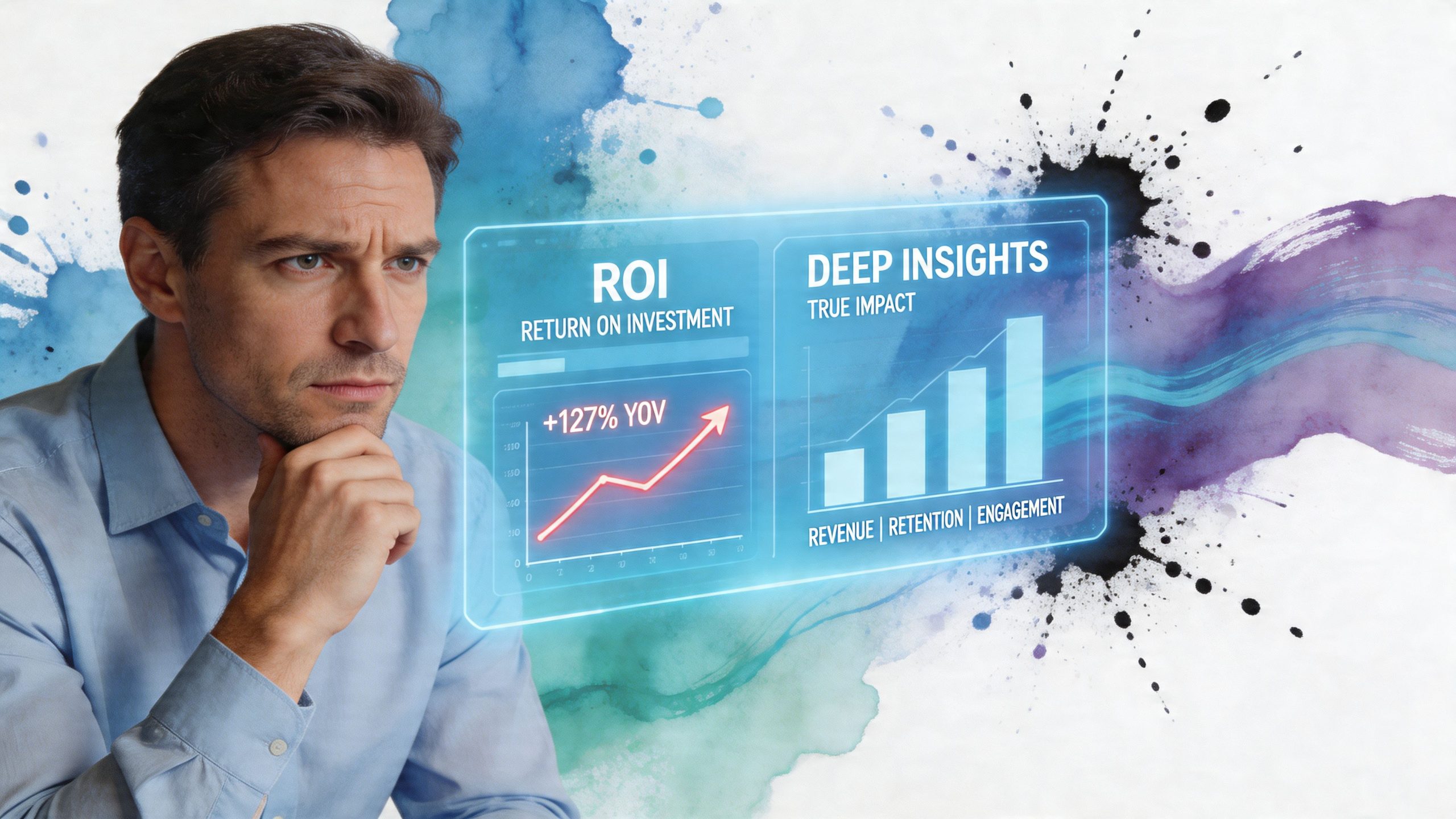
That’s why engagement rate per impressions is the metric I trust more than follower-based engagement rate.
Use the metric that reflects actual visibility
The formula is simple. Engagement rate per impressions = (Total Engagements / Total Impressions) × 100.
The University of Houston example shows why this matters. A post with 5,000 likes and 100 comments on 20,000 impressions has an engagement rate per impressions of 25.5%, while the follower-based version from 100,000 followers would be 5.1%. The impression-based number tells you much more about how the content performed with the people who saw it, as explained in this social media analytics guide.
That’s the benchmark to watch after any engagement push.
What to measure after a campaign
Don’t stop at one metric. Check the full chain.
| Metric | What it tells you | Where to look |
|---|---|---|
| Engagement rate per impressions | Whether viewers interacted | Native post analytics |
| Comments and reposts | Whether the post triggered conversation or distribution | Native platform analytics |
| Profile visits | Whether the post made people curious | Native profile analytics |
| Clicks | Whether attention turned into traffic | Native analytics and UTM tracking |
| Conversions | Whether traffic did anything useful | Analytics platform on your site |
If you’re trying to drive traffic, your post needs more than visible engagement. It needs click intent. That’s where stronger hooks, cleaner CTAs, and better landing pages matter.
How to judge whether the service is helping
Use a controlled approach.
- Pick a post type: For example, a LinkedIn document, an Instagram image, or an X thread.
- Track baseline performance: Note impressions, engagements, clicks, and profile visits.
- Run supported engagement on similar posts: Don’t compare a product launch to a casual meme.
- Check downstream behavior: Did more people click, follow, reply, or visit your site?
- Review quality, not just totals: Good comments and meaningful saves tell you more than hollow likes.
For marketers building a broader playbook, it helps to compare engagement support with other audience-building methods. This piece on systems for Instagram follower acquisition is useful because it forces you to think in channels and workflows instead of chasing one metric.
Transparency matters here. If you can see what tasks were completed and when, your measurement gets cleaner. That makes it easier to separate “the post was good” from “the post got organized support at the right time.”
Use Cases For Different Professionals
A social media engagement service is only useful if it fits real work. Here’s where a community model earns its keep.
The blogger pushing a fresh article
A blogger publishes a strong article and posts the link on X, LinkedIn, and Reddit. The problem isn’t the writing. The problem is dead air in the first wave.
With our Upvote.club service, that blogger can create tasks around the promo posts and get early likes, reposts, comments, or saves from real users. That gives the post an opening instead of letting it die on arrival.
The marketing manager launching a campaign asset
A marketing manager publishes a new brand video, carousel, or product explainer. They don’t need fake hype. They need the content to get seen, discussed, and carried into the next distribution cycle.
In that case, a community-driven system helps create the first layer of visible activity while the internal team handles paid media, comment replies, and reporting. If that manager is also planning content structure, this guide to SEO-optimized social media content is a practical companion because it connects social output to search intent and content planning.
The developer launching in public
Developers often need traction on channels that reward early community attention. Product Hunt, Reddit, X, GitHub updates, and LinkedIn posts all behave better when real users react quickly.
A developer can use community support to get those first interactions on launch posts, changelog drops, or feature announcements. That doesn’t replace product quality. It gives the announcement a fighting chance.
The B2B operator building authority on LinkedIn
LinkedIn behaves differently from entertainment-heavy platforms. People go there to react to opinions, documents, hiring posts, and practical takes from operators.
That makes it a natural place for structured engagement around useful content. If LinkedIn is central to your strategy, it makes sense to use a workflow built around LinkedIn promotion and interaction rather than treating it like just another feed.
Frequently Asked Questions About Engagement Services
Can my account get banned for using a social media engagement service
That depends on the model. Bot-driven systems create the most obvious risk because they rely on fake or automated behavior. A human-powered community is different because real users manually complete actions. Still, use judgment. Don’t chase absurd volume, and don’t use any service that hides how it works.
Is this the same as buying likes
No. Buying likes usually means paying for numbers with no real participation behind them. A community model works through reciprocal action. Users complete tasks, earn points, and then use those points for their own promotion.
How much work does it take
Enough that the system stays grounded in real participation. You can’t expect steady results if you never contribute. The tradeoff is simple: if people help each other, the network stays alive and less dependent on fake delivery methods.
Should I use it for every post
No. Use it on posts where timing matters. Launches, announcements, sales threads, article promotion, opinion posts, and content designed to start discussion make the most sense.
What should I track after using one
Track engagement rate per impressions, comments, reposts, profile visits, clicks, and conversions. If those numbers improve in a pattern that matches your campaign goals, the service is doing real work. If only the vanity metrics move, it isn’t.
If you want a cleaner alternative to fake engagement packages, try Upvote Club. We built it around verified human participation, visible task completion, strict anti-bot moderation, and a points system that lets users earn promotion by helping others. It’s a practical option for creators, marketers, developers, and teams that want real activity without handing over passwords.