
Ever heard of LinkedIn’s Social Selling Index, or SSI? Think of it as a report card for how you're doing on the platform. It’s a simple score from 0 to 100 that grades your effectiveness across four key areas of your professional activity online.
Basically, it's a benchmark for your personal brand, your networking game, how you engage with content, and the relationships you're building.
What The Social Selling Index Score Reveals
Don't let the "selling" part fool you. Your SSI score isn't just for sales teams. It's a key metric for anyone looking to build a strong professional presence—from marketers and developers to founders and creators. To really get it, you first need to understand what social selling truly entails.
LinkedIn calculates your score by looking at four core pillars. Each one is worth up to 25 points, adding up to your total score out of 100.
LinkedIn’s algorithm is constantly evaluating how well you perform in these four areas. Here's a quick breakdown of what each pillar means.
The Four Pillars Of The Social Selling Index
| Pillar | Description | Points |
|---|---|---|
| Establish your professional brand | This measures how complete and customer-centric your profile is. Think a great headshot, a compelling headline, and rich media in your "Featured" section. | 25 |
| Find the right people | This looks at how effectively you're using search tools to identify prospects and build your network with decision-makers. | 25 |
| Engage with insights | Are you sharing relevant content, creating conversations, and interacting with others' posts? This pillar tracks your content engagement. | 25 |
| Build relationships | This is all about nurturing your network. It tracks how you're connecting with senior-level people and strengthening those relationships over time. | 25 |
In short, a balanced performance across all four pillars is what gets you a high score.
This is what a typical SSI dashboard looks like. It gives you a clear snapshot of where you stand, breaking down your overall score so you can see your strengths and weaknesses at a glance.
Why Your Score Matters
So, why should you even care about this number? Because a higher score is directly tied to better professional outcomes.
It's not just a vanity metric. Sales pros with high SSI scores generate 45% more opportunities than their peers with lower scores. On top of that, they are 51% more likely to hit their sales quotas. That's a pretty clear link between a solid online presence and real-world results.
A high score is also a signal to LinkedIn's algorithm that you're an active, contributing member of the community. This can boost the visibility of your profile and your content in the feed.
One of the best ways to keep that score climbing is through consistent, genuine engagement. With our Upvote.club service, you can drive interaction from real people on your posts, giving them the initial push they need. You can learn more in our guide on how to grow your LinkedIn presence.
Deconstructing The Four Pillars Of Your SSI Score
Your Social Selling Index score isn't some random, mysterious number LinkedIn assigns you. Think of it more like a report card. It's calculated by grading your performance across four key areas, with each one contributing up to 25 points toward your total score.
Nailing these four pillars is how you boost your score. More importantly, it's how you make a real professional impact on the platform.
This concept map gives you a quick visual breakdown of how the four components come together to create your final score.
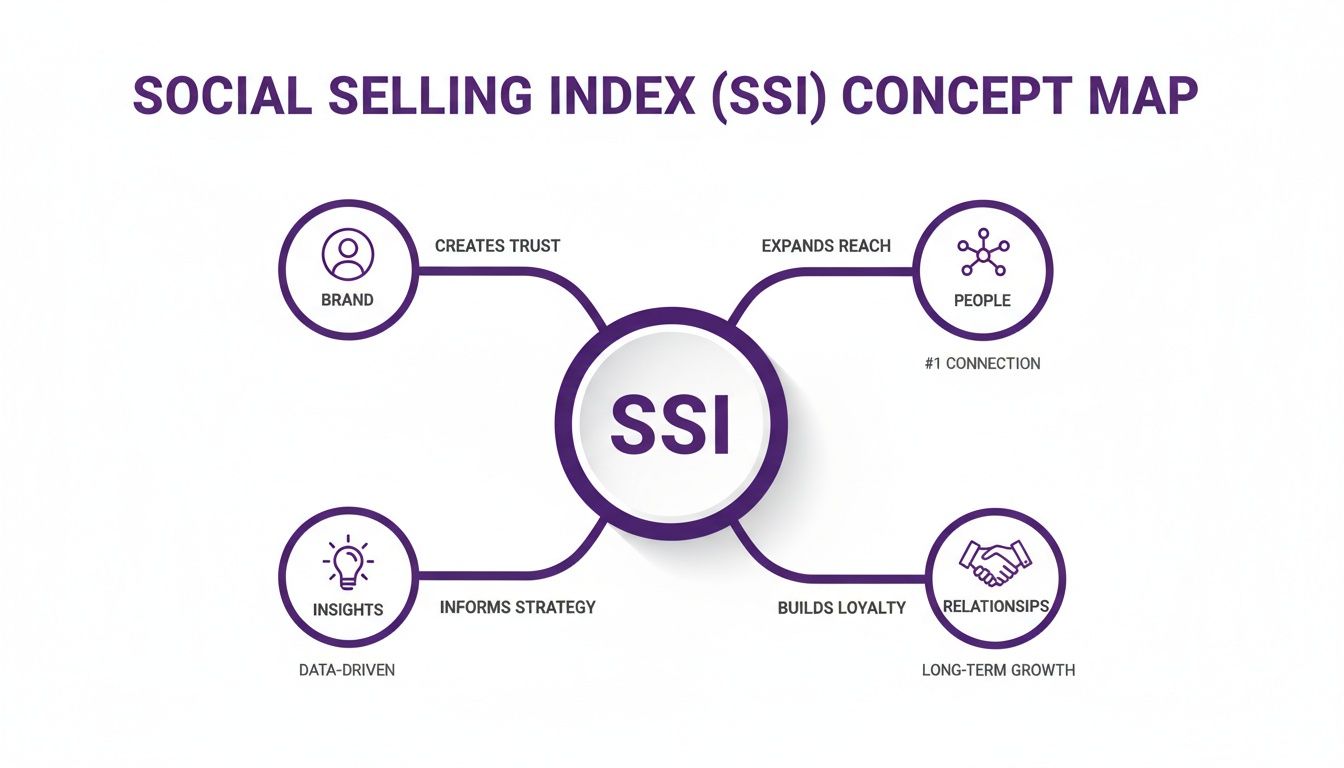
As you can see, a high SSI isn't about acing just one area. It’s the result of consistent, balanced effort across the board—building your brand, finding the right people, sharing good content, and actually nurturing your network.
Establish Your Professional Brand
This first pillar is all about how well your profile is set up to serve your audience. Are you just posting a digital resume, or are you creating a genuine resource hub for your network? A strong professional brand is built on a complete, customer-focused profile.
Your headline needs to do more than just state your job title; it should show the value you bring to the table. Your "About" section is your chance to tell a compelling story, and your "Featured" section should act as a portfolio, showing articles, projects, or media that prove you know your stuff.
Find The Right People
Mindlessly hitting the "Connect" button won't do you any favors here. This pillar grades your ability to strategically identify and connect with the right people—think decision-makers, industry peers, and potential clients. LinkedIn actually rewards you for using its search tools effectively to build a high-quality network.
It’s truly a case of quality over quantity. A smaller, highly engaged network of the right people is infinitely more powerful than a massive, disconnected one. This focused approach makes sure your content lands in front of an audience that actually cares.
Engage With Insights
This pillar is all about what you do on the platform. It’s a measure of your activity. Are you sharing relevant content? Are you jumping into discussions? Are you interacting with posts from others? Every time you share a great article, drop a thoughtful comment, or get engagement on your own content, you're boosting this part of your score.
Consistent activity signals to the algorithm that you're an active, contributing member of the LinkedIn community. This doesn't just bump up your SSI; it also dramatically increases the visibility of your profile and posts.
A huge part of engagement comes down to timing. That first hour after you post—often called the "Golden Hour"—is make-or-break. Early likes and comments tell the algorithm your post is solid and deserves to be shown to more people.
With our Upvote.club service, you can get that needed initial push from real, verified users. Our community-based model lets you create unlimited tasks to receive likes, comments, and reposts right inside that first hour. We made Upvote.club to help you get the early traction your content needs to take off.
Build Relationships
The final pillar is where you turn simple connections into meaningful relationships. This involves actively networking with senior-level individuals in your field and taking the time to nurture those connections. Things like your connection acceptance rate and the seniority of the people in your network are key factors here.
This isn't about collecting contacts like trading cards; it's about playing the long game. Building a strong, loyal following is also a massive signal of influence. If you're looking to really strengthen this pillar, we've got a detailed guide on how to get more LinkedIn followers that you'll find helpful.
How To Find And Interpret Your SSI Score
Alright, so where do you even find this magic number?
The good news is, LinkedIn doesn't hide it behind a paywall. You can check your Social Selling Index score for free, anytime, without needing a premium subscription. It's your personal scoreboard for how you're doing on the platform.
To get your score, just log into your LinkedIn account and head over to the official SSI dashboard. The page loads instantly with your personalized score, breaking down your performance across those four key pillars we just talked about.
You'll see a clean, visual breakdown of your total score and how you stack up in each area.
This little dashboard is very useful. It shows your total score out of 100, and then the individual 25-point scores for each pillar. This means you can spot your strengths and weaknesses in about three seconds flat.
Making Sense Of Your Score
Okay, you’ve got the number. Now what? Your SSI is way more than just a score; it's a direct reflection of your activity and how effectively you're using LinkedIn. Think of it less like a final grade and more like a compass—it shows you exactly where you stand and points you in the direction you need to go.
Generally, a higher score means you're doing things right. LinkedIn's own data suggests that social selling leaders—the people really succeeding—tend to have scores above 75.
Your score is updated daily, which is great because it means you're not stuck with a bad number for long. It reflects your activity over the past 90 days, so consistent, positive habits will start moving the needle pretty quickly. It's a responsive metric, which is exactly what you want for tracking your progress.
Interpreting Your Social Selling Index Score
To give you a clearer picture, here’s a quick breakdown of what the different score ranges typically mean. Think of it as a proficiency scale for your LinkedIn game.
| Score Range | Proficiency Level | What It Means |
|---|---|---|
| 0-25 | Beginner | You're just getting started. Your profile might be incomplete, your network small, and your activity low. Lots of room for growth here! |
| 26-50 | Developing | You've got the basics down but aren't consistently active. You might be strong in one or two areas but need to balance your efforts across all four pillars. |
| 51-75 | Proficient | You're actively using LinkedIn and seeing some results. You're likely engaging with content and building your network but can still refine your strategy for greater impact. |
| 76-100 | Expert | You are a top performer. You have a strong professional brand, a valuable network, and you're consistently engaging and building relationships. You're a social selling pro. |
Seeing your score in this context helps turn an abstract number into a tangible goal. If you're in the "Developing" range, you now know that focusing on a couple of weak pillars can push you into "Proficient."
Benchmarking Your Performance
One of the best parts of the SSI dashboard is that it doesn't just show your score in a vacuum. It gives you some much-needed context by stacking you up against others.
You'll see two key comparisons:
- People in Your Industry: This shows the average SSI for professionals in your field. It's a great way to see if you're keeping pace with, falling behind, or pulling ahead of your direct competition.
- People in Your Network: This is the average score of your connections. If your score is lagging here, it might be a sign you need to connect with more active, influential people in your space.
These benchmarks are gold for setting realistic goals. They turn that number into a concrete target. For example, if you see your "Engage with insights" score is dragging you down, you've found your starting line.
And that's where a little help can go a long way. Boosting engagement is one of the quickest ways to see your score jump. With our product, Upvote Club, you can get real likes and comments from a community of professionals. Our platform works differently from others because it's not about buying engagement—it's about participating in a community where users help each other grow. This kind of authentic interaction is exactly what the LinkedIn algorithm likes to see, giving that pillar—and your overall score—a serious lift.
So, How Do You Actually Improve Your Score?
Alright, knowing your Social Selling Index score is one thing, but making it go up is another. Let's get into the good stuff. Improving your score isn't about gaming the system or finding some secret shortcut. It's really about consistently doing the things that LinkedIn wants to see—the activities its algorithm is built to reward.
Think of your profile as a living, breathing resource for your network. Your goal is to network with a clear purpose and engage in a way that actually starts conversations. Each of the four pillars plays a part, and they all need attention. For your brand, it's about ditching the boring job title and writing a headline that shows value. For finding people, it means using LinkedIn's search tools to build a network of quality connections, not just racking up a huge number of random contacts.

Breaking Down Each Pillar for a Higher SSI Score
To see real movement in your score, you've got to work on all four areas at once. If you let one pillar slide, it can drag your whole score down, even if you’re doing well in the others. Here are some simple, concrete tactics you can start using today for each part of your score.
- Establish Your Professional Brand: Your profile is your digital handshake. Make sure you have a professional, high-quality headshot, a headline that’s focused on the benefits you provide, and a fully completed profile. Your "About" section should tell a compelling story, not just be a dry list of your achievements.
- Find the Right People: Dive into advanced search filters to pinpoint decision-makers, influencers, and peers in your field. Remember, a smaller, highly relevant network is way more powerful than a massive, disconnected one. The idea is to connect with people who will genuinely care about what you have to say.
The Magic of Consistent Engagement
Engagement is the absolute fuel for a high Social Selling Index score. Sharing good content and jumping into discussions shows you’re an active, plugged-in member of the LinkedIn community. This is where most people drop the ball, simply because it takes time and effort to do it day in and day out.
You've probably heard of the "Golden Hour"—that first hour after you post something. Early engagement tells the algorithm, "Hey, people like this!" and encourages it to show your content to a much wider audience.
Getting that initial burst of activity is a game-changer. It creates the momentum that can push a post far beyond your immediate circle, which directly juices up your 'Engage with Insights' and 'Build Relationships' scores.
This is exactly where our community can make a huge difference. With our Upvote Club service, you can get real likes and comments from real people during that critical first hour. Our platform operates on a community-based model where users help each other grow. You earn points by completing tasks for others, and then you use those points to create your own tasks for likes, comments, reposts, and more. It's a smart, sustainable way to build momentum and signal to the algorithm that your posts are the real deal.
Turning Connections into Relationships
Finally, that "Build Relationships" pillar is all about transforming your list of connections into a genuine community. This is so much more than just clicking "accept" on connection requests. It means liking and commenting on your network’s posts, congratulating them on work anniversaries, and having real one-on-one chats in DMs. Every single thoughtful interaction makes your network stronger and boosts your SSI score.
When you post something and get a few genuine comments, it’s like opening the door for more conversation. If you're looking for ways to get more of those meaningful discussions going, our guide on how to get more LinkedIn comments is packed with practical tips.
With Upvote.club, we help you kickstart those initial interactions with a community of verified, human accounts. When you register with us, you receive 13 free points and 2 task slots, enough to create your first task. We added this so you can see for yourself how a community-driven boost can support your growth without sharing passwords or risking your account.
Why A Strong SSI Score Matters For Every Professional
That term "Social Selling Index" can be a little misleading. The word "selling" makes it sound like it's a metric purely for salespeople, but that couldn't be further from the truth. A strong social selling index score is really a measure of your professional brand's health and reach, making it a vital number for marketers, developers, founders—anyone looking to build their career.
Think about it. For a developer, a high score can put you on the radar of top recruiters or bring in interesting freelance projects. For a marketer, it's proof you actually understand social platforms, which builds instant credibility with clients and bosses.

A Universal Metric For Career Growth
The activities LinkedIn measures for the SSI are just good professional habits. The four pillars—building a brand, finding the right people, engaging with insights, and building relationships—are universal ingredients for a successful career. A high SSI score is simply a reflection that you're doing these things well.
Let's break it down:
- A strong brand makes you easy to find and hard to forget.
- Targeted networking ensures you’re in the right conversations and seeing the right opportunities.
- Consistent engagement cements your reputation and authority in your industry.
- Building relationships creates a powerful network of collaborators, mentors, and advocates who have your back.
It’s about more than just a score; it’s a key piece of a modern B2B social media strategy. It’s a tangible measure of your digital influence.
Driving Engagement Across Platforms
While the SSI lives on LinkedIn, the principles behind it work everywhere. And let's be real, a strong personal brand isn't built on a single platform. That's where Upvote.club comes in. We’ve built our service as a community-driven way to get real engagement from real people across networks like Instagram, TikTok, YouTube, Twitter, Facebook, and more.
Getting that initial burst of genuine interaction is important for any platform's algorithm. With our system, you can create tasks for likes, comments, and even LinkedIn reposts to give your content the push it needs. You participate in the community, earn points, and then use those points to promote your own work. It's a sustainable cycle of growth that supports the very activities your SSI score is measuring, turning it into a reflection of a much broader and more powerful personal brand.
Got Questions About The Social Selling Index?
Alright, let's wrap this up by tackling some of the most common questions I hear about the Social Selling Index score. Getting these details straight will help you see the full picture of how this thing really works and what to expect as you start paying attention to it.
How Often Does The Social Selling Index Score Update?
Your SSI score isn't static; it updates daily. This is great because it means the work you put in today—tweaking your profile, making a few strategic connections, or jumping into some conversations—can show up in your score within 24 hours.
This daily feedback loop is one of the most useful things about the SSI. You don't have to wait weeks to figure out if your new content approach is hitting the mark. You can make small adjustments on the fly and see the impact almost immediately.
Do I Need A Paid Subscription To See My Score?
Nope. You absolutely do not need a premium subscription like Sales Navigator to check your SSI score. The Social Selling Index is a free tool that LinkedIn provides to every single member. You can pop over to the official SSI page anytime to see your score and the basic breakdown of the four pillars.
That said, a Sales Navigator subscription does unlock more detailed information and powerful tools that make improving your score much easier. Features like advanced lead searches and InMail credits are designed to support the exact activities that push your score higher.
Does A High Score Affect My Profile In Search Results?
This is the big one. While LinkedIn hasn't come out and officially said, "Your SSI score is a direct factor in our search algorithm," there's a very strong indirect link. Think about it: the very activities you need to do to get a high score are the same things the LinkedIn algorithm is designed to reward.
A complete, active, and engaging profile is just naturally going to show up more often in search results. Likewise, content that gets people talking is pushed to a wider audience. So, by working on your SSI, you're inherently making yourself more visible on the platform.
A high score is the result of behaving like a contributing member of the LinkedIn community. When you consistently focus on those four pillars, you’re sending all the right signals to the algorithm that your profile and your content are worth showing to more people.
That consistency piece is where it gets tricky for busy professionals. That’s why we built Upvote.club. It’s a community-driven growth service that helps you build real engagement without bots. In our community, you can create unlimited tasks to get likes, comments, and followers from other verified, human accounts. We designed it so you can earn points by completing tasks for others, then spend those points to get genuine interaction on your own content. It’s a sustainable way to build authentic interaction—no bots, no password sharing—and support your growth on LinkedIn and beyond.
Ready to get more eyes on your content and watch your professional presence grow? Join the Upvote.club community today and start earning real interaction from real people. Learn more at https://upvote.club/twitter.
More articles
alexeympw
Published December 26, 2025