Table of Contents
- What Is TikTok Engagement Rate
- Why it matters on TikTok
- The bigger context
- What Does “TikTok Rate” Mean?
- The Two Formulas for TikTok Engagement Rate
- Engagement rate by views
- Engagement rate by followers
- Which one should you use
- How to Check Your TikTok Engagement in Analytics
- What Is a Good TikTok Engagement Rate in 2026
- What the benchmark data shows
- How to judge your own number
- What a good number really means
- Don't treat the infographic as the law
- Is TikTok Engagement Rate Higher Than Instagram’s?
- Beyond Likes What Engagement Signals Matter Most
- The signal hierarchy in practice
- What this changes in your content strategy
- What Is the 3-Second Rule on TikTok?
- Why Is My TikTok Engagement So Low?
- How to Get Engagement That Helps Your Growth
- Build for the Golden Hour
- What doesn't work
- Use community momentum, not fake momentum
- A simple posting workflow
- Three Measurement Mistakes to Avoid
- Mistake one using one benchmark for every account
- Mistake two focusing only on follower-based ER
- Mistake three chasing likes and missing stronger signals
TikTok still forces a useful reality check on marketers. In one widely cited benchmark, the platform's average engagement rate was 2.50% in 2025, with smaller accounts under 100K followers reaching 7.50% and even accounts above 10M averaging 2.88%, according to Emplicit's TikTok engagement benchmarks. That changes how you should judge performance. A small account with tight audience fit can beat a giant account on interaction density.
Most advice on tiktok engagement rate stops at formulas. That's not enough. The metric only becomes useful when you know which formula you're using, which benchmark fits your account, and which actions help distribution on the For You Page.
What Is TikTok Engagement Rate
TikTok engagement rate is the percentage of people who interact with your content after they see it or after comparing those interactions to your follower base. The interactions usually include likes, comments, and shares. Some analyses also include saves.
A simple way to think about it is this. Views tell you who stopped. Engagement tells you who cared enough to do something.

Why it matters on TikTok
On TikTok, follower count isn't the main story. Distribution is heavily tied to the For You Page, which means one strong post can travel far beyond your current audience. That's why engagement rate matters more than vanity totals. A creator with a modest audience but strong response per post often has a healthier content engine than a large account with passive followers.
If you're trying to build that kind of response loop, tools built for TikTok community growth can support the early interaction side. But the metric itself still has to be read correctly.
Practical rule: Don't ask, “How many followers do I have?” Ask, “What percentage of people who saw this cared enough to react?”
The bigger context
TikTok's engagement profile has stayed unusually strong as the platform matured. Statista reported 5.77% in 2023 and 4.64% in 2024, showing a decline year over year, but still putting TikTok well ahead of typical benchmarks on older social platforms, according to Statista's TikTok content engagement data.
That's why tiktok engagement rate still matters. It's not just a reporting metric. It's one of the clearest signs that your creative is matching the audience TikTok is testing it with.
What Does “TikTok Rate” Mean?
In most marketing searches, TikTok rate means TikTok engagement rate: the share of viewers or followers who interact with a video. It is not the same as Creator Rewards payouts, RPM, or “how much TikTok pays” per thousand views.
If you are comparing creators or diagnosing content, stick to engagement rate formulas below. Monetization rates answer a different question and use different data.
The Two Formulas for TikTok Engagement Rate
TikTok engagement rate has two common formulas: engagement rate by views divides interactions by total views, while engagement rate by followers divides interactions by follower count. There isn't one official formula—the denominator changes the story. The view-based formula measures post performance; the follower-based formula measures audience activity.

Engagement rate by views
This formula tells you how compelling a specific piece of content was.
Formula
(likes + comments + shares) / views x 100
If a post gets:
- 200 likes
- 40 comments
- 20 shares
- 10,000 views
Then the total engagements are 260.
So the engagement rate by views is:
260 / 10,000 x 100 = 2.6%
This is usually the more useful formula for TikTok creative analysis because TikTok content can spread to lots of non-followers. Rival IQ reports a median engagement rate by view of 3.4% and a median engagement rate by follower of 1.73%, and that gap matters because view-based ER is more diagnostic of creative performance on a For You Page-driven platform, according to Rival IQ's guide to a good TikTok engagement rate.
Engagement rate by followers
This formula tells you how active your audience is relative to the size of your account.
Formula
(likes + comments + shares) / followers x 100
If that same post gets:
- 260 total engagements
- 15,000 followers
Then the engagement rate by followers is:
260 / 15,000 x 100 = 1.73%
That number may look lower than the view-based result, but it answers a different question. It shows how much of your owned audience is activating around your posts.
Which one should you use
Use both, but don't use them for the same decision.
| Formula | Best for | What it tells you |
|---|---|---|
| By views | Creative testing | Whether the post itself pulled reactions from viewers |
| By followers | Account health | Whether your audience is active relative to account size |
If you sell products through content, this distinction matters even more because reach and conversion often split across content discovery and audience trust. If you want a broader view of content measurement in commerce, HiveHQ has a useful guide to driving TikTok Shop growth that helps frame how post-level performance connects to business outcomes.
I usually track view-based ER for content decisions and follower-based ER for account trendlines. If your goal is more profile activity, traffic, and repeat interaction, getting TikTok followers through real interaction patterns makes more sense than obsessing over one isolated post.
How to Check Your TikTok Engagement in Analytics
TikTok does not show a ready-made “engagement rate” percentage on every account view. You calculate it from post stats: open the video, tap Analytics (or check analytics from the creator tools), then pull views, likes, comments, shares, and favorites/saves.
Use the views-based formula for that video, or average the last 10–20 posts if you want an account-level read. If a metric is missing on a specific post, leave it out of the numerator rather than guessing.
What Is a Good TikTok Engagement Rate in 2026
A “good” tiktok engagement rate depends on account size first, then niche, then format. That's why blanket advice fails. 5% can be strong for a larger account and only average for a small niche creator; 10% is often excellent outside nano/micro tiers; 20% is unusual at scale and usually means either a tiny, hyper-responsive audience or a short-lived spike—not a universal target.
A rate that looks average for a small creator could be hard to maintain for a huge account, and a number that looks weak in one niche may be normal in another. Always read the percentage against your follower tier and the formula you used (views vs followers).
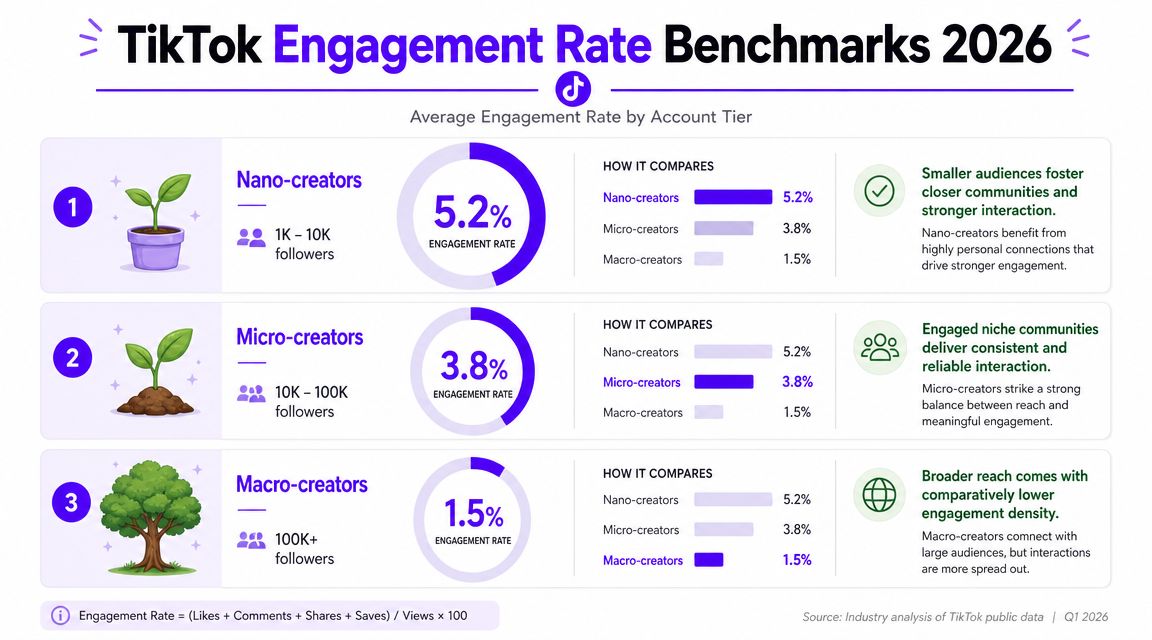
What the benchmark data shows
One widely cited 2025 benchmark put TikTok's average engagement rate at 2.50%, with a clear size effect across follower tiers, according to Emplicit's benchmark report.
The same dataset reported:
- Under 100K followers: 7.50%
- 100K to 500K followers: 5.10%
- 500K to 1M followers: 4.48%
- 1M to 5M followers: 3.76%
- 10M+ followers: 2.88%
That pattern matters more than the platform-wide average. TikTok tends to reward audience fit and content relevance more than brute audience size. Smaller communities usually react more quickly, comment more naturally, and share content that feels specific to them.
Small accounts shouldn't compare themselves to celebrity accounts. The benchmark already shows they play under different conditions.
How to judge your own number
Judge your engagement rate by matching your account size first, your niche second, and your post format third. These factors determine which benchmark provides a meaningful comparison.
Use this order:
Match your account size first
If you're under 100K followers, comparing yourself to mega-creators will distort your expectations.Check your niche next
Some niches naturally generate more response because the audience is tighter and the content is more identity-driven.Look at post format
A fast reaction clip, an explainer, and a story-based post won't produce the same interaction pattern.
What a good number really means
A good tiktok engagement rate isn't just “high.” It means your content is earning enough action from the right viewers to justify broader distribution. For smaller creators, the benchmark is encouraging because it shows you don't need millions of followers to perform well. In practice, many growth spurts start when a creator stops chasing broad appeal and starts making videos for a narrower, more responsive group.
That's also why account size can be misleading. A large audience can produce weaker percentages if viewers are passive or the content is too broad. A smaller account can post something tightly targeted and get a stronger response because the audience understands it immediately.
Don't treat the infographic as the law
The infographic above is useful as a quick visual reference, but your real benchmark should come from repeated post patterns. One strong post can spike. One weak post can drag. What matters is whether your recent videos keep landing within a healthy range for your size and format.
Is TikTok Engagement Rate Higher Than Instagram’s?
Yes in most public benchmark sets: TikTok’s average engagement rate usually lands well above Instagram’s, often by several percentage points depending on the study and whether the denominator is views or followers.
That gap does not mean every TikTok post “wins.” TikTok’s For You Page pushes content to non-followers, so view-based ER is the fairer cross-check. Instagram reporting is still often follower-centric, so comparing raw percentages without matching the formula will mislead you.
Beyond Likes What Engagement Signals Matter Most
A high tiktok engagement rate can still mislead you. The platform doesn't treat every interaction the same, and it doesn't use engagement as the only decision point. Completion rate, watch time, and rewatches usually matter before likes do.
TikTok's algorithm is heavily influenced by watch time, completion rate, and rewatch behavior, while likes, comments, and shares act more like downstream signals, according to this breakdown of how to actually improve TikTok engagement rate. That means a post can show a decent interaction rate and still stall if viewers leave early.
The signal hierarchy in practice
TikTok's practical signal hierarchy starts with retention signals such as watch time, completion, and rewatches. Shares and saves indicate stronger intent, meaningful comments support conversation, and likes provide the weakest signal on their own.
I group TikTok signals like this:
Retention signals
Watch time, completion, and rewatches tell TikTok that viewers didn't just notice the video. They stayed.High-intent actions
Shares and saves usually indicate stronger value. A share says, “someone else should see this.” A save says, “I may come back to this.”Conversation actions
Comments can help, but comment quality matters more than random low-effort prompts.Low-friction actions
Likes are useful, but they're the easiest action to give and the weakest signal on their own.
What this changes in your content strategy
A lot of creators chase visible engagement and ignore the first seconds of the video. That's backwards. If the hook is weak, the algorithm never gets enough retention data to justify more reach.
A post with fewer likes but stronger retention often beats a post with more likes and poor hold time.
Here's the simple test I use:
| Signal type | What to ask |
|---|---|
| Hook | Did the first second tell people why to stay? |
| Retention | Did viewers keep watching or swipe? |
| Action | Did they share, save, or comment with intent? |
If you want more comments, ask better questions. If you want more shares, make content people would send to a friend. If you want more saves, publish reference-style videos people may revisit. And if you want comments that don't look empty, directing people toward TikTok comments from real users fits the platform better than spammy CTA bait.
What Is the 3-Second Rule on TikTok?
The 3-second rule is a practical hook test: if the first one to three seconds do not tell viewers what the video is about and why they should stay, many people swipe—and your engagement rate never gets a fair chance.
Retention comes before likes. A cleaner opening topic, a visible payoff, or an immediate question usually beats a slow setup, even when the rest of the video is strong.
Why Is My TikTok Engagement So Low?
Low TikTok engagement usually comes from a weak hook, poor hold time, a mismatched benchmark, or an audience that is not a fit for the topic—not from one missing hashtag.
Check the sequence: Did viewers stay past the first seconds? Did anyone share or save, or only like? Are you judging a view-based result with a follower-based benchmark (or the reverse)? Fix retention and targeting first; then support early real interaction during the first hour after posting.
How to Get Engagement That Helps Your Growth
The first hour after posting still matters more than most creators admit. If a post gets ignored early, TikTok has less evidence that the content deserves wider testing. If the post gets quick, relevant interaction and holds attention, it has a better shot at reaching beyond your current audience.

Build for the Golden Hour
Build for the Golden Hour by making the topic clear immediately, prompting a meaningful response, replying while the post is active, and designing useful content that earns saves or shares. The goal is not maximum interaction but strong early signals from genuinely interested viewers.
Here's what usually works:
Start with a clean hook
The opening frame should make the topic obvious fast. Don't hide the point.Give viewers a reason to act
Ask for a comparison, an opinion, or a choice. Weak prompts attract weak comments.Reply while the post is warm
Early replies help keep the comment thread active and make the post feel alive.Aim for saves and shares when the format fits
Tutorials, checklists, product demos, and before-after clips tend to earn stronger revisit behavior.
What doesn't work
Generic engagement bait, overloaded captions, posting without follow-up, and bot traffic do not create dependable TikTok growth. They may inflate visible activity, but they rarely improve retention, meaningful interaction, or trusted distribution signals.
- Generic engagement bait like “comment yes if you agree” often creates low-quality responses.
- Overloaded captions pull attention away from the video itself.
- Random posting without follow-up wastes the strongest response window.
- Bot traffic may inflate numbers but won't create the kind of interaction pattern TikTok can trust.
If you want another creator-side perspective on content mechanics, Aicut has a useful post on how to skyrocket your TikTok growth with Aicut. It's worth reading alongside your own post analytics so you can separate generic advice from what your audience responds to.
Use community momentum, not fake momentum
I'd place one practical tool in the stack right here. With our Upvote.club service, you can create tasks for likes, comments, saves, and followers from verified human accounts, not bots. The model is community-based. Users earn points by completing tasks for others, unlock streak-style rewards as they complete bonus tasks, and can invite friends for extra points. We also use strict moderation and don't require passwords because account verification uses an emoji-based system instead.
That setup matters because the goal isn't to buy empty numbers. It's to participate in a network where real people interact during the period that matters most. New users get 13 free points and 2 task slots, which is enough to start testing whether an early engagement push improves post traction. If your TikTok content naturally gets bookmarked or revisited, using TikTok save tasks can fit better than pushing for likes alone.
A quick walkthrough helps here:
A simple posting workflow
A simple TikTok workflow is to publish when you can remain active, monitor the first response pattern, support the post during its first hour, and review retention, saves, shares, and meaningful comments instead of relying on likes alone.
Post when you can stay active after publishing
Don't schedule and disappear.Watch the first response pattern
Ignore vanity totals. Check whether viewers stay, comment with intent, and share.Support the post during the first hour
Reply, pin a useful comment, and keep the thread moving.Review saves and shares, not just likes
Those actions often tell you more about lasting value.
The creators who win on TikTok usually aren't using one trick. They're combining better hooks, tighter audience targeting, and stronger early interaction.
Three Measurement Mistakes to Avoid
The fastest way to misread tiktok engagement rate is to compare the wrong numbers, use the wrong formula, or reward the wrong behavior. I see all three constantly.
Mistake one using one benchmark for every account
Public benchmark posts often push one universal target, but performance varies by category. In one benchmark set, higher education reached 7.36%, which shows how misleading it is to compare a niche account, a B2B explainer, and a meme page using the same standard, according to Shortimize's analysis of good TikTok engagement rates.
The fix is simple. Benchmark by account size and niche first. If your content category naturally produces slower interaction, don't judge it by entertainment-style norms.
Mistake two focusing only on follower-based ER
Follower-based ER matters, but it can hide what's happening on TikTok because so much discovery happens outside your follower base. A post can perform well with non-followers and still look average if you only compare engagement to total followers.
Use follower-based ER for account trendlines. Use view-based ER when judging whether the post itself worked.
Mistake three chasing likes and missing stronger signals
Likes are visible, so teams overweight them. That often leads to weak creative decisions. You end up making content that gets a quick tap instead of content that holds attention, gets shared, or gets saved.
If the post earns likes but viewers leave fast, the content didn't really win.
For teams that need a broader framework for reporting up to managers or clients, Sift AI's piece on social media measurement for leaders is a useful reference for organizing platform metrics into decisions, not just dashboards.
The right correction is to review metrics in this order: retention first, then shares and saves, then comment quality, then likes.
If you want a practical way to support your posts during the window that matters most, try Upvote Club. It's a community-based system where members complete tasks for each other using verified real accounts, so you can build likes, comments, saves, and followers across TikTok and other platforms without bots or password sharing.