Table of Contents
- What Are Twitch Viewer Bots
- Why people get tempted
- This isn't a small side issue
- What they actually do to your stream
- The Underground Economy of Fake Viewers
- What sellers are actually offering
- How the backend works
- Why people keep buying anyway
- How Twitch Detects and Penalizes Botting
- What Twitch looks at
- The easy bots versus the expensive bots
- What penalties look like
- Why this matters beyond compliance
- The Real Dangers of Using Viewer Bots
- Bad data leads to bad decisions
- Real viewers can tell when something is off
- Bots hide your actual problems
- The Sustainable Path to Real Channel Growth
- What real growth actually needs
- Why community-driven engagement works better
- How the workflow stays human
- What to do this week instead of buying bots
- How to Spot and Report Viewer Bots
- Red flags worth watching
- How to report it on Twitch
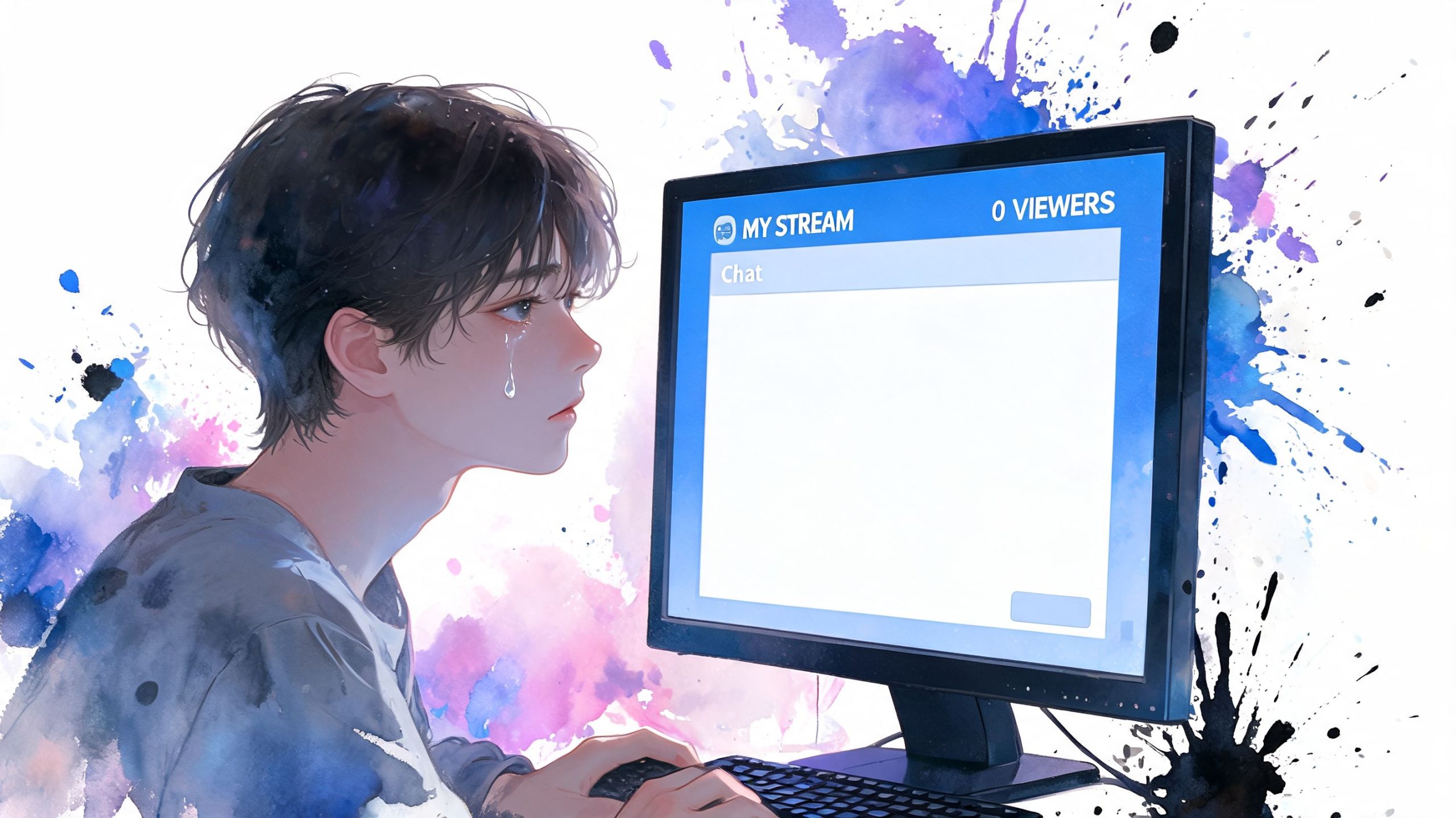
You go live. Your mic is fine, your overlay looks decent, and you've spent hours getting the stream ready. Then you stare at the same thing a lot of new streamers stare at: almost nobody in chat and barely any viewers.
That's where viewer bots twitch searches usually start. Not from greed. From frustration.
The pitch sounds simple. Add viewers, look active, climb the category, get discovered faster. I've watched people try it, and the pattern is always the same. The numbers look better for a moment, but the channel gets weaker where it matters: trust, data, reach, and real community.
What Are Twitch Viewer Bots
A Twitch viewer bot is an automated account or script that inflates your live viewer count. It's fake audience padding. The easiest way to think about it is this: you're not filling a room with fans, you're filling seats with mannequins.
That matters because Twitch doesn't reward empty noise forever. A stream with fake numbers can look alive from a distance, but the moment you check chat, behavior, and retention, the gap shows.
Why people get tempted
Most streamers don't start by asking how to cheat. They ask how to stop being invisible.
A stream with low activity can feel dead even when the content is solid. That creates a strong pull toward anything that promises instant movement. Viewer bots sell the idea that numbers alone will fix discoverability.
They don't.
Practical rule: If a tactic improves your count but gives you no real conversations, no feedback, and no repeat viewers you can name, it isn't growth.
This isn't a small side issue
The scale of botting on Twitch is hard to ignore. The Bots category has logged over 1,000 hours watched, with an average of 12 viewers and a peak of 850 viewers so far this year, according to SullyGnome's Bots category stats. Live tracking cited in the verified data also reported 159,010 live viewers across 2 live channels in that category.
That doesn't describe healthy audience behavior. It shows how visible fake traffic has become.
Here's what viewer bots usually try to simulate:
- Fake watchers who sit in the channel and inflate the live number
- Fake chatters that post repetitive or templated messages
- Fake followers added to make the channel look established
Some are crude. Some are much harder to spot at a glance. But the core idea is the same. They exist to create the appearance of demand.
What they actually do to your stream
A healthy stream has messy signals. Real people come and go at uneven times. Some lurk. Some chat. Some tab out and return. Human behavior has variation.
Bots flatten that mess into a pattern. Even when the numbers go up, the stream often feels oddly empty. You see a count that says one thing and a room that feels like another.
That's why the viewer bots twitch problem isn't just a rule-breaking issue. It creates a false feedback loop. You start making decisions around fake demand, and your channel drifts away from what actual viewers want.
The Underground Economy of Fake Viewers
There's a real market behind this. Not a rumor. Not some hidden corner only a few people know about. Bot sellers package fake attention like a subscription service.
The reason this market exists is obvious. Twitch rewards momentum. If a streamer thinks bigger numbers can push them into better placement, social proof, or a stronger first impression, they start looking for shortcuts.

What sellers are actually offering
A verified investigative analysis from 2023 described one package at $180 weekly for 1,500 followers, 225 chatters, and 750 concurrent viewers, with AI-driven accounts built to appear more real, as detailed in this investigation on Twitch bot pricing.
That pricing tells you a lot. This isn't framed as a prank tool. It's sold as a growth product.
The sales pitch usually rests on three emotional triggers:
| Trigger | What the seller promises | What the buyer hopes happens |
|---|---|---|
| Social proof | A busy-looking stream | New visitors stay longer |
| Category movement | Higher visible CCV | Better discoverability |
| Faster channel progress | More activity around the account | Quicker path to platform milestones |
The problem is that fake attention doesn't carry the second layer that real growth needs. Real people click, react, chat, return, and tell others. Bots only imitate the shell.
How the backend works
At the technical level, better bot services try to avoid obvious patterns. They use rotating infrastructure, spread traffic across different connections, and try to make each account look less identical than the cheap versions.
That's why some channels don't look instantly fake. The better services know what streamers are afraid of. They know buyers want plausible traffic, not a cartoon spike.
What sellers are really selling is cover. They're trying to make the fake audience pass the first glance test.
- Proxy-based distribution makes traffic appear less concentrated
- Staggered joins try to avoid a sudden flood at stream start
- Behavior simulation attempts to copy simple viewer actions
- Chat scripts make channels look less silent than they are
If you work in content or publishing, this same temptation shows up in other places too. A good example is affiliate publishing, where short-term tricks can hurt long-term trust. This guide on Monetizing your blog through affiliates is worth reading because it focuses on building actual value instead of dressing up weak performance with surface metrics.
There's also a wider pattern across social platforms. Some people start with Twitch bots, then look for similar shortcuts elsewhere, such as TikTok follower packages and growth offers. The platform changes, but the mistake stays the same: chasing the metric instead of the audience.
If a service can sell you a crowd on command, that crowd doesn't belong to you. It belongs to the seller.
Why people keep buying anyway
Because the fake version of progress is emotionally convincing. A higher viewer count feels like movement. It gives the streamer relief for a night or two.
But purchased attention creates dependency fast. Once a creator gets used to inflated numbers, streaming without them feels worse than before. That's when the bot service stops looking like a boost and starts looking like rent.
How Twitch Detects and Penalizes Botting
The question many ask isn't whether bots are fake. They know that already. A more significant question is whether Twitch can tell.
Yes, and the detection stack has gotten sharper.
What Twitch looks at
Recent Twitch updates introduced a multi-layer traffic verification system that checks viewer connections across many real-time signals, including device fingerprinting, connection types, and player interactions, with chat analysis using AI to flag templated or repetitive messages, according to this report on Twitch's updated bot detection approach.
That means Twitch isn't only counting heads. It's checking behavior.
A real viewer session tends to leave a messy trail. People join at odd times. They change volume. They go fullscreen. They lurk, then chat, then disappear. Bot traffic often struggles to recreate that uneven pattern at scale.
The easy bots versus the expensive bots
Cheap bots usually fail because they're too uniform. They join too cleanly, idle too predictably, and leave behind weak chat patterns.
Higher-end services try to copy normal viewer behavior more closely. They spread joins over time, vary account details, and add bits of interaction so the traffic looks less robotic. That doesn't make them safe. It only makes the detection game slower.
Here are the kinds of signals that raise suspicion:
- Mismatch between count and activity when a stream shows a crowd but almost nobody responds
- Repeated chat structure where messages feel templated, periodic, or oddly clean
- Connection similarity when too many viewers behave like they came from the same playbook
- Thin player interaction where the audience watches without the small actions real viewers usually make
What penalties look like
Twitch has tools short of an instant ban. One of the most painful is reduced visibility. A channel can look active to the streamer while getting less real discovery.
That's the part many people miss. The punishment isn't always theatrical. Sometimes it's quieter. Your count becomes less useful, your placement weakens, and your stream stops reaching the people you were trying to attract in the first place.
What to remember: The better a platform gets at reading behavior, the less useful fake traffic becomes.
A streamer who relies on botting can also face viewer count caps, account action, or stronger penalties if the pattern continues. Even without public details on every enforcement path, the practical takeaway is clear. Twitch has no reason to protect fake demand.
Why this matters beyond compliance
Once the platform starts filtering suspect traffic, every decision you made around those inflated numbers becomes less reliable. You don't know whether your title worked, whether your category choice helped, or whether your content segment held attention.
The stream becomes harder to read. And when you can't read your own stream, improvement slows down.
The Real Dangers of Using Viewer Bots
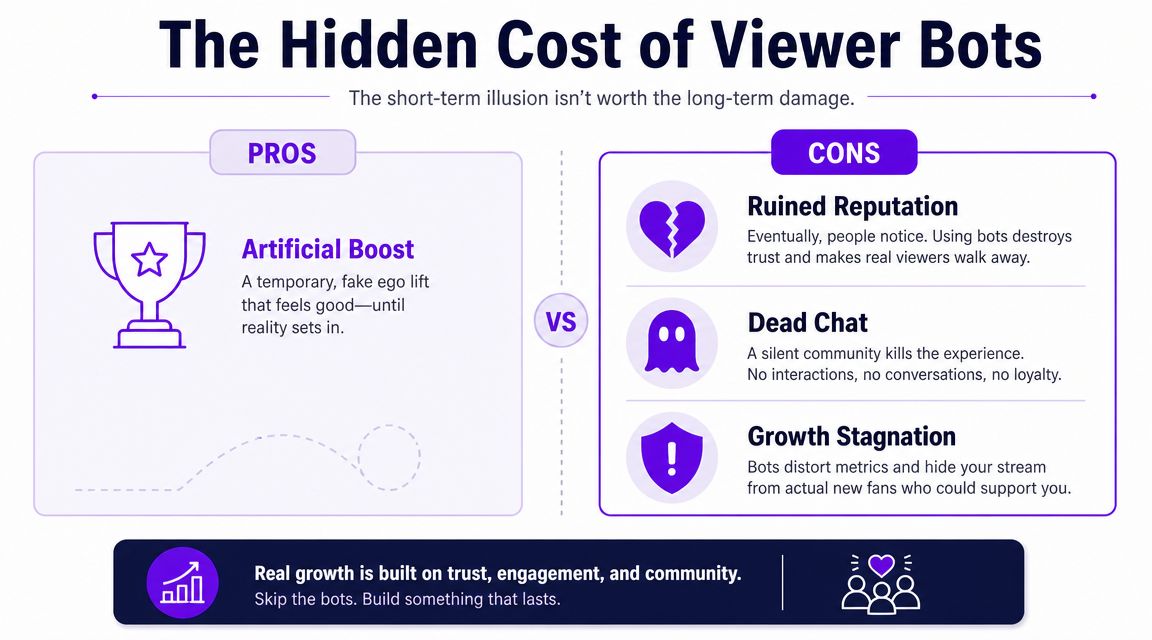
The ban risk gets most of the attention, but it isn't the deepest cost. The deeper cost is that bots make your channel harder to build correctly.
A botted stream can look bigger while becoming less useful to run.
Bad data leads to bad decisions
If your viewer count is inflated, your analytics stop telling the truth. You can't judge what segment held people, what thumbnail or title attracted the right crowd, or when your audience drops off.
That sounds abstract until you try to improve. Then it becomes a daily problem.
A channel grows by reading patterns and adjusting. Bots contaminate those patterns. Instead of learning from viewers, you start learning from noise.
Real viewers can tell when something is off
You don't need forensic tools to feel a fake room. A stream with visible traffic and almost no natural response feels wrong fast.
Verified guidance on long-term risk notes that Twitch can detect mismatched chat-to-viewer ratios, such as 500 viewers but static chat, and also looks for clustering patterns tied to fake traffic. Ban rates aren't public, but streamers can face permanent shadowbans that weaken discovery, as described in this analysis of long-term viewbotting risk.
That same mismatch hurts with humans too. Genuine viewers notice dead chat. They notice copy-paste lines. They notice when a channel looks crowded but feels empty.
- Trust slips first. Once people suspect fake growth, they question everything else.
- Community gets awkward. Real chatters don't want to talk in a room that feels staged.
- Future deals get harder. Brands, collaborators, and moderators care about audience quality, not just visible count.
If you're trying to build stronger public signals on video platforms, it makes more sense to focus on discussion quality and real audience response, not synthetic padding. That's also why people looking at YouTube comment growth options should be careful to separate human participation from automated noise.
Bots hide your actual problems
This is the part that does the most damage over time.
If your hook is weak, a fake viewer count can hide it. If your pacing drags, bots won't tell you. If your stream has no reason for people to stay, artificial traffic can mask that for months.
A fake audience can make a weak stream look busy. It can't make a weak stream good.
That's why botting creates hollow success. The number says progress, but the channel doesn't get better. Then when the fake layer falls away, the creator is left with the same core issues and less trust than before.
The Sustainable Path to Real Channel Growth
Real Twitch growth is slower than a bot package and far more useful. You build content people want to watch, and you make it easy for the right viewers to notice, react, and return.
That's less exciting than a sales page promising instant CCV. It also works.
What real growth actually needs
Most channels improve when the streamer gets disciplined about a few basics:
- A clear stream promise so people know why they should stay
- Better early engagement because the opening minutes set the tone
- Consistent interaction with viewers who show up, even in small numbers
- Content feedback loops based on actual chat, retention, and repeat attendance
The first hour matters a lot in social distribution. Creators often call that the Golden Hour. Early reactions can help content spread further because platforms read that initial engagement as a signal. That's one reason creators, agencies, and teams push hard for immediate response after posting.
Why community-driven engagement works better
I prefer a model built around people, not automation.
With our Upvote.club service, you can build engagement through a community model instead of buying fake activity. We don't sell bot traffic. We run a system where members help each other using verified human accounts across platforms.
The structure is simple. Users complete tasks for others, earn points, and use those points to create their own tasks. That can include likes, comments, reposts, saves, and followers. The point is participation, not fake inflation.
Here's the practical difference:
| Approach | What you get | What it leads to |
|---|---|---|
| Botting | Synthetic numbers | Detection risk and weak signals |
| Community participation | Human interaction | Better feedback and safer traction |
Upvote Club works differently from services that just let you buy metrics. It's based on mutual action. If you want engagement, you contribute to the network and earn the ability to request engagement yourself.
How the workflow stays human
With our Upvote.club service, users start with 13 free points and 2 task slots. They can use those to launch a first task, then earn more points by completing tasks for other members. Each social account only needs to be verified once, and we use an emoji-based verification system so users don't have to hand over passwords.
That setup matters because human verification changes the quality of the activity. We also keep moderation strict and show who completed each task, which makes the process more accountable.
A practical example helps. If someone posts a new video, thread, or short-form clip, they can use community participation to get early likes, comments, reposts, or saves from real accounts. That creates an actual response pattern around the content instead of a fake viewer shell.
For teams working beyond Twitch, we also support a wide spread of networks, including Reddit. That's useful when you want to build discussion around content off-platform and feed attention back to your core channels through community-driven Reddit growth.
There's a short product walkthrough below.
What to do this week instead of buying bots
If I were fixing a small Twitch channel today, I'd do this:
Tighten the stream opening
Start with a clear segment, not filler. Give the first viewers something to react to fast.Create moments worth chatting about
Ask direct questions. React to choices on stream. Give viewers reasons to type.Reuse your best clips on other platforms
Pull strong moments into short videos and threads that can send real people back to your stream.Get early human engagement around your content
That's where community participation helps. Real accounts create cleaner signals than fake viewers ever will.Read your analytics Keep the feedback loop clean. If something didn't work, you want to know that quickly.
Field note: Small streams usually don't need bigger numbers first. They need clearer positioning, better openings, and more real interaction per viewer.
How to Spot and Report Viewer Bots
You don't need perfect proof to notice suspicious traffic. You only need to look for patterns that don't fit normal viewer behavior.
Red flags worth watching
A few signs show up again and again:
- High viewer count with flat chat when the room looks busy but almost nobody reacts
- Repetitive messages that feel copied, looped, or badly timed
- Odd surges at stream start followed by equally odd drop-offs
- Viewers with no real room energy where there's no conversation, no emotes, and no back-and-forth
- Numbers that don't match the stream quality or context in a way that feels staged rather than earned
One strange signal alone doesn't prove botting. Some channels naturally have lots of lurkers. But when several of these show up together, suspicion is reasonable.
If you're focused on growing your own social footprint, your time is usually better spent building healthy audience channels elsewhere too, such as Twitter follower growth with human participation, rather than obsessing over every suspicious stream you see.
How to report it on Twitch
Keep it simple:
- Open the channel or stream page
- Use Twitch's report option
- Choose the reason that best matches fake engagement or suspicious activity
- Add a short factual note about what you observed, such as unnatural chat behavior or a visible mismatch between viewers and interaction
- Submit and move on
Don't turn it into a personal crusade. Twitch has the tools to review patterns at a level viewers can't see from the front end.
The better use of your energy is building a channel that doesn't need fake support. That's the only version of growth that still helps when the platform gets stricter.
If you want a safer alternative to fake engagement, try Upvote Club. With our Upvote.club service, you can earn points by helping other members, then use those points to get likes, comments, reposts, saves, and followers from verified human accounts across platforms. We built it for people who want real momentum without bots, without password sharing, and without turning their metrics into fiction.