
Let’s get one thing straight: engagement rate is the metric that actually matters on social media. It cuts through the vanity of follower counts to show you how many people are paying attention to what you're putting out there.
What Is Social Media Engagement Rate Anyway?

Think of your social media profile like a party you're hosting. Your follower count is the number of people you invited. Your engagement rate tells you how many guests are actually dancing, laughing, and chatting with each other. It’s the vibe check for your content.
A massive follower count might look impressive, but if nobody's interacting, it's just an empty room. This metric is your direct line to understanding what connects with your audience and how strong that connection really is.
The Actions That Matter
So, what exactly counts as "engagement"? While the specifics can differ a bit from one platform to another, the core interactions are pretty universal. These are the signals that tell the algorithms your content is worth showing.
To break it down, here’s a quick look at the core interactions that platforms track.
Key Components of Engagement Rate
This table summarizes the main ways users can interact with your content, signaling to platforms that it's interesting.
| Interaction Type | What It Measures | Primary Platforms |
|---|---|---|
| Likes/Reactions | Basic acknowledgment and appreciation of your post. | All (Instagram, Facebook, X, TikTok, LinkedIn) |
| Comments/Replies | Active participation and conversation starters. | All (Instagram, Facebook, X, TikTok, LinkedIn) |
| Shares/Reposts | How entertaining your content is to others. | All (especially Facebook, X, LinkedIn) |
| Saves | The "keeper" quality of your content; it's good enough to revisit. | Instagram, Pinterest, TikTok |
| Clicks | Deeper curiosity (e.g., link clicks, profile visits, "read more"). | All platforms with outbound links or profiles. |
Each of these actions contributes to the overall picture of how well your content is performing. A healthy mix is the goal.
A high follower count with no engagement is just a number. Real community is built on these interactions. If you're looking to get a better handle on this, you can learn more about how to boost Instagram engagement with our guide.
A high engagement rate is a direct signal to the algorithms that your content is good. This is how you break out of your own follower bubble and get shown to a much wider, organic audience.
Getting a grip on this foundational metric is the first real step toward building an effective online presence. It answers the most direct question of all: is anyone out there actually listening?
The Four Main Formulas to Calculate Engagement
Figuring out your engagement rate isn't a simple, one-size-fits-all deal. Depending on your goals and what data you have, different formulas will paint very different pictures of your performance. Getting to know the four main methods is key to measuring what’s actually working.
These formulas help you look past the vanity metrics and get to the heart of how your content lands with the audience it reaches. Choosing the right one all comes down to whether you want to measure your content against unique viewers, total views, or your overall follower base.
Engagement Rate by Reach (ERR)
This is, hands down, the most accurate way to measure how compelling your content is. It tells you the percentage of unique people who saw your post and actually chose to interact with it.
Formula: (Total Engagements / Total Reach) x 100
ERR is great for understanding content quality because your follower count doesn't skew the results. A post could go viral and hit the screens of thousands of non-followers; this formula tells you exactly how effective it was with that brand-new audience.
Engagement Rate by Post (ER Post)
This one's a bit simpler. ER Post measures the engagement on a single post relative to your total number of followers. Think of it as a quick way to gauge the general activity level of your follower base on a post-by-post basis.
Formula: (Total Engagements on a Post / Total Followers) x 100
The main catch here is that not all your followers will see every post, which can make your rate look a little lower than it really is. Still, it’s a super useful way to get a quick, consistent pulse check on how your content is performing within your community.
Key Takeaway: While ER Post is great for a quick look, ERR gives you a much sharper measure of content quality by focusing only on the people who actually saw your post.
Engagement Rate by Impressions (ER Impressions)
This formula is your best friend on platforms that love to show content multiple times, like X (formerly Twitter). It calculates engagement based on the total number of times your content was displayed—whether to the same person over and over or to different people.
Formula: (Total Engagements / Total Impressions) x 100
On a platform like X, this is a top metric. It’s all about how effectively your content connects with audiences, calculated as the percentage of interactions—likes, replies, and more—divided by the total impressions. For example, if your tweets rack up 73,556 impressions and 1,782 engagements, that’s a solid 2.4% engagement rate. This impressions-based method is often the go-to because it accounts for every single time your content pops up in a feed. If you want to study this further, check out Klipfolio's analysis of Twitter engagement metrics.
Engagement Rate by Followers (ER Followers)
This calculation is a lot like ER Post but is typically used to measure your average engagement rate over a specific period, not just for one piece of content. It’s perfect for getting a broad overview of your account's health over time.
Formula: (Total Engagements over a Period / Total Followers) x 100
By getting a handle on these different methods, you can pick the one that truly lines up with your goals. For instance, if you're trying to boost your YouTube video's visibility, focusing on likes and comments is a rock-solid strategy. You can even check out our guide on how to get more likes for your YouTube videos to see how that early engagement makes all the difference.
What Is a Good Engagement Rate for Different Platforms?
So you've calculated your engagement rate. Now for the real question: is it any good?
Honestly, there's no magic number. A "good" engagement rate changes wildly depending on the platform you're on, your industry, and even how many followers you have. What looks like a home run on one social network might just be average on another.
Think about it: a micro-influencer with a super-loyal community on Instagram is naturally going to see a higher percentage than a massive corporation posting on LinkedIn. Every platform has its own vibe and its own algorithm, which directly shapes how people interact. That's why comparing your numbers to the right benchmarks is the only way to set goals that actually make sense.
Platform-Specific Engagement Benchmarks
To give you a clearer picture, let's break down some typical engagement rates across the big social networks. Think of these as a starting point to see how you stack up. Just remember, these are averages—your mileage will definitely vary.
- Instagram: Most accounts hover around 0.4% to 0.6%. But don't be discouraged if you're just starting out; smaller accounts can often blow this number out of the water. Visuals are king here, so Reels and Carousels are your best friends.
- TikTok: This platform is an engagement powerhouse. A decent rate can be anywhere from 3% to 9%. The algorithm is all about grabbing attention fast, so hook 'em early. For more details, check out our guide on how to get ahead on TikTok.
- Facebook: With organic reach being notoriously tough, an average rate usually falls between 0.06% and 0.20%. Content that builds community and gets people talking, especially video, tends to do best.
- LinkedIn: This professional network sees much stronger interaction, often around 3% to 3.5%. Posts that spark professional conversations, like polls and carousels, really shine here.
This chart is a great way to see how different formulas can paint very different pictures of your performance.
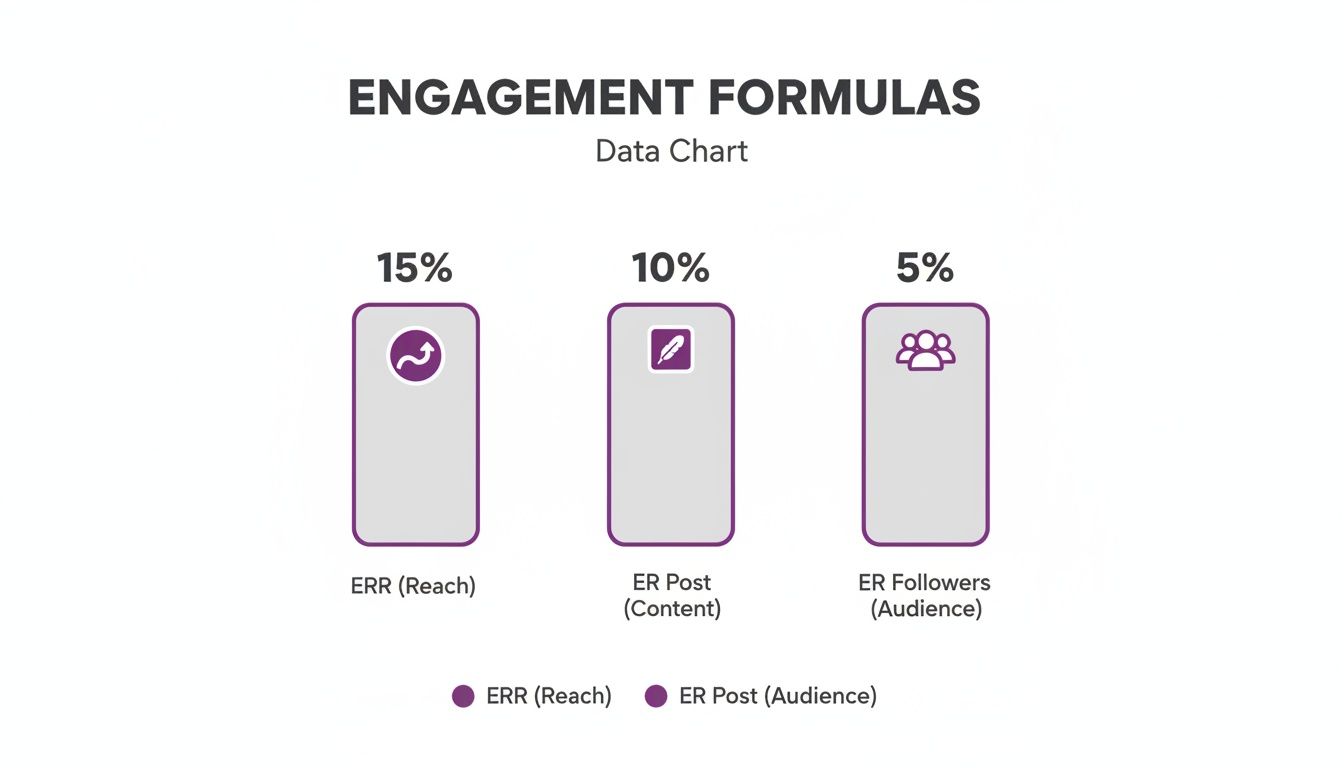
As you can see, measuring by reach (ERR) almost always gives you the highest number, offering a truer read on how compelling your content was to the people who actually saw it.
Average Engagement Rate Benchmarks by Platform and Follower Count
The size of your following plays a huge role in what you can expect for engagement. Smaller, tight-knit communities often see much higher interaction rates than massive accounts. This table breaks down what's typical.
| Platform | Micro-Accounts (<10K) | Mid-Sized Accounts (10K-100K) | Large Accounts (>100K) |
|---|---|---|---|
| 1.5% – 2.5% | 0.8% – 1.5% | 0.4% – 0.8% | |
| TikTok | 10% – 15% | 6% – 10% | 3% – 6% |
| 0.25% – 0.5% | 0.1% – 0.25% | < 0.1% | |
| X (Twitter) | 1% – 2% | 0.5% – 1% | 0.2% – 0.5% |
| 4% – 6% | 2.5% – 4% | 1.5% – 2.5% |
Use these numbers as a guide, not a rule. They show a clear trend: as follower count grows, the average engagement rate tends to drop. This isn't a sign of failure; it's just the nature of scaling an audience.
A Deeper Look at What Makes a Good Engagement Rate
Beyond the platform averages, you need to look at how your content fits into the bigger picture. Digging into more specific metrics like click-through rate benchmarks by industry can add another layer of helpful context.
It helps you understand which types of interactions are driving real business goals, not just vanity metrics. By combining platform benchmarks with industry-specific data, you can set smarter goals and build a content strategy that truly connects.
Common Mistakes When Measuring Engagement
On the surface, measuring engagement looks pretty straightforward. You look at the likes, you count the comments, and you call it a day, right? Not quite.
It’s easy to fall into a few common traps that can completely skew your perception of what's actually working. Getting this wrong means you end up chasing the wrong goals, misreading your audience, and sinking time into strategies that just don't move the needle. The real trick is learning to look at your data with a critical eye.
One of the biggest blunders is obsessing over vanity metrics. Sure, a huge follower count looks impressive on your profile, but it doesn't mean much if your audience is a ghost town. Real connection is in the likes, comments, and shares—not just the number of people who hit "follow" once and never looked back.
Another classic mistake is inconsistent measurement. If you calculate your engagement rate using reach one month and then switch to followers the next, you're comparing apples to oranges. It makes it impossible to know if you're actually making progress.
Ignoring Context and Quality
Context is everything. You can't just lump all your engagement together. A like from a paid ad is completely different from a thoughtful comment on an organic post. If you don't separate these, you’ll get a distorted view of your content's natural appeal and the health of your community.
An even bigger threat to good measurement is fake engagement. Bots can easily inflate your likes and comments, giving you a false sense of victory. Those numbers are hollow because they don't come from real people who could ever become customers or true fans. This is exactly why we have strict anti-bot moderation at Upvote.club. We make sure every single interaction comes from a verified human account, so the engagement you’re building is the real deal.
Misinterpreting Platform Dynamics
You also have to understand how each platform works, because they're all a little different. A sudden spike in visibility doesn't always lead to a stronger connection with your audience.
For example, a 2024 analysis of X (formerly Twitter) found something pretty wild: while post impressions shot up by a massive 98.24%, the overall engagement rate actually dropped by -38.05% year-over-year. You can check out the full breakdown of these surprising engagement trends on Statista. This just goes to show how algorithm changes can water down the quality of interactions, making it even tougher to truly connect.
Relying on inflated numbers from bots or vanity metrics is like having a party with mannequins. The room looks full, but there's no conversation. Authentic interaction from real people is the only way to build a genuine community.
At the end of the day, avoiding these mistakes comes down to focusing on the quality of your interactions, not just the raw numbers. If you're serious about building a real presence on a platform like Twitter, it pays to understand what actually drives genuine engagement. You might find our guide on how to buy real Twitter likes safely helpful.
How to Improve Your Engagement Rate Authentically

Knowing your numbers is one thing, but making them better is a whole different ballgame. If you want to boost your engagement rate for real, it all comes down to creating content that people actually want to interact with. It's about stepping away from the megaphone and starting real conversations.
The bedrock of great engagement is content that begs for a response. No, not every post needs to be a deep philosophical debate. It can be as simple as asking for an opinion, sharing a relatable story, or using formats that make it dead simple for people to chime in.
Creating Content That Connects
The easiest way to get people talking? Give them something interesting to talk about. Stale, one-way updates almost never get the job done. Instead, you need to build your content around interaction from the get-go.
Here are a few methods that just plain work:
- Ask Open-Ended Questions: Don't just state facts. End your captions with a question that invites your audience to share their own stories or opinions. A travel account, for instance, might ask, "What's the one place you're dreaming of visiting next?"
- Use Polls and Quizzes: These are super low-effort ways for your audience to participate. Platforms like Instagram Stories and X have made it ridiculously easy to create polls that reel in quick, simple interactions.
- Host Q&A Sessions: Whether you go live or just post an "ask me anything," Q&As forge a direct line to your audience. It shows you're accessible and actually care about what they have to say.
And please, don't forget to respond to comments. When someone takes time out of their day to reply, acknowledging it shows you're listening. That simple act can turn a passive follower into a true fan and build a powerful sense of community.
The secret to better engagement isn't some complex algorithm hack. It's consistently creating content that makes your audience feel seen, heard, and invited to be part of the conversation.
The Power of the Golden Hour
Timing can make or break you on social media. There’s a critical window known as the "Golden Hour"—the first 60 minutes after you post. During this time, the algorithms are watching your content like a hawk. Every early like, comment, and share sends a powerful signal that your post is high-quality stuff.
When a post explodes with interaction right after going live, the platform's algorithm is far more likely to push it out to a wider audience, massively boosting its organic reach. This is the exact playbook that major influencer agencies use to give their clients' content that initial shove it needs to go big.
This is precisely why we built our Upvote.club service. We designed our entire platform around the Golden Hour principle to help creators get that critical early traction. With our Upvote.club service, you can create unlimited tasks to receive likes, comments, reposts, saves, and followers from verified, human accounts right after you hit publish.
Our platform runs on a community-based model where users help each other grow. It's a self-sustaining system built on mutual support, not just buying fake interactions. By joining our community, you can get the initial push needed to signal quality to the algorithms and unlock wider organic reach. We’ve seen firsthand how this helps creators build genuine credibility without ever asking for passwords or putting their accounts at risk.
Putting It All Together with Our Community
Knowing what engagement rate is and how to improve it is one thing. Actually doing it is another beast entirely.
That's why we built Upvote.club. We wanted to make the process of getting that initial traction simple, effective, and powered by real people. This isn't about buying engagement; it’s about participating in a community to earn it.
When you register with us at Upvote.club, we kick things off with 13 free points and 2 task slots right out of the gate. That’s enough to get your first piece of content moving. You could immediately create a task to get a few genuine likes on a new Twitter post, giving it the nudge it needs in that critical "Golden Hour."
How Our Community-Based Model Works
The whole system runs on mutual support. It's a "give-to-get" model.
If you need more points to get more engagement, you just complete a few tasks for other community members. By helping others get eyes on their content, you earn the ability to promote your own. It creates a sustainable cycle of real interaction from actual people. No bots here. We have implemented strict moderation, and bot accounts are not allowed.
We're also dead serious about security. We will never ask for your passwords. When you connect a social media account for the first time, our system will ask you to verify it. We have added a unique emoji-based verification system. It's a secure, one-time thing for each platform that keeps your account safe while confirming you're a real human.
Making Professional Growth Strategies Accessible
Here’s the thing: influencer agencies have been using coordinated engagement to boost their clients' content for years. It's their not-so-secret weapon. A burst of early activity signals to the algorithms that a post is high-quality, which in turn helps it reach a much bigger audience.
With Upvote.club, we're putting that same powerful method in your hands.
Getting real likes, comments, and shares within the first hour of posting is how you directly influence the algorithm in your favor. This isn't a shortcut or a hack; it's a strategic play to give your great content the best possible shot at being seen.
You can start for free, and we'll even give you another free task slot every 24 hours. For creators who want to move faster, we have subscriptions that provide a large number of points and free task slots right away. We support growth across Instagram, TikTok, YouTube, Twitter, and a ton of other platforms, making it a super versatile tool for any creator's toolkit.
And as you build your community, you can reward your most active followers with tools like a YouTube comment picker for running contests, which is a fantastic way to strengthen those connections. At the end of the day, our goal is simple: to help you build genuine credibility and expand your reach through real, human-powered engagement.
Ready to give your content the boost it deserves? Join the Upvote.club community today and see how real engagement can transform your reach. Start for free and watch your content connect with a wider audience. Get started on Upvote.club.
More articles
alexeympw
Published February 13, 2026