Table of Contents
- Starting Your LinkedIn Journey
- Set Clear Goals and KPIs for LinkedIn
- Pick one primary outcome
- Ignore vanity metrics unless they support pipeline
- Use a monthly review cadence
- Identify Your High-Value Audience
- Go past job titles
- Use LinkedIn tools like a researcher
- Build an audience brief you can actually use
- Develop a Winning Content Plan
- Use formats on purpose
- Build around a few repeatable pillars
- Write a weekly schedule you can keep
- Follow format rules that make posts easier to consume
- Make carousels pull their weight
- Execute Organic Growth Tactics
- Fix the basics first
- Turn employees into distributors, not parrots
- Use groups and newsletters the right way
- Activate Initial Engagement with Community Support
- Why early interaction matters
- What actually works
- Make the first hour part of your workflow
- A Quick-Start Guide to LinkedIn Ads
- Choose the right ad type
- Build your first campaign in Campaign Manager
- Watch the right signals
- Measure Performance and Refine Your Strategy
- Use a simple review loop
- Decide what to do more of and less of
- Keep a short operating checklist
I remember publishing a carefully written LinkedIn post, checking back an hour later, and finding almost nothing. A couple of polite likes. No discussion. No business impact.
That's a common starting point. Individuals often post without a system, then blame the platform when the underlying problem is strategy.
Starting Your LinkedIn Journey
If you're serious about strategy marketing linkedin, stop treating LinkedIn like a place to “stay active.” Treat it like a pipeline builder.
My early mistake was simple. I wrote whatever felt smart that day. Some posts were educational. Some were personal. Some were thinly disguised sales pitches. None of it connected because there was no plan behind it. I wasn't clear on who I wanted to reach, what I wanted them to do, or how my content should move them one step closer.
That changed when I stopped chasing random engagement and built a repeatable workflow. I narrowed the audience. I picked content themes. I wrote posts for one business outcome at a time. Results got steadier because the process got tighter.
If you work in SaaS, consulting, recruiting, or agency services, LinkedIn is still one of the best channels to build trust in public. The useful part isn't that people can “see” you. The useful part is that buyers can watch how you think before they ever book a call.
I also recommend reading Big Moves Marketing’s guide on mastering LinkedIn marketing for tech if your audience includes technical buyers. It does a good job showing how messaging shifts when you sell to people who don't respond to fluffy marketing.
For hands-on LinkedIn growth mechanics, I’d also review LinkedIn growth workflows. Not for theory. For seeing how promotion fits into a repeatable publishing rhythm.
Most LinkedIn failure isn't a content problem. It's a planning problem.
The rest of this playbook is the system I wish I’d used from day one.
Set Clear Goals and KPIs for LinkedIn
Most LinkedIn strategies fail before the first post goes live. The reason is boring and fixable. People don't define success.
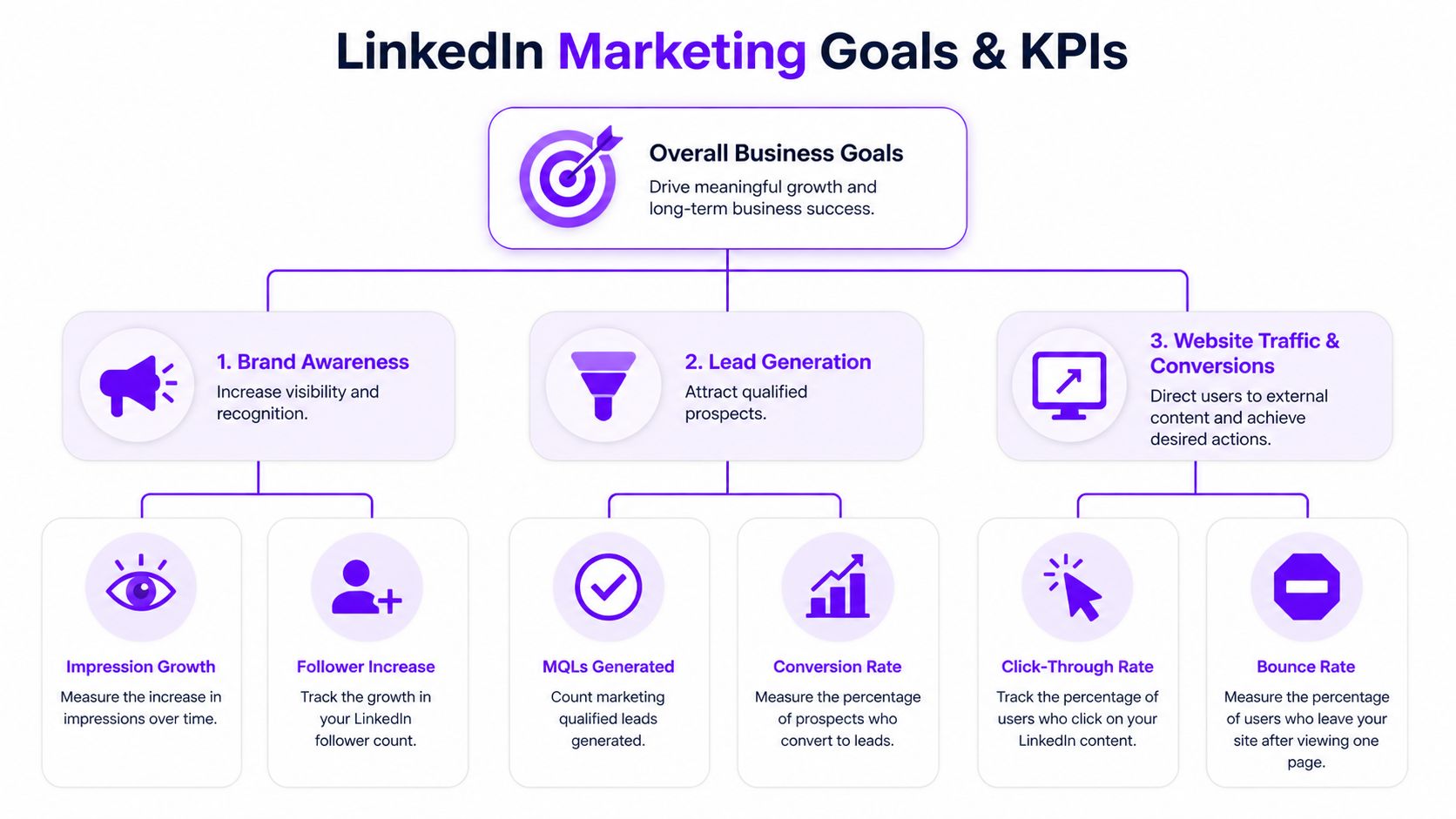
If your only target is “get more visibility,” you'll end up chasing weak metrics and calling it progress. Visibility matters, but only if it connects to a business result. I separate LinkedIn goals into three buckets: brand awareness, lead generation, and website traffic with conversion intent.
Pick one primary outcome
Start with a question marketers often avoid. What should LinkedIn do for the business?
If you're a founder, your main job may be demand creation. If you're a service business, you may care more about conversations with qualified prospects. If you're running a content-led brand, traffic to a lead magnet or webinar page might be the only thing worth tracking.
Here’s the clean way to frame it:
- Brand awareness: Track post impressions, follower growth, profile views, and repeat engagement from the same audience segment.
- Lead generation: Track qualified inbound messages, demo requests, sales calls sourced from LinkedIn, and click-through behavior on offer posts.
- Website traffic and conversions: Track clicks, landing page behavior, and whether LinkedIn visitors take the action you designed for them.
This isn't theory. LinkedIn remains the strongest platform for B2B social lead generation, with 80% of B2B leads from social media coming from LinkedIn, and its ad reach extends to nearly 1 in 6 people globally, according to these LinkedIn statistics for 2025. That same source notes that posting 3 to 5 times weekly can double visibility. Activity matters. Random activity doesn't.
Ignore vanity metrics unless they support pipeline
A post can get applause and still do nothing for your business.
I've seen posts pull comments from peers, former coworkers, and other marketers who were never going to buy. That can feel good and still be a dead end. If your business depends on pipeline, then your KPI set should answer a harder question: did the right people move closer to buying?
Use this filter for every metric:
| KPI | Keep it if… | Ignore it if… |
|---|---|---|
| Impressions | Your audience match is improving | Random reach is inflating the number |
| Likes | They come from buyers, partners, or warm prospects | They're mostly peers and friends |
| Comments | They open conversations with relevant people | They stay shallow and off-topic |
| Clicks | They send people to a clear next step | The page they land on is weak |
| Inbound messages | They are relevant and specific | They are vague or low-fit |
| Follower growth | Your audience quality is improving | You can’t tie followers to business fit |
Use a monthly review cadence
Don't inspect performance every hour. That's how marketers become reactive and weird.
Review once a week for tactical changes. Review once a month for bigger decisions. In that monthly review, ask:
- Which posts brought the right audience into the comments or inbox?
- Which topics got attention but no business movement?
- Which call to action created actual next-step behavior?
- Which format earned both engagement and commercial intent?
Practical rule: If a KPI doesn't help you decide what to do next, it's dashboard decoration.
A solid strategy marketing linkedin plan is measurable, but not bloated. Pick a primary goal, attach a short KPI list, and make every post earn its place.
Identify Your High-Value Audience
Bad LinkedIn targeting usually sounds like this: “We sell to marketing managers” or “Our audience is startup founders.” That’s not an audience. That’s a loose category.
You need to know which people inside a company can approve, influence, block, or speed up a purchase. If you miss that, your content may get engagement from the wrong layer of the market.

Go past job titles
A head of marketing at a lean SaaS company behaves very differently from a head of marketing inside a global enterprise. Same title. Different power, budget, urgency, and language.
That’s why I map audiences in layers:
- Economic buyer: The person who can approve budget.
- Functional buyer: The person who will use or manage the product.
- Internal influencer: The person who shapes the shortlist.
- Gatekeeper: The person who can delay, redirect, or ignore your message.
When you build content, you need to know which layer you’re speaking to. A post for a functional buyer should deal with workload, speed, and execution pain. A post for the economic buyer should focus on missed revenue, wasted headcount, risk, or efficiency.
Use LinkedIn tools like a researcher
Many marketers use LinkedIn search like a directory. That's a wasted opportunity.
Inside Campaign Manager, LinkedIn’s audience tools can help you study buyer groups rather than rely on surface-level filters. AI tools can also help identify buyer groups on LinkedIn by analyzing profile data and engagement history, which makes targeting more precise, as described in Hootsuite’s LinkedIn marketing strategy guide.
I use that idea in a practical way. I gather a sample of ideal customer profiles, review their posts, check which topics they engage with, and note the phrases they repeat. Then I write content in their language, not mine.
You should also study their activity patterns:
- What they complain about
- What they celebrate
- Which vendors they mention
- What kind of proof they seem to trust
- Whether they write, comment, lurk, or mostly repost
That gives you more than a persona sheet. It gives you a working message map.
For relationship building, I like using targeted LinkedIn connection workflows as a reminder that outreach should follow audience research, not come before it.
You don't need a bigger audience. You need a tighter one.
Build an audience brief you can actually use
Skip the fluffy persona template with hobbies and favorite podcasts unless those details directly affect buying behavior.
Your audience brief should answer six things:
| Question | What to write down |
|---|---|
| Who are they? | Role, company type, seniority |
| What are they trying to do? | Team goal, commercial target, operational priority |
| What gets in the way? | Internal friction, lack of time, poor tools, slow approvals |
| What do they fear? | Wasting budget, looking foolish, missing targets |
| What language do they use? | Repeated phrases from posts, comments, profile headlines |
| What proof do they trust? | Product demos, peer examples, tactical breakdowns, operator opinions |
Once you have that, content planning gets much easier. Your posts stop sounding “professional” and start sounding relevant.
Develop a Winning Content Plan
Most LinkedIn content plans are too loose to work. “Post three times a week” isn't a strategy. It’s a reminder.
What works is a content plan tied to audience pain, business goals, and format choice. Format matters more on LinkedIn than many marketers want to admit. If you publish strong ideas in weak packaging, the platform won't carry them far.
Use formats on purpose
According to a study of 1.3 million company posts, carousel posts generate 11.2 times more impressions than text-only updates, making them the strongest engagement format on LinkedIn, as reported by CXL’s LinkedIn for B2B marketing analysis. That lines up with what I’ve seen in practice. Carousels give you more room to pace an argument, teach a framework, or break down a process.
Text posts still matter. They’re fast, conversational, and useful when you want comments. But if you need to teach something clearly, carousels usually do the job better.
Here’s how I use the main formats.
| Content Type | Primary Goal | Best For |
|---|---|---|
| Text post | Conversation | Opinions, lessons, quick contrarian takes |
| Carousel | Reach and retention | Frameworks, step-by-step breakdowns, before-and-after thinking |
| Native video | Familiarity and trust | Commentary, face-to-camera teaching, product perspective |
| Poll | Audience research | Quick feedback, topic testing, discussion starters |
| Document or checklist post | Saves and shares | Templates, tactical instructions, swipe files |
Build around a few repeatable pillars
You don't need endless originality. You need consistency with enough variation to hold attention.
I usually recommend four content pillars:
Pain-point content
Name the problem plainly. Show the cost of leaving it unsolved. Keep it sharp.How-to content
Break a process into steps people can use right away. Carousels are particularly effective for this.Point-of-view content
Tell the market what you believe and what you reject. Buyers want a clear brain, not a neutral one.Proof content
Show work, lessons from campaigns, frameworks you use, mistakes you corrected, or what changed after a new process.
If you're stuck, study adjacent examples outside LinkedIn. I often send teams to discover content marketing strategies because seeing good examples from other channels helps sharpen your LinkedIn ideas.
Write a weekly schedule you can keep
The best content calendar is boring enough to sustain.
Here’s a simple weekly rhythm that works for many B2B teams:
- Monday: Strong opinion post tied to an industry problem
- Tuesday: Carousel with a framework or checklist
- Wednesday: Comment-heavy networking day, light posting or none
- Thursday: Short case-style lesson, process breakdown, or founder note
- Friday: Native video or reflective post with one sharp takeaway
That rhythm gives you range without chaos.
Follow format rules that make posts easier to consume
Good LinkedIn content is readable before it's clever.
Use these rules:
- Start with a hard opening: Make the point in the first line.
- Keep one post to one idea: Don't mix five lessons into one update.
- Write for skimming: Short paragraphs, clean spacing, obvious structure.
- End with one action: Ask for a comment, a click, or a reply. Not all three.
- Turn strong comment threads into future posts: Your audience tells you what they care about.
A clear post with a strong structure beats a smart post buried in a blob of text.
Make carousels pull their weight
A carousel shouldn't be a text post split into slides. That’s lazy and usually weak.
A better carousel follows a simple flow:
- Slide 1: Hard hook
- Slide 2: State the problem
- Slides 3 to 6: Teach the process, mistake, or framework
- Slide 7: Sum up the action
- Slide 8: Light call to action
That structure keeps readers moving. It also forces you to think like a teacher, not a ranter.
A strong strategy marketing linkedin plan isn't built on volume. It's built on repeatable formats, clear pillars, and a schedule you won't abandon after two weeks.
Execute Organic Growth Tactics
Posting is only one part of LinkedIn growth. If that's all you do, you're leaving distribution to chance.
Organic reach gets stronger when your company page, personal profiles, comments, groups, and newsletter activity all support each other. Small teams can do this well because they can move fast and stay personal.

Fix the basics first
A weak company page makes every other tactic less effective. I still see pages with vague banners, stale descriptions, and no point of view. That kills trust before content even gets a chance.
Your company page should do three jobs:
- State what you do clearly
- Show who it’s for
- Support the messages your team repeats in public
Then get your internal team in order. Employee profiles matter because people trust people faster than they trust logos.
Here’s the standard I use for small teams:
| Asset | What good looks like |
|---|---|
| Company page | Clear banner, sharp description, current offer, recent activity |
| Founder profile | Strong headline, opinion-led content, active comments |
| Team profiles | Consistent positioning, real experience, useful posting habits |
| Content library | Easy access to approved posts, talking points, and examples |
Turn employees into distributors, not parrots
Employee advocacy fails when marketing hands everyone the same copy and expects magic.
Give your team a few themes, not scripts. Ask sales to talk about objections they hear. Ask product people to explain what users get wrong. Ask recruiters to talk about talent trends. Let each person sound like themselves.
That works better because it creates different entry points into the brand.
A few simple habits go a long way:
- Comment early on team posts: This helps discussions start faster.
- Share with context: Add a personal take instead of reposting silently.
- Tag carefully: Only when the mention helps the reader.
- Reply like a human: Fast, specific responses beat polished corporate language.
For teams that want to build follower momentum around key profiles, LinkedIn follow growth actions can support a more deliberate publishing cadence.
Use groups and newsletters the right way
Groups still work if you act like a contributor, not a spammer.
Join a few relevant groups and answer real questions. Don’t drop links and disappear. If you keep showing up with useful answers, people start checking your profile on their own.
Later in the cycle, newsletters help turn casual readers into repeat readers. A newsletter works well when you already know your best-performing topics. Don't start one because it sounds impressive. Start one because you can keep a promise to readers.
This walkthrough is worth watching if you're training a team and want to tighten execution:
Organic LinkedIn growth gets easier when more than one person carries the brand voice.
The teams that win don't just post. They build a lightweight distribution system around every post.
Activate Initial Engagement with Community Support
LinkedIn has an ugly truth most guides ignore. Good content often dies before anyone sees it.
That happens because early engagement affects distribution. If a post gets no traction in its first stretch of life, LinkedIn has little reason to keep pushing it outward. Consequently, many solo creators and small teams get stuck. They publish into a thin network and mistake silence for failure.
Why early interaction matters
You don't need fake engagement. You need real people to notice the post soon enough for the platform to keep testing it.
That distinction matters. Buying garbage engagement is a bad move. It creates noise, weak signals, and the wrong audience behavior. But getting real humans to interact with a post early is different. That mirrors what active communities and internal teams already do naturally.
This gap is more common than people admit. A 2025 HubSpot report notes that 68% of B2B marketers face low engagement on LinkedIn, while algorithms now give more weight to authentic conversations, according to this discussion of underserved LinkedIn marketing needs. That same piece argues that most guides ignore community-driven support models that help posts get their first real interactions.
What actually works
The practical fix is simple. Pair strong organic content with a small, real support system that can help posts get initial visibility.
That support can come from:
- Your internal team: Sales, founders, marketers, and customer success
- Trusted peers: People in your network who regularly exchange useful engagement
- Private communities: Groups built around mutual participation, not bot activity
- Customer advocates: Clients or users who already care about the topic
What doesn't work is asking people to leave empty comments. “Great post” is worthless. It doesn't help the reader, and it doesn't build trust. If someone is going to engage, they should add a thought, ask a real question, or react in a way that fits the post.
Early engagement only helps when the engagement is credible.
Make the first hour part of your workflow
I treat the first hour after posting as active distribution time, not passive waiting.
Use a simple checklist:
- Send the post to a short list of relevant teammates or peers.
- Ask for honest engagement only if the post matches their interests.
- Stay active in comments and reply quickly.
- Comment on adjacent posts that day so your profile stays visible.
- Save weak posts for revision instead of forcing them with bad engagement.
Some marketers also look into LinkedIn follower support options when trying to build initial momentum, but the only version of this idea I respect is community-based and human-led. If the engagement isn't real, it becomes a liability.
The missing angle in many strategy marketing linkedin articles is that distribution support matters just as much as content quality. Strong writing helps. Strong timing helps more. Real people showing up early helps most when your network is still small.
A Quick-Start Guide to LinkedIn Ads
Organic activity should come first. Paid promotion works better when you already know which messages people respond to.
I don't recommend starting with a giant ad account build. Start small. Pick one offer, one audience, one objective, and one ad format. You want signal, not complexity.
Choose the right ad type
The simplest starting point for many is Sponsored Content. That means promoting a post that's already working or publishing a native ad in the feed. It fits the platform and doesn't ask the audience to switch context too hard.
Message Ads can work when the targeting is tight and the offer is strong, but they're easier to misuse. If your message sounds like a cold pitch, people will ignore it.
A simple decision rule:
| Ad format | Use it when | Avoid it when |
|---|---|---|
| Sponsored Content | You have a clear offer or proven post topic | Your messaging is still untested |
| Message Ads | Your audience is narrow and your ask is specific | You’re sending broad sales outreach |
| Text Ads | You want a low-complexity test | You need richer storytelling |
Build your first campaign in Campaign Manager
Keep the setup clean.
Start with an objective that matches the business outcome. If you want site visits, choose traffic. If you want hand-raisers, use a lead-focused objective. Then define the audience using the research work you already did. Don't stack every possible filter. Tight enough to be relevant is better than so narrow that delivery gets awkward.
Your first ad workflow should look like this:
- Pick one objective
- Define one audience
- Write one message
- Use one landing page
- Launch one test at a time
Watch the right signals
Once the campaign is live, don't panic and start editing everything after a few hours.
Review:
- Click-through behavior
- Lead quality
- Comment quality on promoted posts
- Landing page fit with ad promise
If the ad gets clicks but no action, the landing page is often the problem. If the ad gets no clicks, the hook is weak or the audience is off. If the wrong people respond, your targeting needs work.
Paid LinkedIn can get expensive fast when the basics are sloppy. But when you already have a good organic message and a clear audience, it becomes a useful accelerator.
Measure Performance and Refine Your Strategy
The marketers who get the most out of LinkedIn don't guess better. They review better.
Once your system is running, the key task is pattern recognition. Which topics pull in qualified people? Which formats earn attention but no action? Which calls to action create replies, clicks, or meetings? If you don't answer those questions regularly, you'll keep repeating weak moves.
Use a simple review loop
I keep measurement practical. Every month, review personal profile analytics, company page performance, inbound conversations, and website behavior tied to LinkedIn traffic.
Look for patterns across four areas:
- Audience fit: Did the right people engage?
- Content strength: Which topics and hooks held attention?
- Format performance: Did text, video, or carousel move best?
- Business movement: Did posts create conversations, clicks, or leads?
The benefits of your KPI choices become evident. If you set the right metrics earlier, your review becomes straightforward. You can tell which activity deserves more time and which should be cut.
Decide what to do more of and less of
A monthly review should end with decisions, not notes.
I like this format:
| If you notice this | Do this next |
|---|---|
| High impressions, weak follow-through | Tighten the CTA or landing page |
| Strong comments from the wrong audience | Adjust topic framing and examples |
| Good clicks, poor lead quality | Narrow the audience and sharpen the offer |
| One format repeatedly wins | Increase that format’s share next month |
| A topic gets saves and shares | Turn it into a series or newsletter issue |
Don't keep underperforming content pillars out of loyalty. If a topic doesn't attract the audience you want, drop it or rework it.
The point of analytics isn't reporting. It's deciding.
Keep a short operating checklist
This is the rollout checklist I give teams when they want LinkedIn to produce steady results:
- Define one main business goal for the quarter
- Choose a short KPI list tied to that goal
- Map the actual buying audience, not broad job titles
- Build three to four content pillars
- Commit to a repeatable posting rhythm
- Use format choice intentionally
- Support each post with active distribution
- Test paid promotion only after organic signals are clear
- Review monthly and cut what isn't working
- Repeat with sharper messaging each cycle
A good strategy marketing linkedin system isn't flashy. It's disciplined. You publish with intent, distribute on purpose, measure accurately, and adjust fast.
If you want a practical way to support your social growth across platforms, try Upvote Club. With our Upvote.club service, you can get real engagement from verified human accounts through a community-based model, not bots. We let members create tasks for likes, comments, reposts, saves, and followers, earn points by helping others, and grow across LinkedIn, X, Instagram, TikTok, YouTube, Reddit, Medium, Quora, Product Hunt, GitHub, and more, all without sharing passwords.