Table of Contents
- Table of Contents
- The Foundation Your Channel Needs to Grow
- Pick a niche with visible demand
- Plan your first batch before you post
- Creating Videos People Actually Finish Watching
- Start with tension, not greetings
- Use honesty to earn attention
- Mastering YouTube SEO for Organic Discovery
- Build each video around one clear search promise
- Send traffic to your subscriber magnets
- The Golden Hour and Gaining Initial Traction
- What the first hour tells YouTube
- What strong early traction looks like
- Turn Viewers into a Community and Iterate
- Use comments as your planning board
- Set a volume target, not just a posting goal
- Your YouTube Growth Checklist and Pitfalls to Avoid
- Your repeatable checklist
- Mistakes that stall a new channel
I've watched creators spend months polishing thumbnails, scripting better intros, and posting more often, only to get stuck at the same low view counts. The channels that finally move usually fix two things at once: they make better videos, and they get those videos moving fast in the first hour.
Table of Contents
- The Foundation Your Channel Needs to Grow
- Creating Videos People Actually Finish Watching
- Mastering YouTube SEO for Organic Discovery
- The Golden Hour and Gaining Initial Traction
- Turn Viewers into a Community and Iterate
- Your YouTube Growth Checklist and Pitfalls to Avoid
The Foundation Your Channel Needs to Grow
Most new channels don't fail because the creator lacks effort. They fail because the channel starts with random uploads. One video is a tutorial, the next is a vlog, the next is commentary, and YouTube never gets a clean signal about who should see the content.
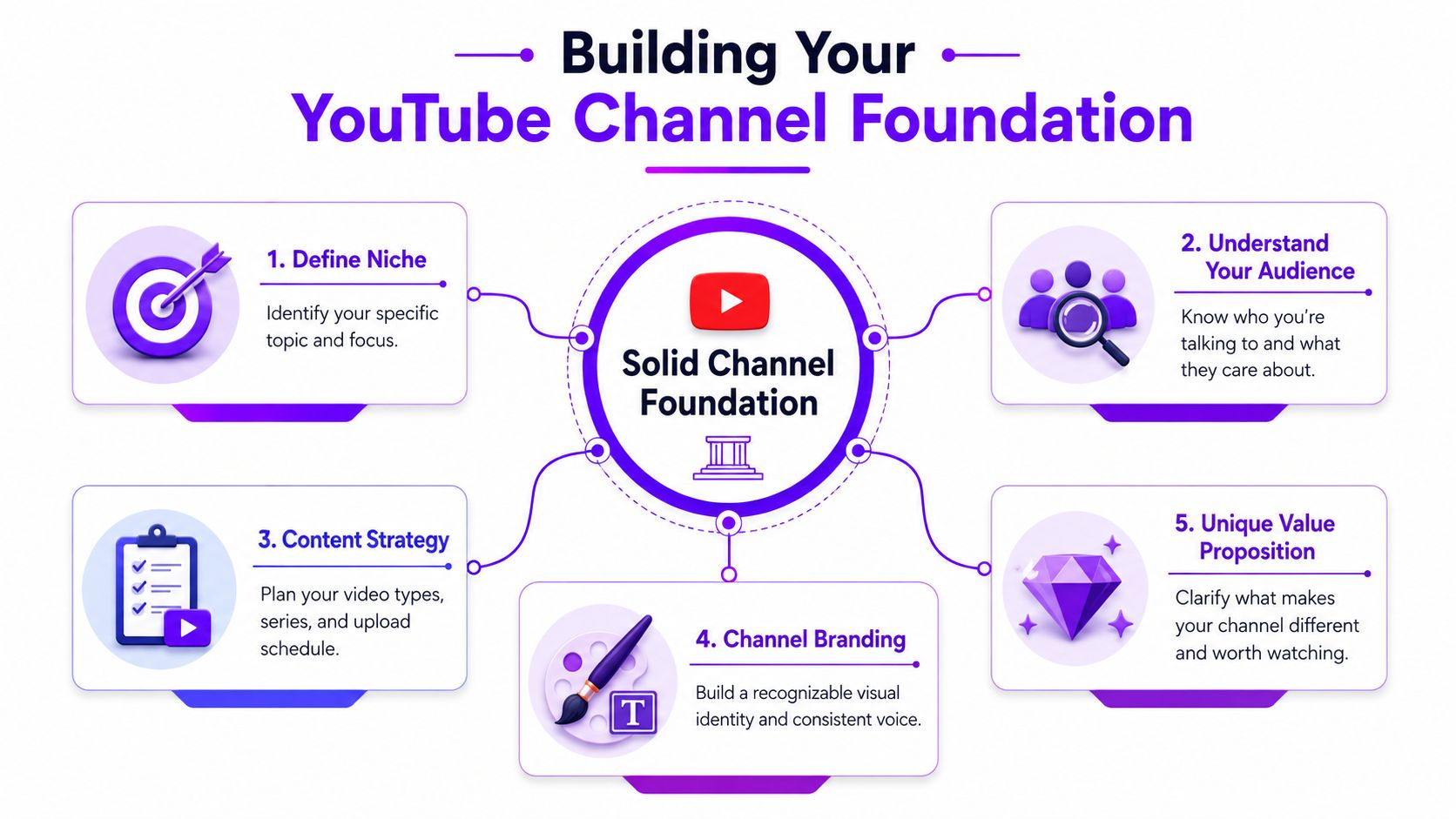
If you're serious about learning how to get followers on YouTube, start with demand, not self-expression alone. The best early niches sit in the overlap between what you can talk about for months and what viewers are already trying to find.
Pick a niche with visible demand
A simple way to choose a topic is to look for what many creators call a hungry audience. The idea is straightforward. Search your topic on YouTube and look for videos with strong view counts from channels that aren't giant yet.
A proven method lays this out clearly. The conservative benchmark is a 2% viewer-to-subscriber conversion rate, which means roughly 50,000 views to reach 1,000 subscribers. The same method suggests looking for videos with high views, such as 250,000 views, on channels with under 100,000 subscribers, then producing 16 videos over two months around that opening in the market. That framework comes from the Hot Dog Method breakdown on YouTube.
That gives you a practical filter:
- Good sign: Smaller channels getting outsized views on a topic.
- Bad sign: Huge channels dominate every result and smaller channels barely register.
- Better sign: Comment sections with unanswered follow-up questions.
- Best sign: Multiple videos on the same topic perform well, but none explain it in the way you would.
Practical rule: Don't ask, "What do I want to upload?" Ask, "What problem keeps getting searched, and where is the current answer weak?"
One more point. Keep the niche narrow enough that a stranger can tell what your channel is about in five seconds. "Fitness" is broad. "Strength training for remote workers with bad backs" is clearer. "Coding" is broad. "Python automation for non-developers" is clearer.
If you want a practical place to study YouTube-focused engagement patterns around creator campaigns, browse the YouTube growth page on Upvote.club and look at how creators think about early response around a post. Even if you don't use any tool, the lesson is the same: distribution starts with clarity.
Plan your first batch before you post
New creators waste time by treating every upload like a fresh decision. The better move is to plan a batch up front. That way your first uploads build on each other instead of fighting each other.
I like this sequence for a first run of 16 videos:
| Video type | Purpose | Example |
|---|---|---|
| Search-led tutorial | Catch existing demand | "How to fix…" |
| Mistake video | Pull in problem-aware viewers | "Why your… isn't working" |
| Comparison | Attract decision-stage viewers | "X vs Y for beginners" |
| Reaction to a common myth | Give the niche a clear point of view | "Stop doing…" |
Then repeat those patterns around the same audience pain points.
A strong early channel usually has three traits:
- One audience
- One recurring problem set
- One identifiable promise
That promise matters more than production polish. Viewers don't subscribe to a camera. They subscribe to a result, a point of view, or a style of teaching they want again.
Creating Videos People Actually Finish Watching
A searchable topic gets the click. Retention gets the next impression. That's where many channels break down. They open with a slow logo, a long greeting, or a broad setup when the viewer wanted the answer fast.
The first job of your video is to keep the promise of the title. The second job is to make the viewer care enough to stay.
Start with tension, not greetings
A good opening usually does one of three things. It shows the problem in action, names the mistake fast, or previews the payoff without overexplaining it.
Here's a simple retention structure that works across tutorials, commentary, and educational videos:
- Open on the friction: State what isn't working, what people get wrong, or what result they're after.
- Show the path: Tell the viewer what you'll cover in plain language.
- Deliver in steps: Keep each section tight and remove anything that doesn't move the point forward.
- End with a next action: Give them one obvious thing to watch or do next.
If your intro can be cut without hurting the video, it should be cut.
Creators often overfocus on gear. Better lighting helps. Better audio helps. But a viewer will forgive modest production if the video moves. They won't forgive a slow, self-centered opening.
Music matters too, but it should support pacing, not cover weak editing. If you're building a workflow around faster production, this guide on the benefits of AI music for content creators is worth reading because it addresses a real bottleneck for smaller teams: getting usable background music without turning every upload into a licensing project.
Use honesty to earn attention
Polished channels can look impressive and still feel flat. Viewers often connect faster with creators who admit what went wrong, where they struggled, or what they misunderstood.
One verified data point stands out here. Creators who admit insecurities or failures can gain 2x more subscribers than creators who keep a polished persona, and channels that add vulnerable segments see 35% higher retention and subscriber conversion within six months, according to the referenced YouTube analysis.
That doesn't mean turning every video into therapy. It means using honest framing when it's relevant.
For example:
- "I wasted months doing this the wrong way."
- "This part confused me at first."
- "I thought this tactic would work, and it didn't."
- "Here's the version I wish someone had shown me."
That style does two things. It lowers distance between you and the viewer, and it makes the lesson feel earned instead of recycled.
A clean way to use this without overdoing it is to add one moment of earned honesty in the middle of the video, right where viewers might drop off. That's often where trust rises.
Mastering YouTube SEO for Organic Discovery
One of the fastest ways to stall a good video is to package it for the wrong search. I learned that the hard way after publishing a tutorial that was useful but titled with the wording I preferred, not the wording viewers typed into YouTube. Retention was solid. Discovery was weak. The fix was not better tags. It was matching the video to a clear search promise from the start.
YouTube SEO works best when content quality and discovery setup support each other. Search can get you the first click. The video still has to satisfy the promise well enough to earn watch time, return viewers, and stronger early signals once people start arriving.
This part should be mechanical. You shouldn't reinvent your process every week.
Build each video around one clear search promise
Before publishing, check these four parts:
| Element | What it should do | Common mistake |
|---|---|---|
| Title | Match search intent and create curiosity | Trying to say everything |
| Thumbnail | Make one visual promise | Crowding it with text |
| Description | Add context and supporting terms | Stuffing keywords |
| Captions | Help clarity and engagement | Skipping them |
Good SEO starts with a simple question. What exact problem is this video solving, and how would a viewer phrase that problem?
The title should answer that in plain English. The thumbnail should add tension, contrast, or outcome, not repeat the title word for word. The description should reinforce the topic with natural language, front-load the main phrase, and give YouTube enough context to place the video beside similar content. Accurate captions help the platform read the video correctly and help viewers follow along, especially in tutorials, commentary, and fast-paced edits.
I also test phrasing before I publish. Search autocomplete, competitor titles, comments, and community threads all reveal how viewers describe the problem in their own words. If you want a simple example of using discussion-first platforms to find that language, the Reddit community page on Upvote.club shows why creators look beyond YouTube when validating topics.
Send traffic to your subscriber magnets
Organic discovery and subscriber growth are related, but they are not the same job. Some videos rank well and bring in new viewers. Other videos convert those viewers into regulars.
YouTube Analytics helps you separate the two. You can click Subscribers > See More and find the videos that drive the highest subscriber conversion, often called Subscriber Magnets. Then route traffic toward them with end screens, playlists, pinned comments, channel home sections, and links from related uploads. That workflow is described in the FreeCodeCamp YouTube growth article.
This is the part many creators miss. They optimize each upload in isolation.
A better system is to assign each video a role. One video brings in search traffic. Another closes the loop and gets the subscription because it gives the viewer the clearest next step, best transformation, or strongest reason to come back. When those pieces work together, SEO stops being a metadata exercise and starts feeding the same growth engine that powers stronger first-hour performance later.
The Golden Hour and Gaining Initial Traction
The upload that changed my channel did not start with a better camera or a smarter title. It started with a better first hour.
I had a strong video underperform for weeks because I treated publishing like a finish line. I uploaded, shared it once, and left. Later, I ran the same kind of video with a tighter opening, captions ready, a pinned comment planned, and time blocked to reply fast. The difference was obvious. Retention gave the video a chance. Early activity gave it speed.
That is the growth engine. Content quality gets a video through the click and keeps people watching. Initial engagement velocity helps YouTube test that video with more viewers while the signal is fresh. Separate those two and growth stalls. Run them together and a good upload can spread far beyond your current audience.
What the first hour tells YouTube
The first hour gives YouTube quick evidence about viewer response. Are people clicking at the rate your packaging promised? Do they stay past the opening? Do they comment, share, or keep watching instead of dropping off?
Those signals work together. A comment spike on a weak video rarely changes the outcome for long. Strong retention with no early push can still work, but it usually spreads slower. The channels that grow consistently treat those variables as one system, not two separate jobs.
Captions belong in that system too. They help viewers follow the video in more situations, especially on mobile or in low-volume environments. If captions are always an afterthought, you are publishing a weaker version of the video during the period when YouTube is judging it fastest.
What strong early traction looks like
The first hour needs an operating plan, not hope.
- Captions are ready at publish time. Clean up the auto-generated ones or upload your own.
- The pinned comment starts a real discussion. Ask for a choice, objection, result, or problem. Do not post "What do you think?"
- Replies happen early. Fast responses turn one comment into a thread, and threads create better signals than dead comment sections.
- Traffic is pre-positioned. Use your email list, Discord, community tab, or private group where viewers already know your work.
- You are available to watch the data. If retention collapses in the first 30 seconds, note it and fix that pattern in the next upload.
I also tell creators to stop treating publishing time like a pure analytics problem. A decent slot where you can actively support the video often beats the theoretical best slot where you are in a meeting, asleep, or away from your phone.
If your audience also watches short-form content, the TikTok audience growth page on Upvote.club is a useful reminder that attention moves across platforms. Short clips can create the first spark, but the long video still has to earn the watch with a strong opening and clear payoff.
Don't upload and disappear. The first hour is part of the video.
That trade-off matters more than creators admit. You can publish at the perfect time and waste it by being absent. Or you can publish at a merely good time, show up, answer comments, drive qualified traffic, and give a strong video the momentum it needs to get tested wider.
Turn Viewers into a Community and Iterate
Subscribers don't come from views alone. They come from repeated proof that your channel is worth returning to. That means each upload should give you material for the next one.
Channels get stronger when comments, analytics, and topic planning feed each other.

Use comments as your planning board
One of the simplest habits is still one of the best. Reply to comments. Not with filler. Pull out confusion points, objections, edge cases, and follow-up questions.
That gives you at least four useful buckets for future videos:
- Questions people repeat
- Points viewers misunderstood
- Objections you can answer in a full video
- Stories from viewers that reveal a bigger topic
FreeCodeCamp's documented growth playbook highlights responding to every comment as part of a data-driven feedback loop, along with keeping a steady posting cadence. That's not just community management. It's topic research built into the publishing process.
A natural subscription prompt helps too. The best ones don't beg. They frame the reason to subscribe. "If you're trying to do X without wasting months on Y, subscribe." That's much stronger than "Please like and subscribe."
Set a volume target, not just a posting goal
A lot of creators ask how many uploads it takes before a channel starts moving in a real way. "Post consistently" is true, but it's vague. A sharper target gives you something to aim at.
Data from creator communities points to 33 videos as a common inflection point where YouTube begins recommending content to new viewers more reliably, with a 4x increase in subscriber velocity compared to channels with fewer uploads. That same discussion notes this benchmark is absent from 90% of mainstream growth guides, based on the NewTubers community reference on Reddit.
That doesn't mean your first 32 videos don't matter. It means volume gives YouTube and your own brain enough data to spot patterns.
Here's the loop I trust most:
- Publish.
- Read comments closely.
- Check where viewers drop and where they subscribe.
- Make the next video based on what worked, not what felt impressive while editing.
If you also build audience touchpoints outside YouTube, the Instagram growth page on Upvote.club is a useful reminder that creators often build familiarity across multiple surfaces while keeping one main content home.
Your YouTube Growth Checklist and Pitfalls to Avoid
I see the same failure pattern all the time. A creator spends weeks polishing a video, posts it, gets a weak first hour, and assumes the content was the problem. Or they push hard on comments and shares for a mediocre video and wonder why nothing sticks after day one.
Growth comes from both parts working together. The video has to earn watch time, and the launch has to create enough early movement for YouTube to test it with more people. Content quality and Golden Hour response are one system.
Your repeatable checklist
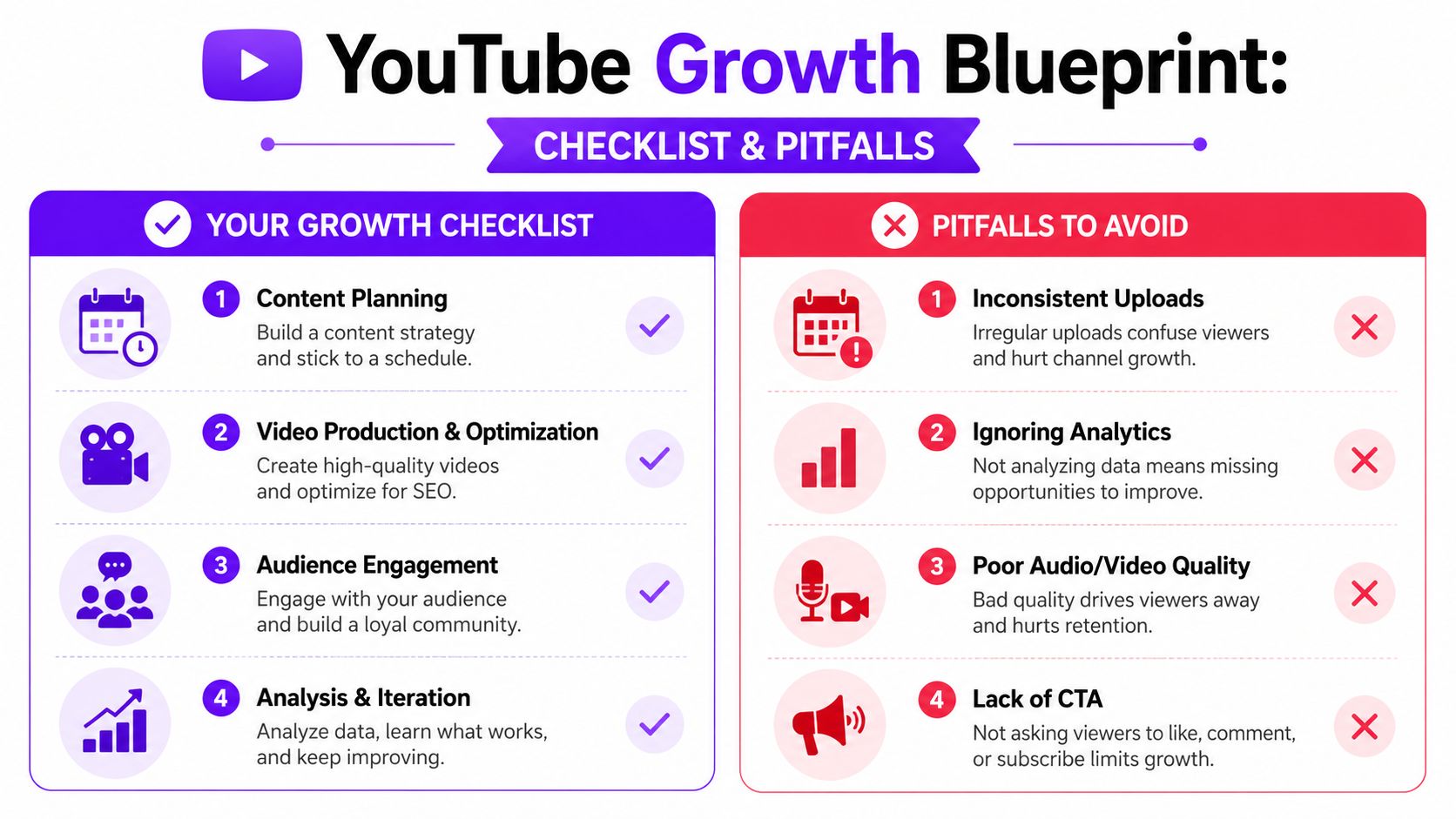
Use this before every upload cycle:
- Check topic fit: Each upload should make sense to the same viewer. If someone likes one video, the next one should feel like an obvious recommendation.
- Check the opening: The first 30 seconds need a clear promise and a reason to keep watching. If the intro wanders, early clicks will not turn into momentum.
- Check packaging before publish: Title and thumbnail should make one clear claim, not compete with each other.
- Check your volume target: New channels usually need a body of work before YouTube can reliably match the content to the right audience. Earlier statistics cited from SQ Magazine's YouTube roundup also point to a broader pattern: Shorts pull massive daily view volume, weekly posting helps, and strong first-month results are possible, but only when creators give the platform enough uploads and enough signal to work with.
- Check your first-hour plan: Send the video to people who already care, reply to comments fast, and stay available while YouTube is deciding whether to keep testing the upload.
- Check the follow-through: Review retention, click-through rate, comments, and subscriber gains together. One metric never tells the full story.
Mistakes that stall a new channel
The biggest mistake is treating quality and traction as separate jobs.
A strong video with no early response often dies before YouTube gathers enough evidence. A weak video with a burst of early clicks usually gets tested, then fades because viewers do not stay. I learned this the hard way. My biggest jumps came from videos that were tight before upload and actively managed right after publish.
Here are the patterns that stall channels:
| Mistake | What happens |
|---|---|
| Topic drift | YouTube gets mixed signals about who to recommend the channel to |
| Publishing without a launch plan | The video misses its best window for early testing |
| Weak title and thumbnail pairing | Impressions do not turn into clicks |
| Slow or absent comment response | You lose early engagement and useful viewer language |
| Chasing every format at once | Energy gets split before one repeatable system is working |
One more trap is judging a video too early without checking the right thing. A low-view upload can still be useful if it held viewers well and attracted the right comments. That is often the video type worth repeating. A higher-view upload with poor retention can send you in the wrong direction if you copy it blindly.
Keep the checklist simple. Make videos people finish. Package them clearly. Show up hard in the Golden Hour. Then study what earned both attention and follow-through, not just what got a temporary spike.
With our Upvote Club service, you can support the one part many creators ignore: early engagement from real people, not bots. We built Upvote.club as a community-driven growth service where members help each other by completing tasks for likes, comments, reposts, saves, and followers across YouTube and other networks. When you join, you get 13 free points and 2 task slots to start, then earn more points by completing tasks for others. Every social account is verified once through our emoji-based system, no passwords required, moderation is strict, bot accounts aren't allowed, and you can see who completed your tasks. Upvote Club works differently from services that sell fake numbers. It's a community model. You help others grow, you earn points, and you use those points to get real early traction on your own posts during the Golden Hour, when fast engagement can make the biggest difference.