Table of Contents
- Table of Contents
- The Follower Growth Blueprint You Have Been Missing
- Pick a narrow viewer, not a broad topic
- Build the channel around that viewer
- How to Find Your Subscriber Magnet Video Topics
- Use overperforming small-channel videos as your map
- Turn one good signal into a content slate
- Content That Keeps Viewers Watching and Subscribing
- Fix the first moments first
- Use engagement ratios as a reality check
- YouTube SEO and Packaging for Clicks
- Make the topic obvious in one glance
- Write titles for humans first
- Activating Growth with Early Engagement Signals
- Why early activity matters
- How I would use community-driven engagement
- Using Analytics to Build a Repeatable Growth Engine
- Track subscriber efficiency, not just subscriber count
- Run a simple weekly review loop
I've watched new creators spend months tweaking banners, adding end screens, and asking for subscribers, then wonder why nothing moves. The fix usually isn't more channel polish. It's picking better video ideas, packaging them clearly, and getting real activity fast enough for YouTube to keep testing the video.
Table of Contents
- The Follower Growth Blueprint You Have Been Missing
- How to Find Your Subscriber Magnet Video Topics
- Content That Keeps Viewers Watching and Subscribing
- YouTube SEO and Packaging for Clicks
- Activating Growth with Early Engagement Signals
- Using Analytics to Build a Repeatable Growth Engine
The Follower Growth Blueprint You Have Been Missing
Most advice on how to get YouTube followers starts too late. It starts with thumbnails, tags, CTAs, or upload frequency. I think that's backwards.
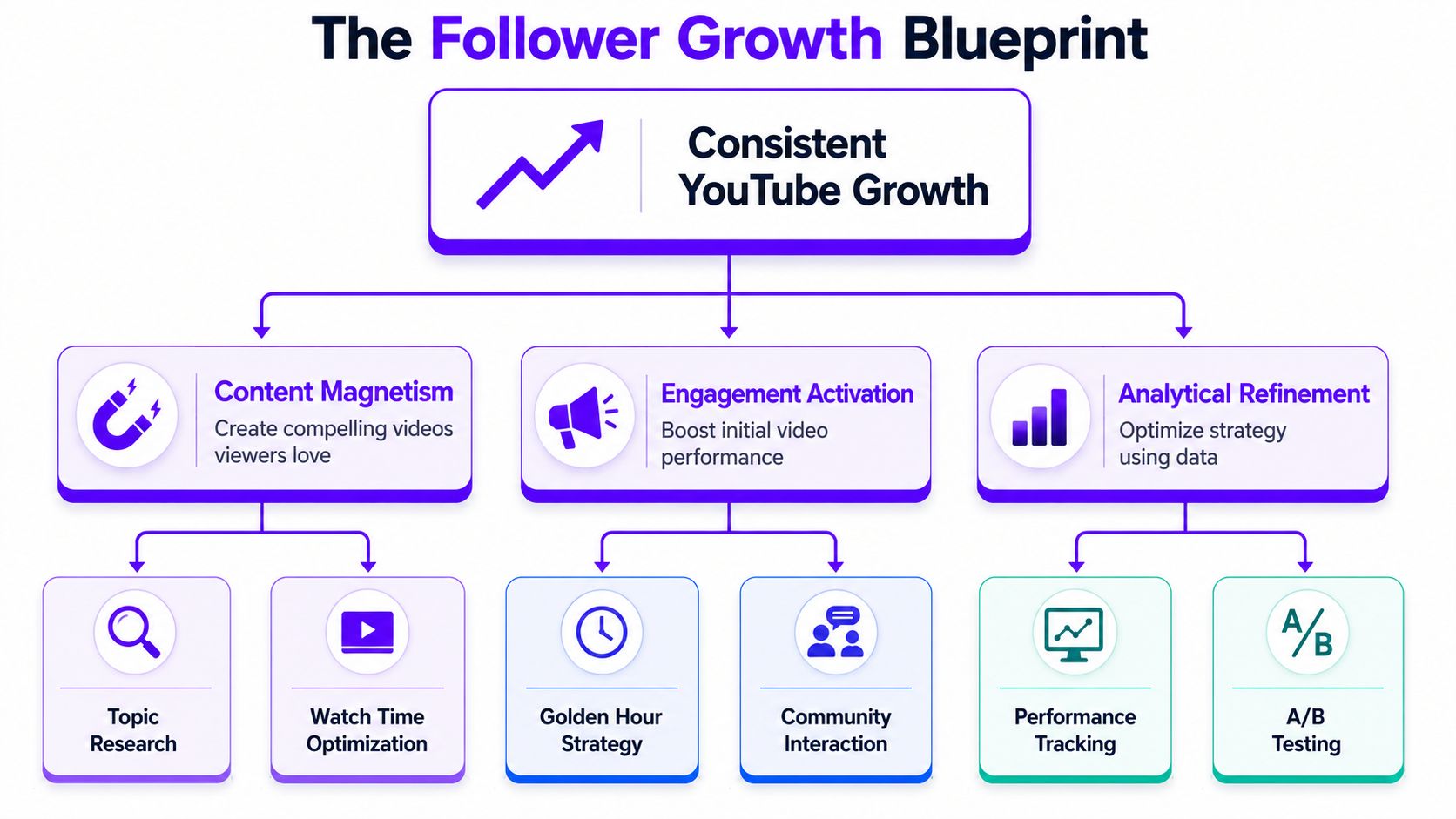
If I were starting a new channel today, I'd begin with one question: who should feel that this channel was made for them? Not “what niche am I in.” Not “what can I talk about.” A specific viewer, with a specific frustration, looking for a specific kind of help.
Pick a narrow viewer, not a broad topic
Broad channels blend in. Narrow channels give viewers a reason to subscribe.
That's why I agree with the view that the better question isn't how to gain subscribers, but how to become the obvious choice for a specific audience segment. A niche-research piece points to sub-niching and long-tail keywords, while creator guidance also recommends studying competitor comments, structure, and audience reactions to calibrate content, which is a good reminder that growth comes from message-market fit, not just channel optimization (Social Video Plaza on sub-niching and audience calibration).
This is how I view it:
- Weak channel idea: personal finance
- Better channel idea: personal finance for first-year freelancers
- Stronger channel idea: cash flow, taxes, and pricing for solo designers in their first two years
That last one gives you topic direction, viewer language, and a reason to subscribe because the content feels customized.
Practical rule: If your target viewer could swap your channel with ten similar ones and lose nothing, your positioning is too loose.
This is the same logic creators use on other platforms. If you're also building short-form distribution, this guide on how to optimize your TikTok profile is worth reading because the principle is identical. Clear audience fit beats generic “creator branding.”
Build the channel around that viewer
Once the viewer is defined, make the whole channel reflect that choice.
Your banner should say what problem you solve. Your profile picture should be simple and readable at small size. Your description should name the audience and the result. Your first line matters most because that's where people decide whether they've found the right channel.
I'd also make a small platform stack around that niche. For example, if you want supporting distribution outside YouTube, you can connect adjacent audience-building work through tools like Upvote Club for TikTok creators, but the key point is this: every platform should point to the same audience promise.
A good channel identity does three jobs at once:
| Channel element | What it should do |
|---|---|
| Banner | State the topic and viewer fit fast |
| Description | Explain why someone should stay |
| Video library | Prove the promise is real |
Most creators try to earn subscribers one video at a time. I'd rather build a channel where every piece tells the same viewer, “You're in the right place.”
How to Find Your Subscriber Magnet Video Topics
Creators waste a lot of time making videos that sound smart but don't convert. The topic might be interesting, yet it doesn't create that reaction YouTube wants: “I need more from this channel.”
The simplest fix is to stop guessing and start looking for topics that already overperform for smaller channels.
Use overperforming small-channel videos as your map
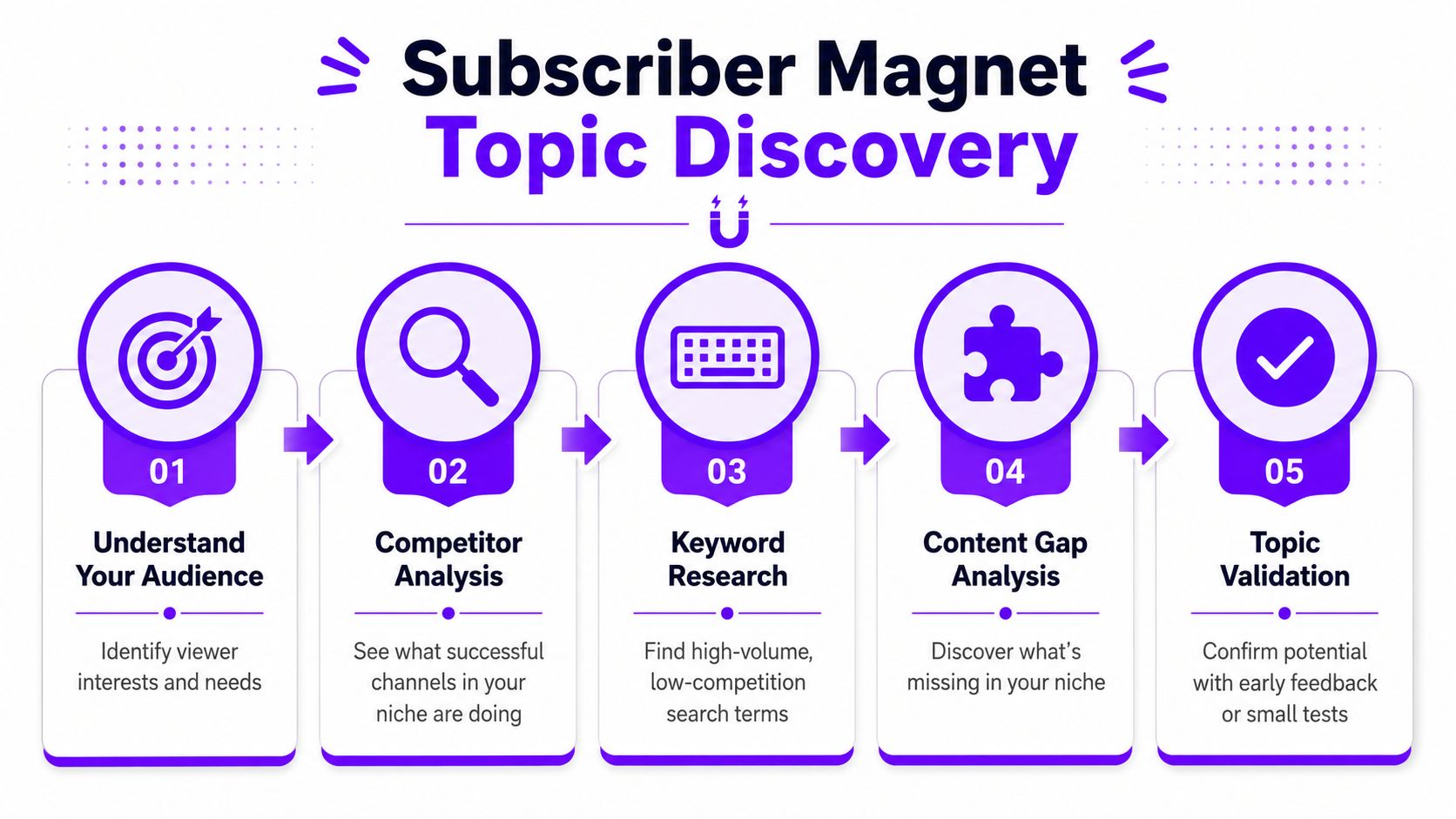
One of the biggest gaps in typical advice about how to get YouTube followers is that it rarely answers which videos convert viewers. A creator growth talk highlighted “market inefficiencies” and “gold mine videos,” meaning videos from smaller channels that overperform by at least 5x relative to their subscriber base. That points to topic selection as the main growth lever, not just funnel tweaks (Backlinko's overview of YouTube subscriber tactics).
If I were building a new channel, I'd do this every week:
- Search one core problem in your niche. Use YouTube search with a clear viewer intent phrase.
- Filter mentally for smaller channels. I want creators who are still climbing, not giant channels that win on brand alone.
- Look for view-to-subscriber mismatch. If the video has far more reach than the channel size would suggest, that's a real clue.
- Study the angle, not just the keyword. What pain point did the title hit? What promise did the thumbnail make?
- Read the comments. Comments tell you what people cared about, what confused them, and what follow-up video they want.
Reddit proves very helpful. If I want raw language from real users before I write a title, I'll scan niche communities and discussion threads. That's one reason tools tied to audience discovery, like Upvote Club for Reddit, fit nicely into topic research workflows.
Turn one good signal into a content slate
A strong topic isn't a one-off. It's a branch.
If one video angle works, build around it with adjacent versions. For example:
- Beginner version: the simplest answer to the core problem
- Mistake version: what people keep getting wrong
- Comparison version: two approaches, tools, or workflows
- Advanced version: what to do after the basics work
- Reaction version: respond to common bad advice in your niche
Don't copy the winning video. Copy the audience demand behind it.
I'd keep a running sheet with three columns: problem, winning angle, next angle. That gives you a content calendar based on proof, not mood.
The core skill isn't “coming up with ideas.” It's noticing where audience demand is already visible, then packaging your own take with better clarity and stronger delivery.
Content That Keeps Viewers Watching and Subscribing
A good topic gets the click. The video itself earns the subscriber.
That means your job isn't to cram in more information. Your job is to hold attention long enough for the viewer to trust you.

Fix the first moments first
Most weak videos fail early. Slow intros, throat-clearing, overexplaining, logo animations, and generic “hey guys welcome back” openings all waste attention.
I'd structure nearly every video like this:
- Open with the problem. Name the pain fast.
- State the payoff. Tell the viewer what they'll get if they stay.
- Prove you can help. Show the result, the framework, or the example.
- Move. Cut dead space. Keep visual and verbal momentum.
If your hook is weak, nothing later matters. Viewers decide fast whether to keep watching.
A simple working formula is: problem, promise, proof, path.
My rule: never start with who you are. Start with why the viewer should care.
The middle of the video should keep paying off the opening promise. Use sections, on-screen labels, quick examples, and pattern changes so the video never feels flat. Tight editing matters less than clear progression. People stay when they feel the video is going somewhere.
Here's a useful example of strong video pacing and presentation:
Use engagement ratios as a reality check
If you want a hard reset on whether your content is landing, use benchmarks. Independent analytics guidance suggests targeting likes to views around 4%, comments to views around 0.5%, and views to subscribers around 14% for a mature channel. Under that framing, a channel with 1,000 subscribers should average about 140 views per video, while a 100,000-subscriber channel should expect around 12,000 to 15,000 views per video (Tubular Labs on YouTube success metrics).
That's useful because it tells you where the problem is.
| If this metric is weak | The likely issue |
|---|---|
| Views are low | Packaging or topic choice |
| Likes are weak | The video didn't connect emotionally or practically |
| Comments are weak | You didn't trigger opinion, reaction, or discussion |
| Subscribers lag | The video solved one problem but didn't create channel-level trust |
I'd also use direct calls to action sparingly. Ask for the subscribe only after you've delivered something useful. Better yet, tie it to a clear reason. “Subscribe for weekly teardown videos on X” works better than “don't forget to subscribe.”
If you want a practical way to support that follower action itself, YouTube subscribe growth support through Upvote Club fits as one distribution-side option. But the video still has to earn the click and the watch first.
YouTube SEO and Packaging for Clicks
Packaging is where a lot of creators lose easy wins. They make a decent video, then wrap it in a vague title and a cluttered thumbnail.
That's a mistake because YouTube is one of the biggest attention markets online. Business of Apps reports 2.74 billion monthly active users in 2024 and says YouTube Shorts were watched 70 billion times per day on average, which means even small gains in click-through and retention can compound fast inside a huge audience pool (Business of Apps YouTube statistics).
Make the topic obvious in one glance
Your thumbnail has one job. Make the viewer understand the promise immediately.
I'd keep thumbnails simple:
- One idea only. Don't stack multiple claims into one image.
- High contrast. Small screens punish muddy design.
- Readable text. If text is needed, keep it short.
- Human emotion or obvious outcome. Faces help when the expression matches the promise.
- Consistency. Not identical design, but recognizable style.
A bad thumbnail hides the topic. A good thumbnail makes the viewer curious about the answer.
If you want a deeper read on how discovery works beyond the basics, this piece on mastering YouTube's discovery algorithm is a useful companion to your thumbnail and title process.
Write titles for humans first
I think creators overthink YouTube SEO and underthink clarity.
Your title should usually do one of these things:
- Promise a result
- Call out a mistake
- Frame a comparison
- Create a knowledge gap
- Name a sharp problem
Examples of stronger title logic:
- Result-focused: How I Edit Talking Head Videos Faster
- Mistake-focused: Why Your Budget Spreadsheet Keeps Failing
- Comparison-focused: Notion vs Trello for Solo Creators
- Problem-focused: I Stopped Wasting Hours on Video Research
Descriptions matter too, but mainly as supporting context. Put the main topic early, write naturally, and include related terms without stuffing. You're helping YouTube categorize the video and helping the viewer confirm they clicked the right thing.
For creators who want outside support while building distribution around packaged content, Upvote Club for YouTube engagement is one practical option to pair with stronger titles and thumbnails. Packaging gets the click. Distribution helps the video earn enough early visibility to be judged fairly.
Activating Growth with Early Engagement Signals
Publishing isn't the finish line. It's the test.
A practical subscriber benchmark from creator guidance is a roughly 2% view-to-subscriber conversion rate, so reaching 1,000 subscribers under that assumption takes about 50,000 total views. The same workflow recommends publishing 16 videos over 8 weeks, with the expectation that around one-third can find a strong audience and start compounding daily views and subscriber growth (this YouTube growth workflow).
That matters because you do not need every upload to win. You need enough swings, and you need each upload to get a fair shot.
Why early activity matters
The first phase after publishing tells YouTube whether your video deserves broader testing. If viewers click, watch, like, and comment quickly, the platform has a reason to keep distributing it.
That's why I'm strict about launch discipline. When a video goes live, I'd already have these ready:
- A pinned comment that invites a real response
- A community post or cross-platform mention that sends relevant viewers, not random traffic
- A reply window blocked off so I can answer comments quickly
- A follow-up short or clip if the topic has obvious short-form hooks
If you publish and disappear, you waste the strongest window the video gets.
For creators working Shorts into that system, Framesurfer's guide to Shorts growth is worth a look because Shorts can feed discovery and bring new viewers into long-form content when the topic overlap is tight.
How I would use community-driven engagement
This is the one place where I'd use a structured external boost, but only if it's real people and only if the video already deserves traction.
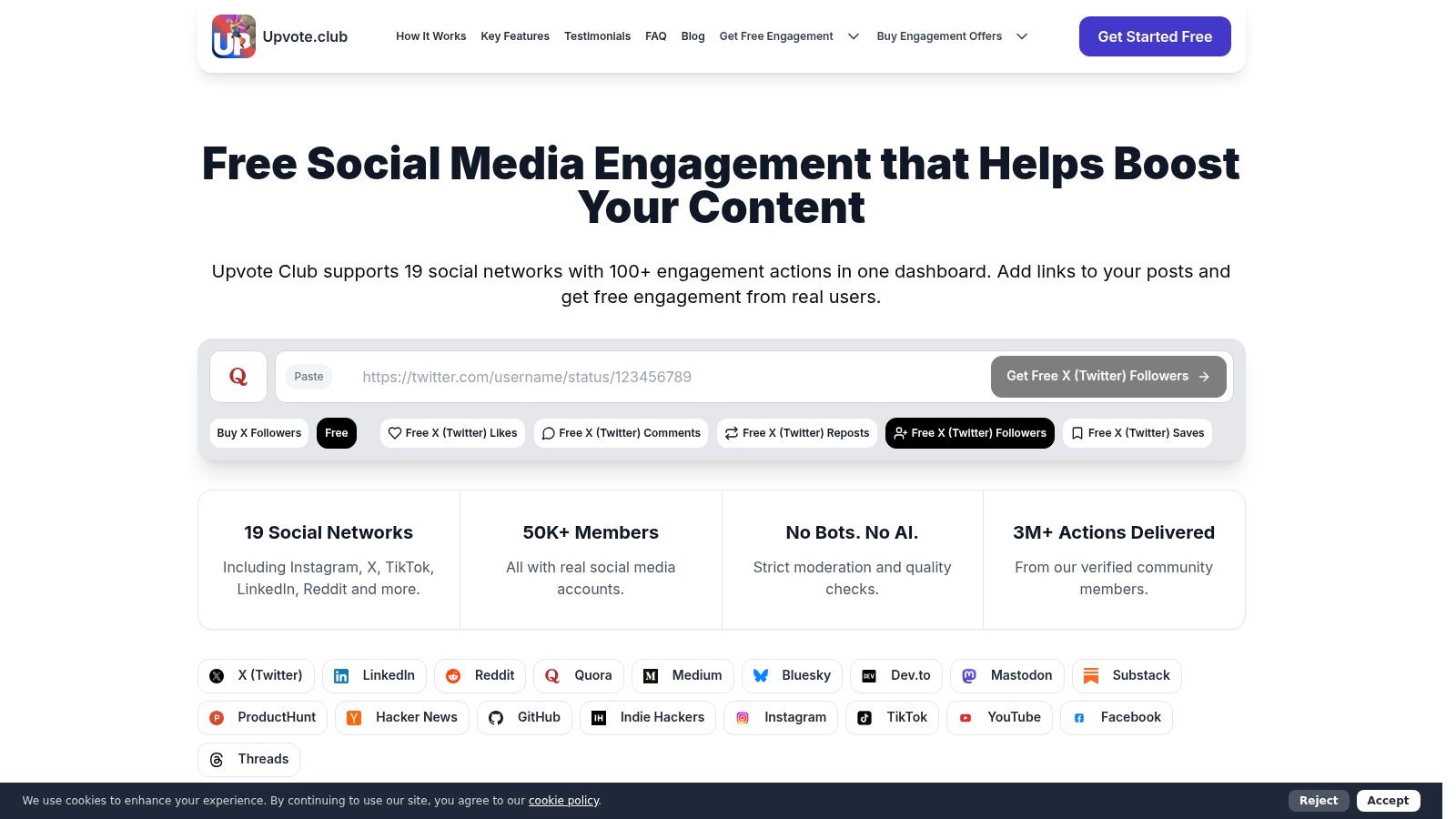
With our Upvote.club service, you can create tasks for likes, comments, reposts, saves, and followers from verified human accounts across YouTube and other platforms. It runs on a community model, not bot buying. Members complete tasks for others, earn points, and use those points to create their own tasks. New users receive 13 free points and 2 task slots, each network only needs one verification, no passwords are required, and the platform uses an emoji-based verification system. Users also receive 1 free task slot every 24 hours. I like this model because it focuses on accountable participation, visible task completion, and strict anti-bot moderation rather than fake volume.
That fits the reality of YouTube launch windows. If a video is strong but your channel is still small, early human interaction can help the video clear the dead zone where nobody sees it, nobody reacts, and YouTube stops testing it.
Good promotion doesn't rescue bad content. It gives good content enough oxygen to compete.
I'd use that support selectively. Not on every upload. Only on videos that match the channel tightly, have a clear subscriber angle, and deserve extra push in that early period.
Using Analytics to Build a Repeatable Growth Engine
Most creators check subscriber count, feel happy or annoyed, then move on. That's lazy analysis.
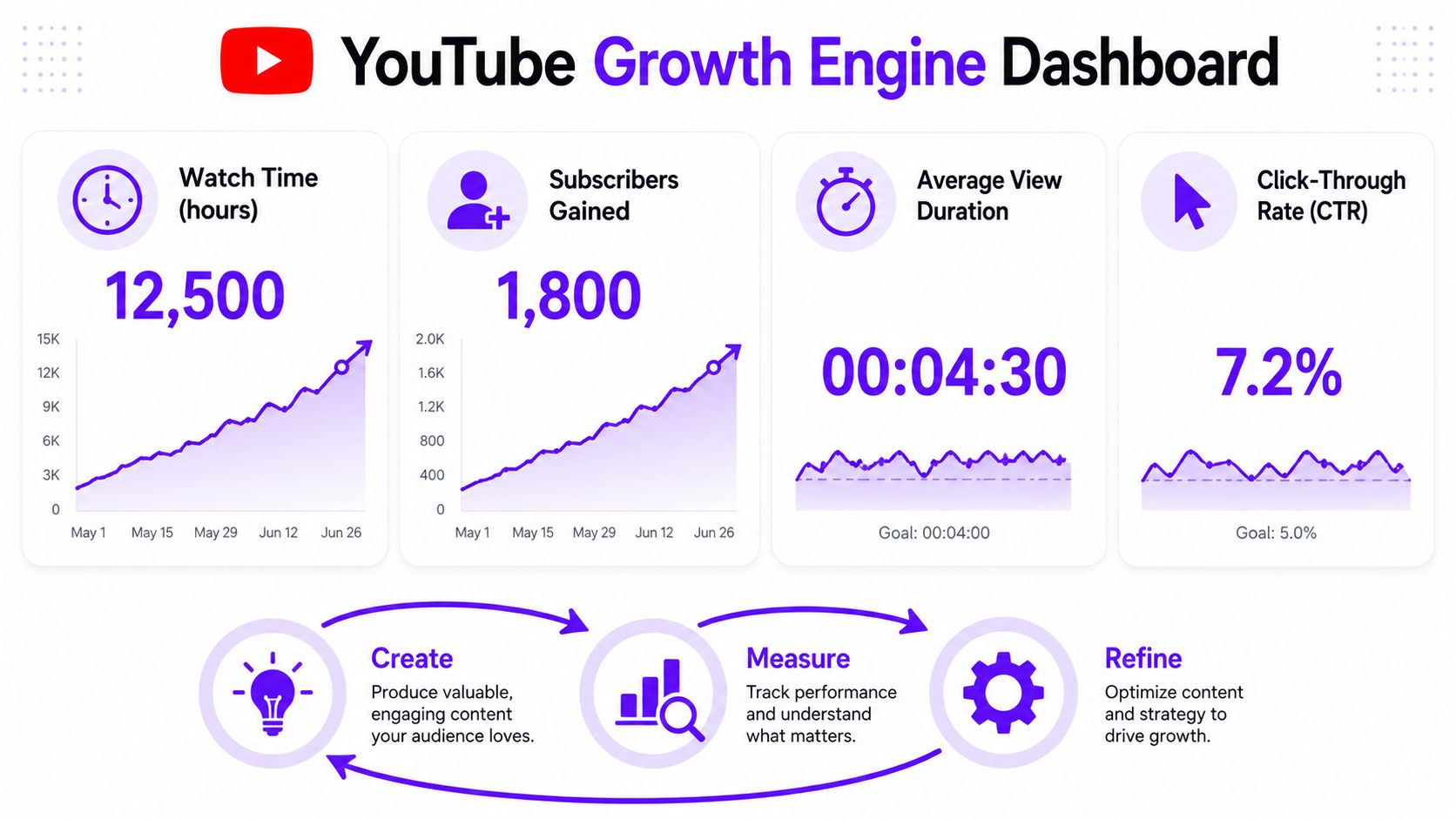
YouTube gives you better tools than that. Google says YouTube Analytics lets channel owners monitor performance across videos, channels, and audience data, and advanced mode supports comparisons over the last 7 days versus the previous 7-day period and exportable reports (Google's YouTube Analytics help page).
Track subscriber efficiency, not just subscriber count
If I were trying to figure out how to get YouTube followers faster, I wouldn't ask “Which videos got the most subscribers?” I'd ask, which videos got the most subscribers per view?
That question changes everything.
A high-view video can look impressive and still be weak at building a channel. A lower-view video can become a subscriber magnet because the viewers are exactly right.
Here's the scorecard I'd review for each upload:
| Question | What I'm looking for |
|---|---|
| Did people click? | Was the packaging strong enough to earn a test |
| Did they stay? | Did the opening and structure hold attention |
| Did they react? | Comments and likes show actual connection |
| Did they subscribe? | The topic and delivery created channel trust |
When a video wins on all four, I don't celebrate and move on. I make sequels, adjacent angles, and updated versions.
Run a simple weekly review loop
My weekly review would be short and blunt.
- Cut losers fast. If a topic repeatedly brings weak viewers or weak conversion, stop forcing it.
- Double down on efficient winners. Make the next three ideas from the same audience pain point.
- Check traffic source patterns. Search-led wins and browse-led wins often want different packaging.
- Use short comparison windows. The 7-day versus previous 7-day view in advanced mode is enough to spot movement without drowning in noise.
- Export and label patterns. Save notes on topic type, title angle, thumbnail style, and subscriber pull.
Working rule: every upload should teach you what to make next.
That's the part most creators miss. Analytics isn't for reporting. It's for decision-making.
If a video pulled in the right viewers, held them, and turned them into subscribers, your next job is obvious. Make the next version for the same audience with a sharper angle. If a video got views but didn't build the channel, stop treating it like a win.
That's how I'd build from zero today. Narrow audience. Better topic selection. Cleaner packaging. Stronger launch activity. Ruthless review. Repeat.
If you want a practical way to support early engagement across YouTube and other social platforms without using bots, take a look at Upvote Club. It uses a community-based model where members complete tasks, earn points, and use those points to bring real interaction to their own posts, which makes it a useful option when you want more visible launch activity from verified human accounts.