Table of Contents
- Table of Contents
- Beyond "Good Content" Why Your Channel Isn't Growing
- The Foundation Your Channel's First Impression
- Clarity beats design flair
- Build a page that answers three questions fast
- The Content Engine Designing Videos That Attract Subscribers
- Pick a viewer, not a broad niche
- Find your subscriber magnet and build around it
- YouTube SEO and Packaging Getting Discovered
- Discovery starts before recording
- Packaging is a promise
- The Golden Hour Driving Initial Engagement
- What early engagement actually does
- A practical way to seed that first wave
- Turning Viewers Into a Community
- The passive channel vs the active channel
- Small community habits that compound
- The Growth Loop Analytics and Realistic Timelines
- Measure the videos that create subscribers
- Use a planning model, not a fantasy
Most advice on how to get YouTube subscribers is too soft to be useful. “Make great videos” sounds right, but it leaves out the part that hurts most creators: you can publish solid work and still stall.
That happens because subscriber growth isn't driven by content quality alone. It comes from a system. The videos need to fit a clear promise, the packaging needs to win the click, and the channel needs a path that turns casual viewers into repeat viewers. Without that, even strong uploads land, get watched, and disappear.
That matters on a platform this large. YouTube had 2.6 billion monthly active users in 2026, viewers spent more than 1 billion hours per day watching videos, and Shorts averaged over 200 billion daily views according to Hootsuite's YouTube statistics roundup. The audience is there. The problem usually isn't “YouTube is too crowded.” The problem is that the channel isn't giving viewers a clear reason to subscribe.
Table of Contents
- Beyond "Good Content" Why Your Channel Isn't Growing
- The Foundation Your Channel's First Impression
- The Content Engine Designing Videos That Attract Subscribers
- YouTube SEO and Packaging Getting Discovered
- The Golden Hour Driving Initial Engagement
- Turning Viewers Into a Community
- The Growth Loop Analytics and Realistic Timelines
Beyond "Good Content" Why Your Channel Isn't Growing
“Good” is too vague to build a channel around.
A video can be well edited, useful, and even entertaining, yet still fail to turn viewers into subscribers. The usual reason is disconnect. One upload targets beginners, the next targets advanced viewers, the thumbnail style changes every week, and there's no repeatable reason for someone to think, “I want more of this.”
That's why channels with a lot of consistent, focused videos often beat channels with a handful of impressive but unrelated uploads. Viewers subscribe to predictability. They want to know what they'll get next.
Practical rule: Don't ask whether a video is good. Ask whether it fits a repeatable promise that the right viewer would subscribe for.
The system is simple to describe and harder to run well:
- Content: the topic, audience, format, and payoff.
- Packaging: the title and thumbnail that win attention.
- Promotion: the push that gets the video moving early and puts it in front of more of the right people.
If one part is weak, the whole thing drags. Strong content with weak packaging gets ignored. Strong packaging with weak content gets clicks but weak retention. Strong videos with no follow-through turn into isolated wins instead of channel growth.
If your uploads are getting some views but not many subscribers, it helps to first diagnose YouTube video problems by separating reach problems from conversion problems. Those are different failures, and they need different fixes.
The Foundation Your Channel's First Impression
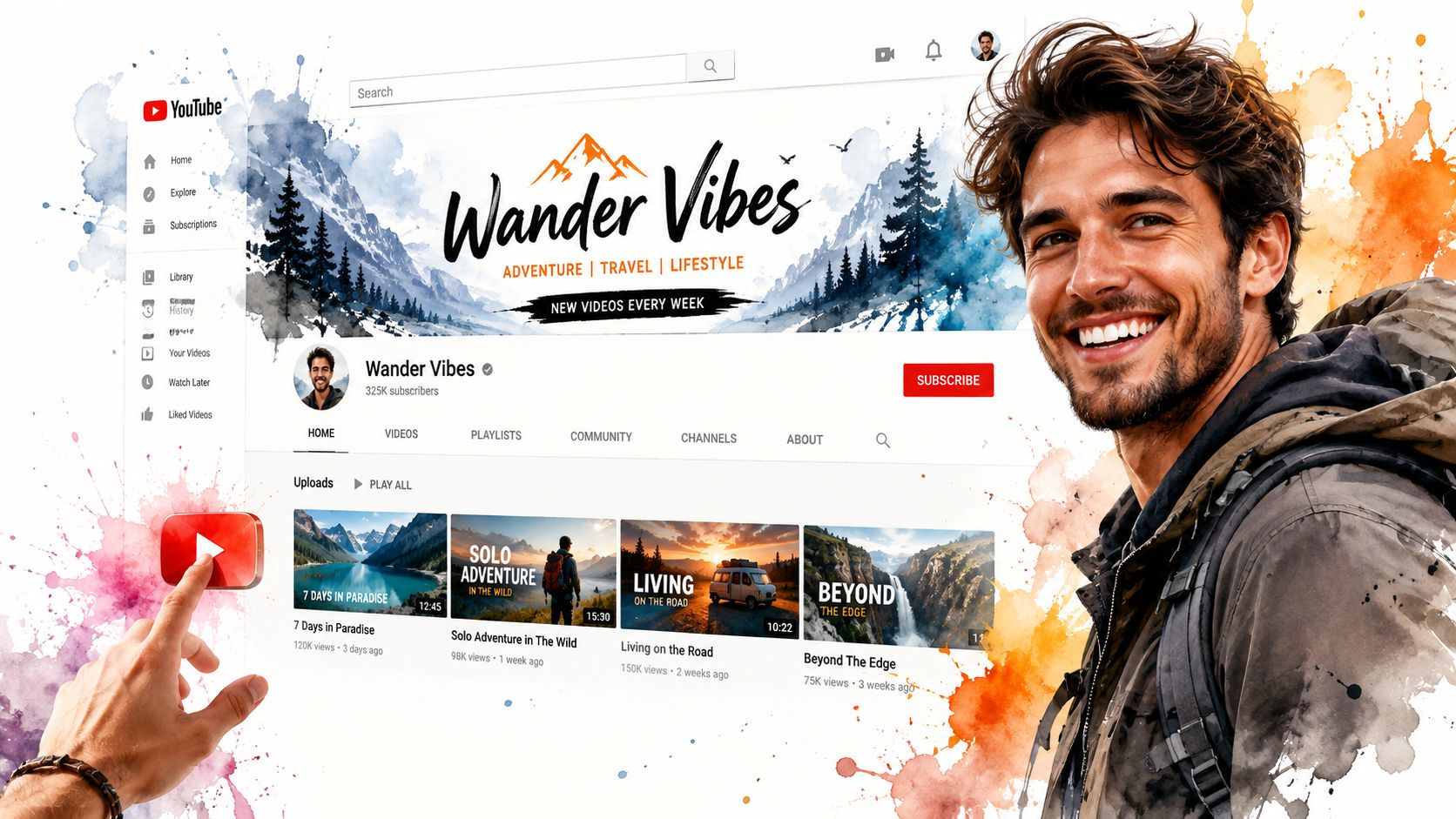
Most channels lose subscribers before a viewer watches a second video. The visitor lands on the page, scans for a few seconds, and can't tell who the channel is for.
That first impression isn't about fancy branding. It's about reducing confusion. A channel page should answer three things fast: what this channel covers, who it helps or entertains, and why there will be more worth watching.
Clarity beats design flair
A clean banner matters because it sets the promise. Skip vague slogans. Use plain language that names the topic and the viewer. If your channel helps beginner photographers shoot better travel videos, say that. If you publish breakdowns of indie game marketing, say that.
The same goes for your profile photo and visual style. Recognition matters more than decoration. If you also stream, your production setup should be watchable and stable, not fancy. For creators building a basic on-camera workspace, Budget Loadout's streaming setup guide is a useful starting point because it focuses on practical gear choices instead of aspirational studio builds.
Build a page that answers three questions fast
A strong channel page usually has these parts working together:
- Banner: state the topic and posting pattern in plain English.
- Featured video: use a short trailer for new visitors, or feature your best converting video if the trailer feels too generic.
- Home page sections: group videos into clear playlists by problem, outcome, or format.
- About page: write a short description that says who the channel serves and what viewers should expect.
One easy mistake is treating the trailer like a brand ad. It works better as a direct pitch. Tell people what they'll get if they subscribe. Name the type of videos, the point of view, and the result.
A creator who posts tutorials, reviews, and random life updates all on the same home page usually creates doubt. A creator who organizes the page into focused playlists gives the visitor a path.
Later, when you start pushing engagement to key uploads, your channel page should already be ready to convert that traffic. If you want a straightforward place to support a YouTube release with community activity, our YouTube growth page on Upvote.club shows how that workflow fits into a broader publishing routine.
Here's a quick visual breakdown of how creators frame channel pages for conversion:
A visitor shouldn't have to investigate your channel. They should understand it on arrival.
The Content Engine Designing Videos That Attract Subscribers
Subscriber growth comes from formats, not isolated ideas.
A lot of creators chase novelty. They post one video about a tool review, another about productivity habits, then a reaction, then a tutorial. That can create spikes, but it rarely creates momentum. People subscribe when they can imagine the next upload before it exists.
Pick a viewer, not a broad niche
“Fitness” is too broad. “Home workouts for new dads with limited time” is usable. “Marketing” is too broad. “YouTube growth systems for solo B2B founders” is usable.
That difference changes your topics, intros, thumbnails, and examples. It also changes what people subscribe for. A broad niche makes you replaceable. A specific viewer makes you memorable.
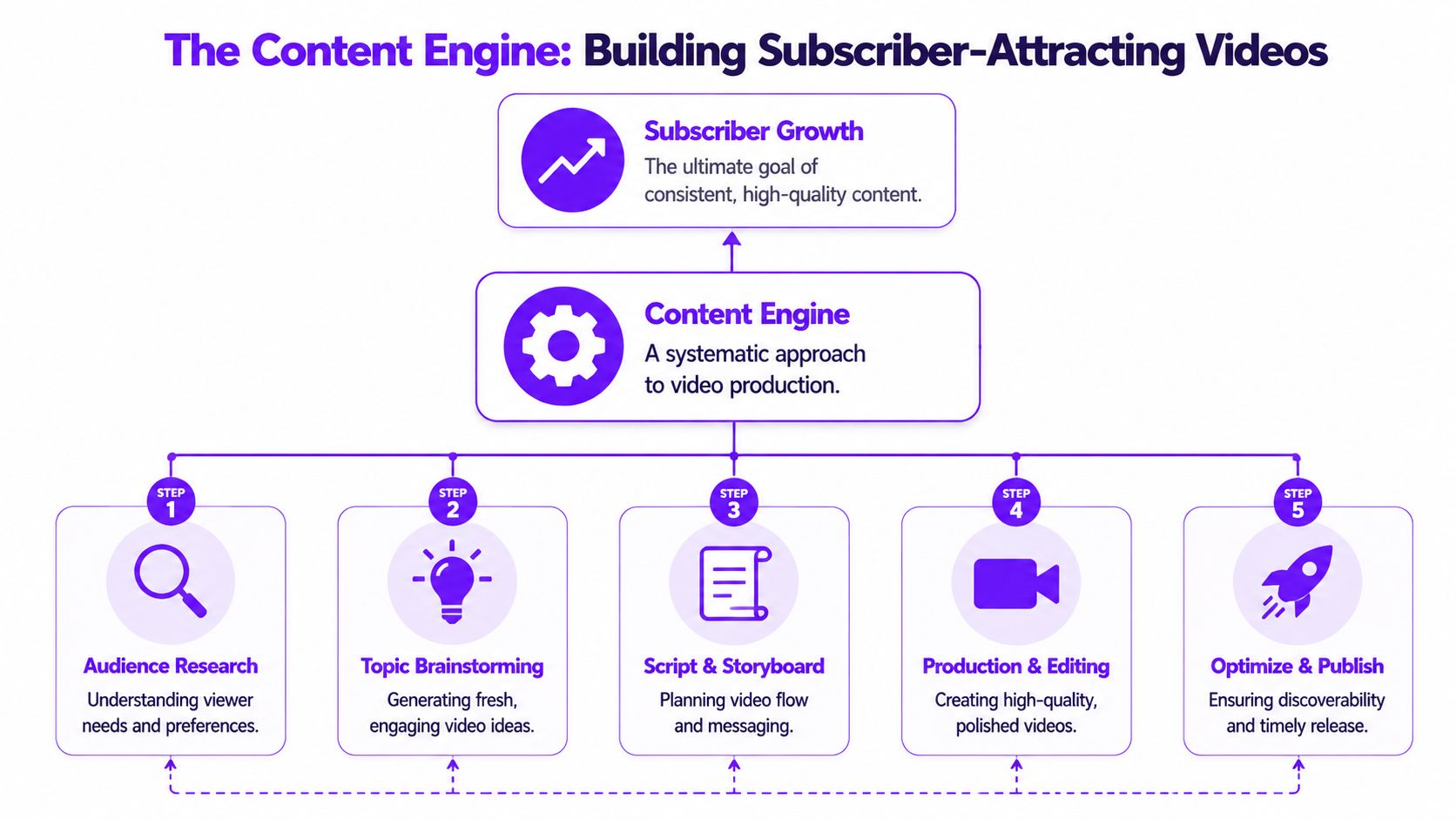
The content engine usually starts with three buckets:
| Bucket | What it does | Example |
|---|---|---|
| Problem videos | Pull in search and intent traffic | “Why your Shorts get views but no subscribers” |
| Format videos | Build repeat viewing through familiarity | “Channel teardown Friday” |
| Proof videos | Show your method in action | “I repackaged three old videos and tracked the result” |
This is also where repurposing can help. If you're turning one core idea into multiple short assets for testing hooks or angles, tools like ShortGenius AI UGC ad platform can help speed up creative variations. That's useful when you're trying to find which framing earns attention before you commit to a bigger long-form production.
Find your subscriber magnet and build around it
One of the biggest missed opportunities on YouTube is conversion optimization. Broad advice keeps telling creators to ask for subscribers, use end screens, and make playlists. That's fine, but it misses the harder question: which specific videos already turn viewers into subscribers?
Backlinko points to finding your channel's Subscriber Magnet in Analytics, then routing more traffic to that asset through end screens, playlists, cards, and even the channel trailer in its guide on how to get YouTube subscribers. That idea matters because many channels have one or two videos doing the main conversion work while the rest just gather views.
Once you identify that type of video, don't just celebrate it. Clone the underlying pattern:
- Keep the audience the same. If the winning video attracts a different type of viewer than the rest of the channel, it may produce weak long-term loyalty.
- Repeat the core promise. Turn one successful angle into a series, not a one-off.
- Send traffic intentionally. Put that video in playlists, cards, and pinned comments across related uploads.
- Study the opening. Often the underlying reason a video converts isn't the topic alone. It's the way the problem is framed in the first thirty seconds.
If you also want early social proof on selected uploads while you test video packaging, our YouTube likes task flow at Upvote.club is one way to coordinate human engagement around a release without using bots or sharing passwords.
YouTube SEO and Packaging Getting Discovered
Search and browse don't reward effort. They reward clarity.
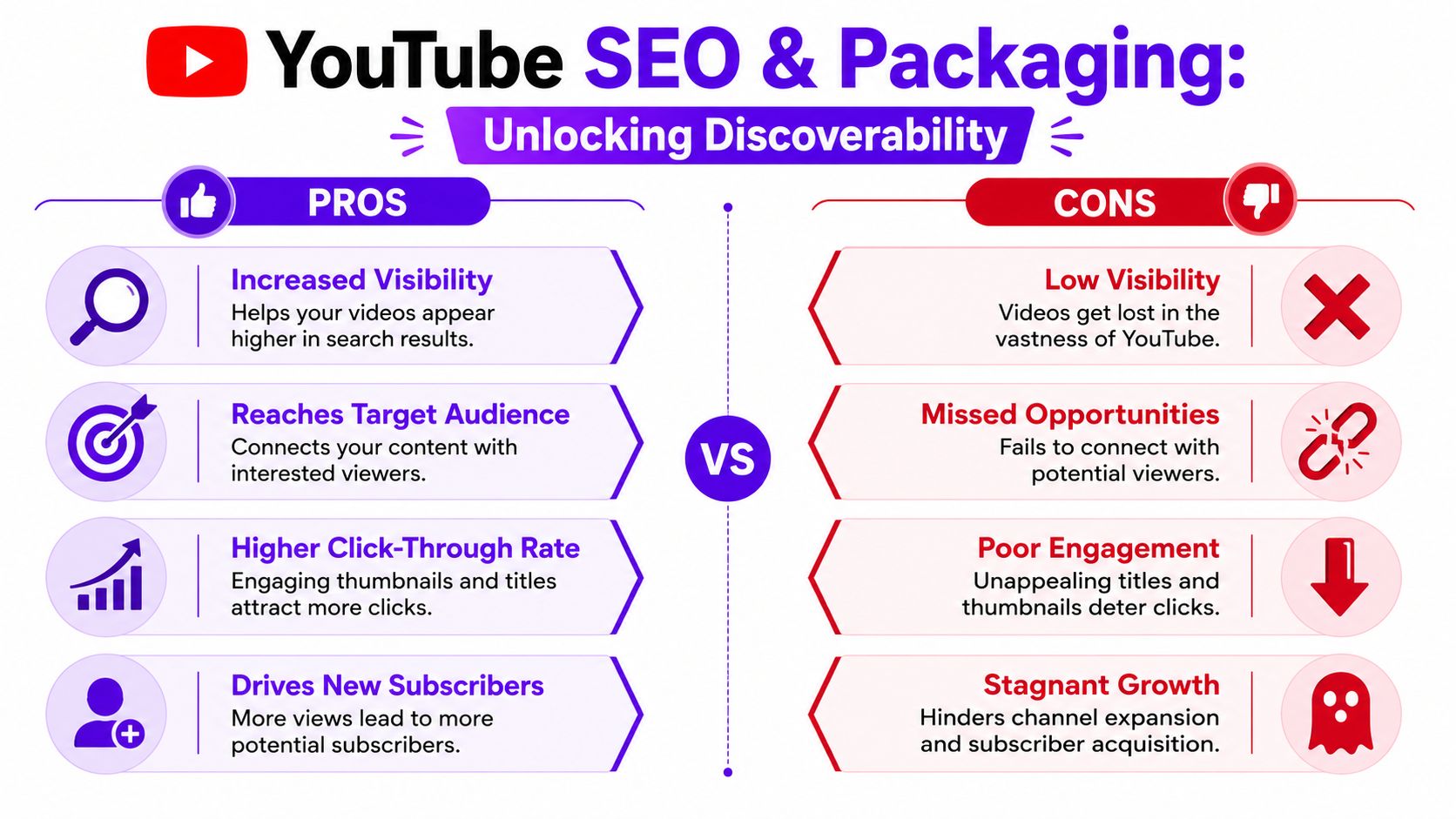
You can spend days making a solid video and still lose because the title is vague, the thumbnail says nothing, or the opening doesn't match the promise. Good packaging gets the click from the right person. Bad packaging hides a good video in plain sight.
Discovery starts before recording
Most creators do keyword research too late. They record first and try to invent a searchable title after the fact. That usually leads to awkward phrasing or a title that doesn't match what viewers wanted.
A better workflow is to start with language viewers already use. Search your topic on YouTube, study autosuggestions, look at the wording in results, and note which angles keep appearing. You're not copying. You're finding demand.
A simple filter helps:
- Clear problem: the viewer knows what they need solved.
- Specific outcome: the title promises a result, not a theme.
- Fit with channel: the topic should lead naturally to another video on your page.
Good title:
“Why Your YouTube Shorts Get Views but No Subscribers”
Weak title:
“My Thoughts on Shorts Growth”
The first is searchable and specific. The second is about you, not the viewer.
Packaging is a promise
Titles and thumbnails work as a pair. If both say the same thing, one of them is wasted. The title should carry the context. The thumbnail should carry the tension, contrast, or payoff.
Here is a better way to conceptualize it:
| Element | Weak version | Stronger version |
|---|---|---|
| Title | Broad topic | Specific problem or outcome |
| Thumbnail text | Repeats title | Adds a new angle |
| Visual | Generic face shot | One focal point tied to the claim |
The packaging also needs to match the video itself. If the thumbnail screams big transformation and the opening rambles, viewers leave fast. That hurts the video twice. You lose the view, and you lose trust.
Packaging check: If a stranger saw only your title and thumbnail, would they know who the video is for and why it matters now?
Comments can also sharpen discoverability after publish because they add discussion around the topic and signal what viewers care about. If you're organizing launch activity around a new upload, our YouTube comment task option on Upvote.club can be used to prompt real users to engage with the video from their own accounts.
The Golden Hour Driving Initial Engagement
The first hour after publish often tells you whether a video has real life in it.
If viewers click, watch, like, and comment soon after the upload goes live, YouTube gets a cleaner signal that the video is worth testing more widely. If the launch is flat, the video can still recover later, but the climb is harder.
What early engagement actually does
Early engagement doesn't fix a weak video. It does something more practical. It gives a strong video a fairer chance to be evaluated.
That distinction matters because many creators either ignore launch mechanics or go the wrong direction and chase fake activity. Inflated numbers from low-quality sources don't help much if the people interacting aren't real viewers with real accounts and real watch intent.
A cleaner approach is to line up actual people who can engage around release time. That can be your email list, your Discord, peers in your niche, or a community-driven task system. The point isn't vanity. It's momentum.
A practical way to seed that first wave
With our YouTube subscribe task flow on Upvote.club, creators can set up engagement tasks through a community model rather than buying bot activity. Members complete tasks for others using verified human accounts, earn points, and use those points on their own posts. New users get 13 free points and 2 task slots, each social account is verified once through an emoji-based system without passwords, and users receive 1 free task slot every 24 hours. That structure keeps the process tied to participation instead of fake automation.
Upvote Club works differently from services that just sell engagement. It runs on a community loop. Users help other users, moderation is strict, and bot accounts aren't allowed. You can create tasks for likes, comments, reposts, saves, and followers across YouTube and other platforms, and you can see who completed them.
A practical launch stack looks like this:
- Before publish: prep the thumbnail, title variants, pinned comment, and playlist placement.
- At publish: notify your warm audience first.
- In the first hour: reply to comments quickly and keep the thread active.
- After that window: move traffic from related videos, Shorts, or posts into the new upload.
If a video needs help getting seen, give it a real audience first, not fake numbers.
Turning Viewers Into a Community
Two channels can publish equally good videos and end up in very different places.
The first channel uploads, leaves, and returns next week. Comments pile up unanswered. The pinned comment is either missing or wasted on “subscribe for more.” The Community tab sits empty. Subscribers drift in and out without much attachment.
The second channel treats every upload like the start of a conversation. Viewers ask questions, and the creator answers with follow-ups, not one-word replies. Polls in the Community tab shape future uploads. End screens send people into a playlist that deepens the relationship instead of dropping them at the end of a single video.
The passive channel vs the active channel
Community isn't built through motivational language. It's built through repeated signals that viewers matter.
One easy way to judge that is by the interaction quality around your videos. Tubular Labs notes benchmark ratios of about 4% likes to views and 0.5% comments to views, and for a 100,000-subscriber channel it cites 12,000 to 15,000 views per video as an expected range, or about 14% views-to-subscribers, in its article on three metrics that benchmark YouTube success. Those numbers are useful as a diagnosis tool. If a channel gets impressions but weak interaction per view, the content may be attracting curiosity without enough satisfaction to earn durable subscribers.
Small community habits that compound
The strongest community habits are simple and repeatable:
- Reply with purpose: answer the comment, then ask a short follow-up question.
- Pin for discussion: use the pinned comment to extend the topic, not to beg for the subscription.
- Guide the next watch: send viewers to a playlist that matches the problem they just watched.
- Use the Community tab like a workshop: polls, behind-the-scenes notes, and topic tests work better than generic announcements.
A subscriber list is useful. A returning audience is better.
When people feel known, they don't just click subscribe. They come back with context, they comment sooner, and they start pulling other viewers into the discussion on your behalf.
The Growth Loop Analytics and Realistic Timelines
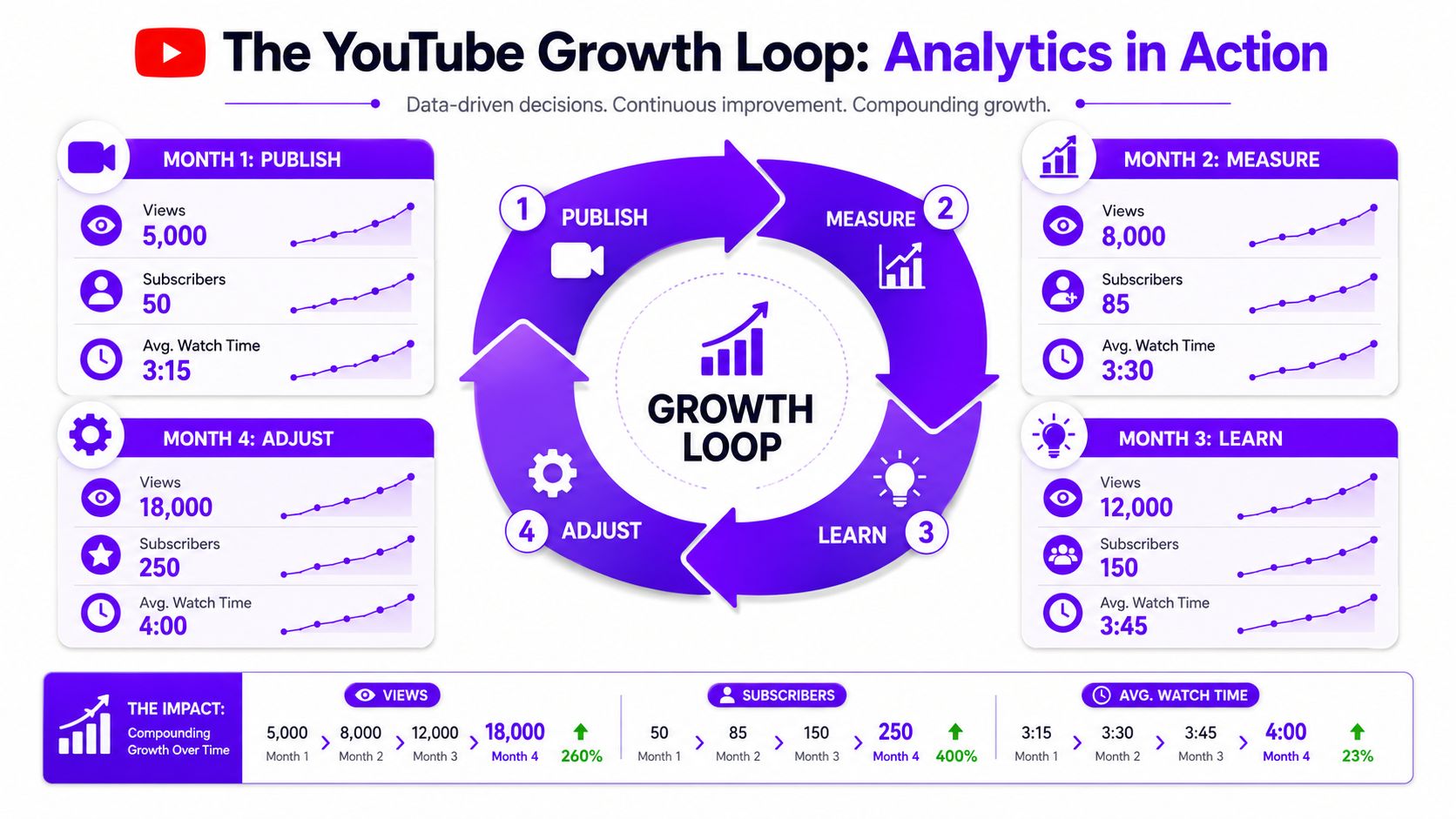
Channels usually stall when creators measure the wrong things. Views alone can hide the truth. A video can get traffic and still be weak at turning that traffic into subscribers.
The better loop is simple: publish, inspect what converted, fix what didn't, and repeat.
Measure the videos that create subscribers
YouTube Analytics gives creators a direct way to track where subscriptions happened. In YouTube's own help documentation, subscription source data shows whether viewers subscribed from watch pages, Shorts, live streams, posts, and other surfaces, which means you can identify which formats convert viewers instead of only counting views in YouTube Analytics subscription source reporting.
That changes what you do next. If Shorts drive reach but watch pages drive more subscriptions, your job isn't to argue about formats. Your job is to use Shorts as the front door and long-form videos as the closer. If one topic keeps creating subscribers, build more around that topic. If a video gets views but no meaningful subscription activity, it may be attracting the wrong viewer.
Use a planning model, not a fantasy
Subscriber growth is measurable, but it isn't linear. Some uploads pull hard, some barely move, and most channels hit long flat stretches before momentum shows up.
A practical creator benchmark says a channel converts about 2% of viewers into subscribers, so reaching 1,000 subscribers takes roughly 50,000 total views. One creator method also suggests working backward by publishing about 16 videos over 8 weeks and targeting topics where even a third of the uploads find a hungry audience, as explained in this creator benchmark video on reaching 1,000 subscribers. That's not an official YouTube number, but it is a useful planning model because it pushes you to think in volume, fit, and repetition instead of hoping one video changes everything.
The creators who reach their first real milestone usually don't do anything mystical. They keep tightening the loop. They post with intent, track subscription sources, study which formats convert, and double down on what earns repeat attention.
If you want a practical way to support launches with real human engagement across YouTube and other platforms, Upvote Club runs on a community model where members complete tasks for one another, earn points, and use those points to drive likes, comments, reposts, saves, and followers without bots or password sharing.