Table of Contents
- Table of Contents
- Set Up a Profile People Want to Follow
- Make the follow decision easy
- What a strong profile actually includes
- Does X Premium Help You Get More Followers?
- Develop a Content System That Works
- Pick a few lanes and stay in them
- Use formats that fit the idea
- Do Twitter Threads Still Work in 2026?
- Build around a repeatable workflow
- How Many Times Should You Post on X Per Day?
- Master Active Community Engagement
- A real daily workflow
- What a good reply looks like
- Kickstart Engagement During the Golden Hour
- Why the first hour matters more now
- What's the Fastest Way to Get Twitter Followers?
- A practical way to get early engagement
- Measure What Matters for Follower Growth
- The metrics that tell the truth
- What to do with the numbers
- How Long Does It Take to Get Twitter Followers Organically?
- How to Go From 0 to 1,000 Followers on X
- Avoid These Common Growth Mistakes
- Should You Buy Twitter Followers?
- Is It Too Late to Grow on X in 2026?
You get Twitter followers on X when a clear profile, niche content, and real replies turn profile visits into follows. I've watched new accounts post smart takes for weeks and still get ignored. Then they fix the profile, tighten the content, start replying like a real person, and the account finally moves. Organic growth usually takes weeks to months when those pieces stay consistent — not overnight spikes from empty tactics.
Table of Contents
- Set Up a Profile People Want to Follow
- Develop a Content System That Works
- Master Active Community Engagement
- Kickstart Engagement During the Golden Hour
- Measure What Matters for Follower Growth
- How Long Does It Take to Get Twitter Followers Organically?
- How to Go From 0 to 1,000 Followers on X
- Avoid These Common Growth Mistakes
Set Up a Profile People Want to Follow
I've seen this mistake over and over. Someone writes a solid post, gets a spike of profile visits, and turns that attention into nothing because the profile says nothing useful.
Your profile is the conversion point. It decides whether a visitor becomes part of your audience or disappears after one glance. If it looks vague, over-optimized, or disconnected from what you post, you lose the kind of follower you want most. The fix is simple. Make your profile clear, specific, and credible.
Make the follow decision easy
People follow accounts they can understand fast.
A weak profile forces visitors to guess:
- “Building in public”
- “Thoughts on tech, startups, life”
- “DM for collabs”
Those bios are empty. They signal no niche, no audience, and no reason to stick around.
A strong profile does three things right away. It shows what you talk about, who your content helps, and what kind of posts people should expect. If you're a developer, say what you build and what you share. If you're a marketer, name the channel, market, or buyer you focus on. If you're a journalist, make your beat obvious.
Nielsen Norman Group has long documented how people scan web pages for clear value and cues before they commit attention. The same behavior shows up on X. Visitors scan your name, photo, bio, header, and pinned post in seconds. If those pieces line up, trust goes up.
Practical rule: A stranger should understand your topic, your angle, and your usefulness before they scroll.

What a strong profile actually includes
A strong profile includes a clear bio, a recognizable image, a relevant header, a useful pinned tweet, and one focused link. Together, these elements tell visitors what you cover, establish credibility, and make the follow decision easier.
- A clear bio: Use plain language and niche words people recognize. “I break down B2B SaaS landing pages” beats “marketing thinker.”
- A clean headshot or brand image: Fuzzy avatars make small accounts look disposable.
- A header with context: Your banner should reinforce your niche, product, or point of view.
- A pinned tweet: Pin the post that shows your best thinking, proof, or welcome message.
- One real link: Give visitors a single next step, whether that's a site, newsletter, or product.
Write your bio for the visitor, not for your own ego. Positioning beats self-expression here. You are not trying to sound impressive. You are trying to make the follow decision easy.
Here's the difference:
| Profile element | Weak version | Better version |
|---|---|---|
| Bio | “Entrepreneur. Ideas.” | “I share daily lessons from building developer tools” |
| Header | Random graphic | Visual that matches niche or offer |
| Pinned tweet | Old personal post | Best thread, case breakdown, or welcome post |
| Link | None | One clear destination |
If you want extra ideas on how to build an engaged community on X, that guide is worth reading because it focuses on audience fit, not vanity metrics.
Keep your profile aligned with the page you want people to reach. If X supports your acquisition funnel, your destination should match the promise your profile makes. For example, if you use a Twitter engagement page focused on real audience growth, your profile should clearly signal that you care about quality followers, healthy early engagement, and community-led growth instead of inflated numbers that never turn into conversations.
Does X Premium Help You Get More Followers?
Yes, X Premium can help visibility — but it does not replace a followable profile or useful content. A paid badge, longer posts, and better reply placement may give your posts more surface area in a crowded feed. That edge only matters if visitors still understand who you are and why they should follow.
Treat Premium as a distribution assist, not a growth plan. If your bio is vague, your pillars are scattered, and you rarely reply, the subscription will not create durable follower growth on its own. Fix positioning and content first, then decide whether Premium is worth testing for the extra reach tools.
Develop a Content System That Works
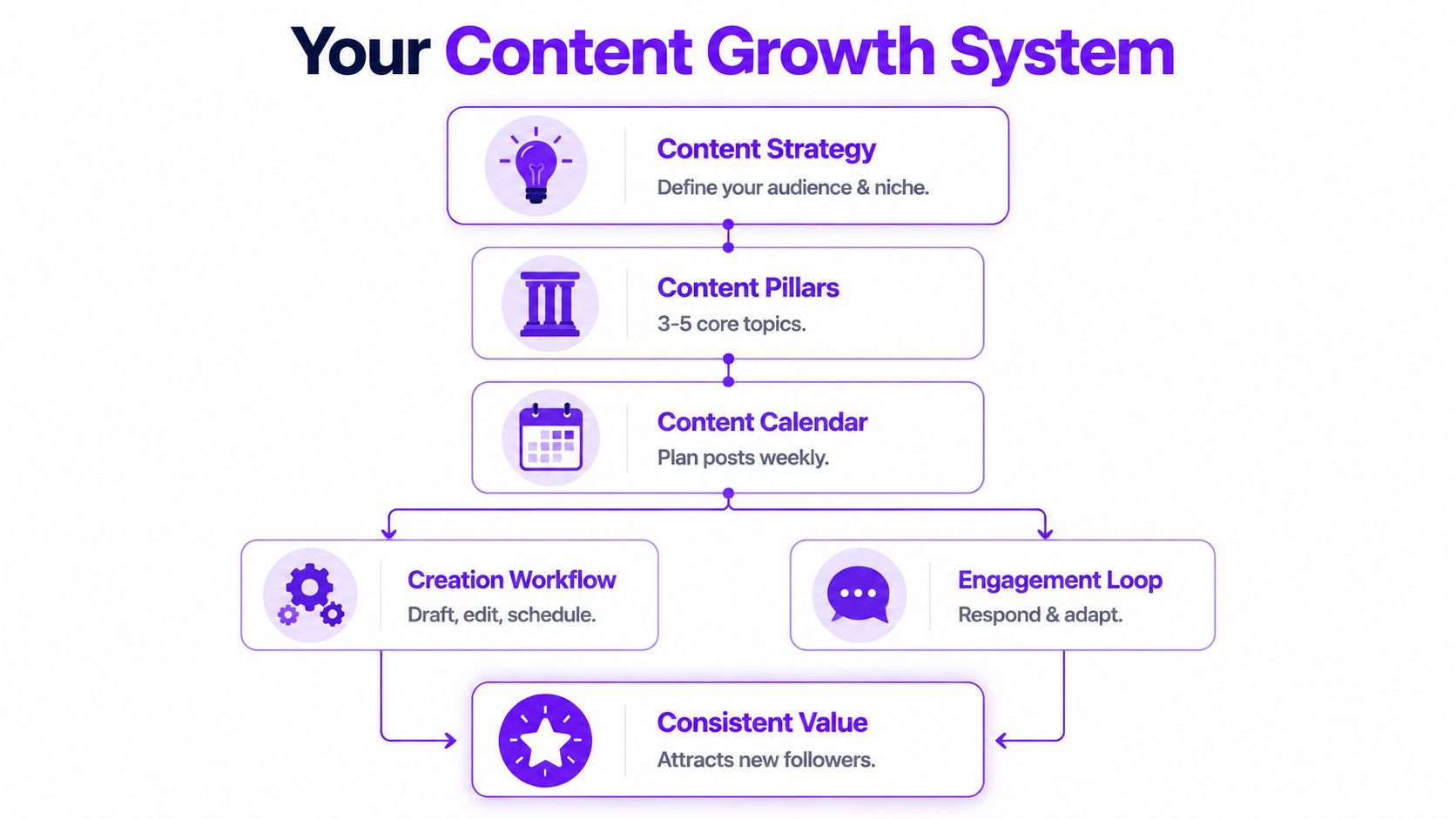
A content system that grows an X account combines three to five consistent topic pillars, formats matched to each idea, a sustainable posting cadence, and regular performance reviews. This structure keeps your feed recognizable while showing you which posts generate replies, profile visits, and follows.
Content is only one part of distribution. One growth case study found that roughly 33% of new followers came from strong content, while the rest came from outreach and distribution in a combined strategy, according to this MarketingExperiments interview. Build the content system first, then support it with relevant replies and consistent distribution.
A simple visual helps here:
Pick a few lanes and stay in them
Most accounts are too scattered. They post one thread about startups, one joke, one rant about politics, then wonder why nobody sticks around.
Pick three to five content pillars. That's enough range to keep your feed alive without confusing people.
Examples for a founder account:
- Build logs: What you shipped, broke, fixed, or learned
- Market lessons: What customers say, what they ignore, what they buy
- Tools and workflows: Screenshots, stack choices, shortcuts
- Opinion posts: Sharp takes tied to your niche
- Personal pattern posts: Habits, mistakes, decisions behind the work
Use formats that fit the idea
Not every thought deserves a thread. Strong accounts mix formats because different ideas need different packaging.
- Short posts: Good for sharp opinions, contrarian takes, and quick lessons
- Threads: Best for teaching, breakdowns, and story-led posts
- Questions: Useful when you want replies from your niche, not empty reach
- Polls: Fine for light market research or audience input, not daily filler
The hook matters. Lead with tension, a result, a mistake, or a clean observation. Don't warm up. Don't explain why you're posting. Start where the reader cares.
Here's a basic rewrite:
| Weak hook | Better hook |
|---|---|
| “Some thoughts on onboarding” | “Most onboarding fails because the first screen asks for too much” |
| “A thread on content” | “The fastest way to kill your X growth is to post without recurring themes” |
| “Just shipped a new feature” | “We shipped the feature users kept asking for, and it fixed the worst part of setup” |
This video is a useful companion if you want another angle on writing content people read:
Do Twitter Threads Still Work in 2026?
Yes — threads still work when they teach, break down a process, or tell a tight story. They are weaker when they are padded lists or soft intros stretched across ten posts. In 2026, a strong thread still earns profile visits and follows because it gives people a reason to stay with you longer than a single short post.
Use threads for depth, not volume. Open with a clear payoff, keep each post necessary, and end with a takeaway or question that invites replies. If the idea fits in one sharp sentence, publish a short post instead. Format should serve the idea, not the other way around.
Build around a repeatable workflow
My preferred rhythm is simple. Capture ideas during the day, draft in batches, post consistently, then review what got replies, shares, profile clicks, and follows.
Good accounts don't run on motivation. They run on a content inventory.
If you want another outside take, the Narrareach Twitter guide is useful because it pairs content planning with distribution instead of pretending publishing alone is enough.
And if you also publish long-form writing, connect your X strategy to places where your ideas can live longer. A lot of smart creators do better when they pair short-form posting with an archive like our Medium growth page, then pull highlights back into X.
How Many Times Should You Post on X Per Day?
Most growing accounts do well with about one to three solid posts per day, plus real replies in their niche. More volume only helps if quality and positioning stay intact. Posting ten thin updates then disappearing for a week resets attention and trains people to ignore you.
Pick a cadence you can keep for weeks. One strong post with a clear hook and follow-up replies usually beats a spray of filler. Track which posting days produce profile visits and follows, then protect that rhythm instead of chasing a higher daily count.
Master Active Community Engagement
I'll give you a simple example. A developer building a small SaaS wants to get noticed by indie hackers, technical founders, and product people. Posting alone won't get him there fast enough, so he starts using X like a room, not a billboard.
He follows a tight set of relevant accounts. Not celebrities. Not giant general-interest handles. People in the same lane who spark discussion.
A real daily workflow
A practical daily engagement workflow is to discover relevant conversations, read before replying, add useful responses early, visit profiles that engage with your comments, share worthwhile posts, and review which actions produced profile visits. Repeat that routine around the same niche accounts instead of chasing unrelated high-reach threads.
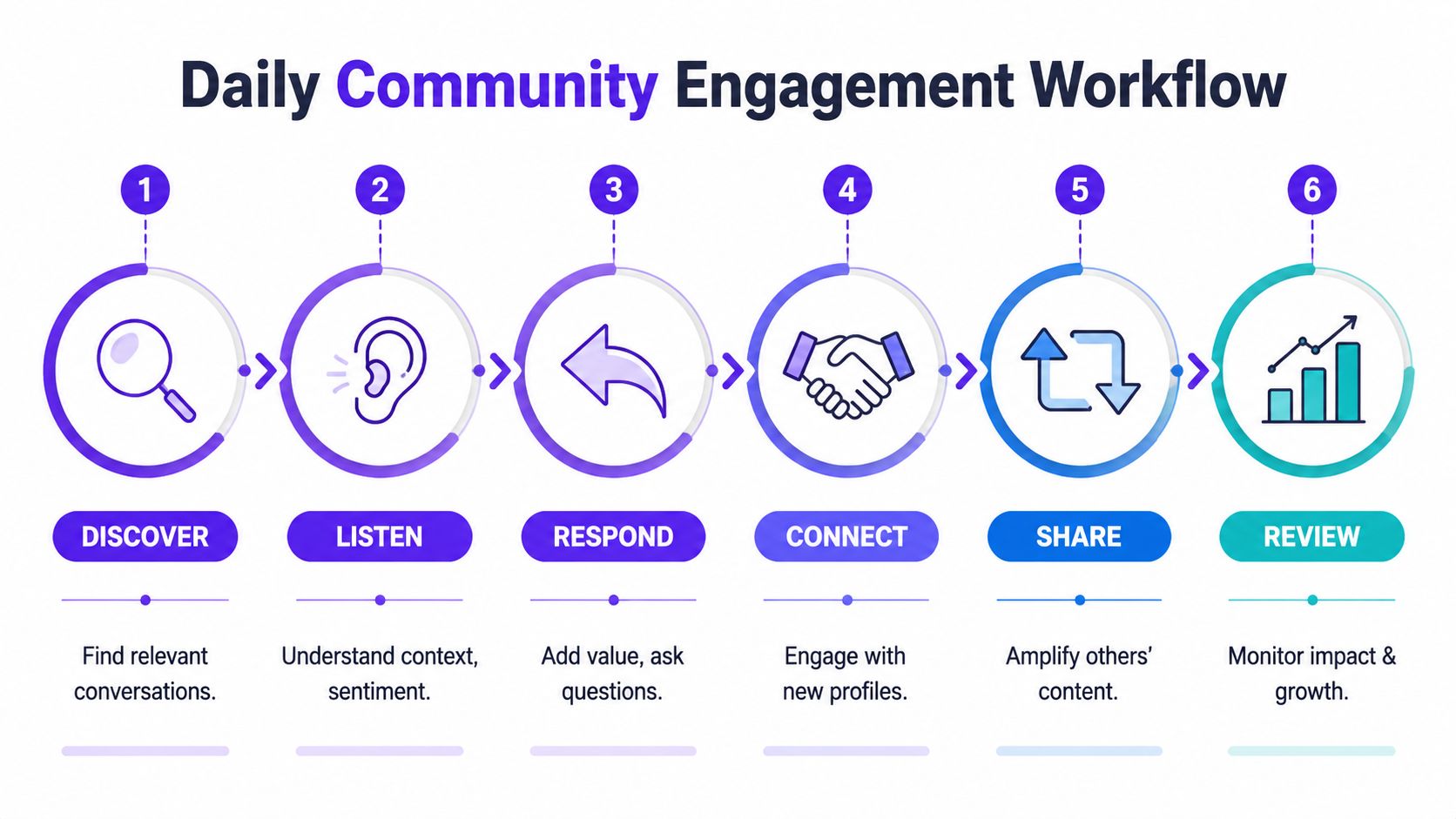
- Start with discovery: Search niche terms, product keywords, and pain points your audience talks about.
- Read before replying: A rushed reply that misses the point does more harm than silence.
- Reply early when you have something real to add: Timing helps, but substance matters more.
- Visit profiles that like smart comments: Many follows come from second-order visibility.
- Share other people's good posts: Not as flattery. As signal that you know what matters in the niche.
- Review what sparked profile visits: Good engagement should pull people back to your account.
X has long treated follower growth as a visible credibility metric, and its analytics tools are built around measuring audience response to content, which is why quality engagement works as a real growth signal rather than a vanity one, as explained in X Analytics.
What a good reply looks like
A good reply adds a concrete example, a reasoned disagreement, a useful question, or an important missing detail. It should advance the conversation and give readers a reason to visit your profile, rather than repeating empty reactions such as “Great point” or “This.”
Bad reply:
- “Great point”
- “This”
- “Love this take”
That's dead weight.
Good reply:
A founder posts that onboarding users is getting harder. The developer replies with a short example from his own product, names the screen where users dropped off, and asks whether shorter setup or delayed permissions worked better for the founder. That reply can pull attention from the original poster and from everyone reading the thread.
Add one of these in replies: a concrete example, a disagreement with logic, a useful question, or a missing detail.
If you want help pushing that reply strategy further, our Twitter comment tool is one way to support more visible discussion around the posts that matter to your account. The point isn't noise. The point is making your best conversations easier to notice.
Kickstart Engagement During the Golden Hour
Kickstart engagement during the first hour by posting when your niche is active, staying available to answer replies, and sharing the post through relevant distribution paths. Early likes, comments, reposts, and profile visits can help a strong post earn wider testing, but the activity must come from people who are genuinely interested in the topic.
This matters most for smaller accounts whose posts can disappear before the right audience sees them. Treat the golden hour as an active distribution window: publish your strongest material, start real conversations immediately, and avoid random engagement that adds numbers without attracting relevant followers.
Why the first hour matters more now
When the feed gets tighter, early reaction matters more. Posts that pull likes, replies, reposts, and profile visits quickly have a better shot at wider distribution. Posts that sit idle don't get many second chances.
That doesn't mean you should chase junk engagement. It means you should stop pretending that timing and early traction don't matter.
Here's the mistake I see all the time:
| Bad approach | Better approach |
|---|---|
| Post and disappear | Post, stay active, reply, and drive early conversation |
| Wait for “organic magic” | Line up likely responders and distribution paths |
| Chase random reactions | Get relevant engagement from real people in your niche |
What's the Fastest Way to Get Twitter Followers?
The fastest durable path is early relevant engagement on strong posts — not buying a follower dump. Publish when your niche is active, stay in the replies during the first hour, and make sure your profile converts the clicks you earn. Fake spikes can move the count overnight and still leave the account weaker a month later.
Speed comes from compounding signals: a clear bio, a post worth sharing, and real people reacting quickly enough for X to test the post wider. If you need a controlled kickstart for likes, comments, saves, or followers from real members, use community support as a supplement — never as a substitute for content and replies.
A practical way to get early engagement
In my view, a community model makes sense. With our Upvote.club service, members create tasks to receive likes, comments, saves, and followers from verified human accounts. People earn points by completing tasks for others, then use those points to create their own tasks. That gives newer accounts a way to get initial activity without sharing social-media passwords or leaning on bot farms.
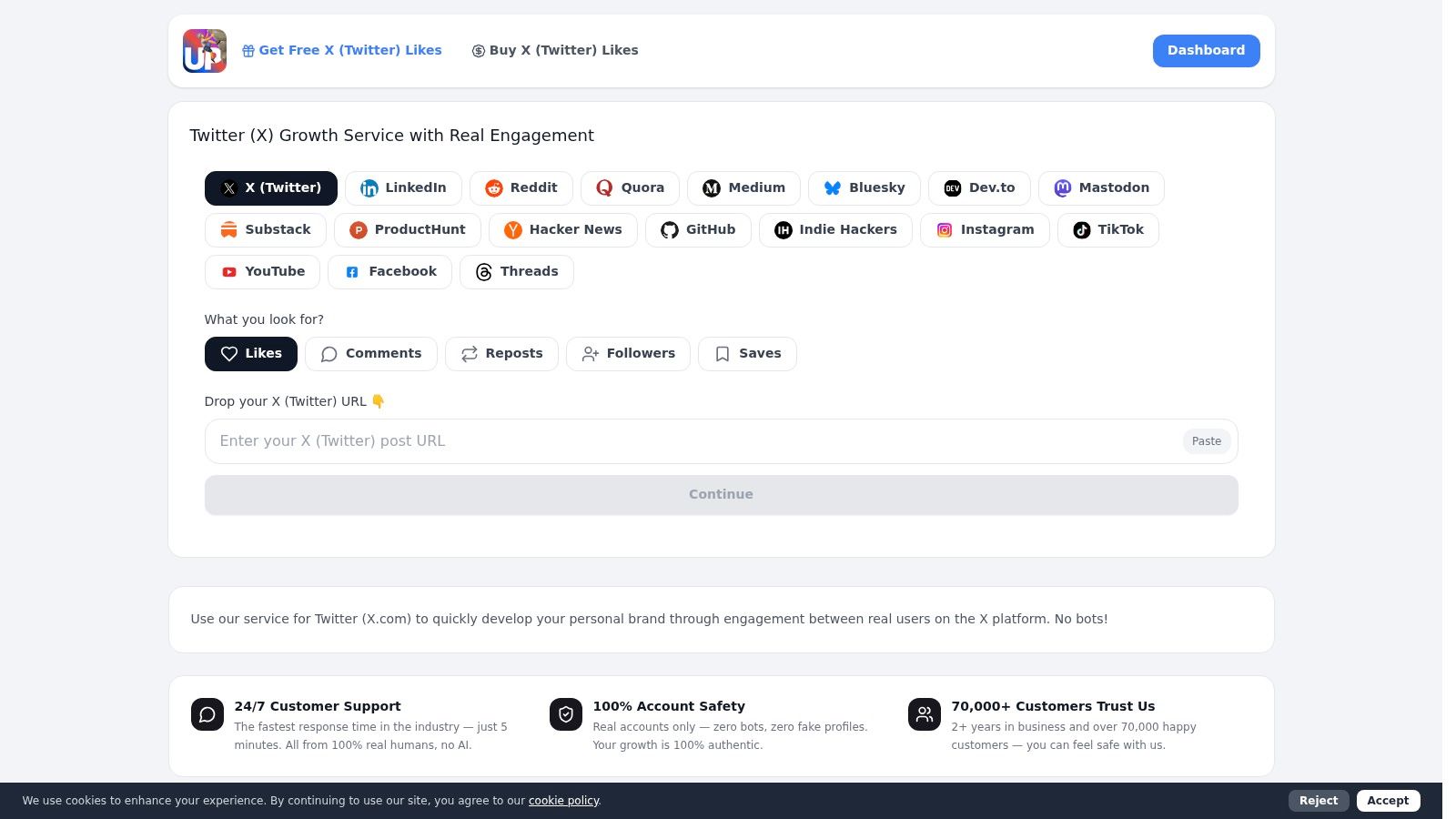
Upvote Club works differently from services that sell fake numbers. We run on participation. When someone joins, they get 13 free points and 2 task slots to launch a first task. If they need more points, they complete tasks for other users and earn the internal currency that funds their own promotion. Social profiles are verified through our emoji-based verification flow where required. No social-media passwords are required.
That structure matters for one reason. It keeps the activity tied to real members instead of empty bot spikes.
Community-led engagement is slower than fantasy promises, but it fits how real accounts grow. Fast spikes from shady sources often leave a bad smell on the account. If you care about getting Twitter followers without burning trust, early traction from real people is the safer direction.
Use this kind of support with discipline:
- Push your best posts first: Don't waste early traction on filler.
- Match task type to post type: Comments for discussion posts, saves for keep-worthy posts, likes for social proof, followers when the profile is ready to convert.
- Stay present after posting: Early engagement only helps if you continue the conversation.
- Keep your profile ready: If new people click through, the account needs to convert.
Measure What Matters for Follower Growth
If you only watch total followers, you'll misread your account. Growth on X is now tracked with more detail than a simple headline number.
Modern follower tracking tools show real-time totals plus related profile metrics, including following count, total tweets, average likes, engagement rate, daily gains, and unfollowers, as outlined in this breakdown of Twitter follower count tracking.

The metrics that tell the truth
The four most useful follower-growth metrics are daily net follower gains, unfollowers, engagement rate, and profile-level movement such as profile visits that convert into follows. Average likes can provide additional context, but these four signals show whether your content is reaching the right audience and persuading people to stay.
- Daily follower gains and unfollowers: This tells you whether growth is steady or leaky.
- Engagement rate: Good reach with weak engagement means your topic or framing is off.
- Average likes: Not perfect on its own, but useful for spotting content consistency.
- Profile-level movement: If your account gets attention but people don't stick, the issue may be positioning, not posting.
What to do with the numbers
Use the numbers to identify the broken stage of your growth system. High views with weak engagement call for stronger topics or hooks; good engagement with few follows points to a profile-conversion problem; short-lived follower spikes call for repeatable content; and rising unfollows mean your audience fit or content pillars need tightening.
| Signal | What it usually means | Action |
|---|---|---|
| High views, weak engagement | Topic reached people but didn't connect | Fix hooks, sharper angle, stronger opinion |
| Good engagement, few new followers | Post worked, profile didn't convert | Rewrite bio, improve pinned tweet |
| Follower gains spike then stall | One post hit, system didn't hold | Repeat the topic in a new format |
| Unfollowers keep rising | Audience fit is loose | Narrow your content pillars |
Track pace and consistency, not just totals. The shape of growth tells you more than the headline number.
The point isn't to stare at dashboards all day. It's to connect a content choice or an engagement habit to a measurable response, then do more of what works.
How Long Does It Take to Get Twitter Followers Organically?
Organic Twitter follower growth usually takes weeks to months, not a fixed number of days. Accounts that keep a clear niche, post on a steady cadence, and reply in their community tend to see compounding gains. Accounts that sprint for a week and go quiet usually reset the clock.
Timeline depends on starting point and consistency. A new account with a sharp profile and daily useful posts can start earning relevant follows within the first few weeks. Crossing larger milestones still takes longer because each follow has to come from people who understood the account and chose to stay. Track weekly net gains, not one viral day.
How to Go From 0 to 1,000 Followers on X
Going from 0 to 1,000 followers on X is a system, not a single viral post. Start with a followable profile, pick three to five content pillars, publish on a cadence you can keep, and spend part of every day in niche replies. Early on, profile clarity matters as much as posting — visitors who cannot tell what you stand for leave without following.
Use this sequence:
- Weeks 1–2: Tighten bio, header, and pinned post. Publish your first useful posts in one niche.
- Weeks 3–6: Keep the posting rhythm and reply to people you want as peers, not celebrities only.
- Ongoing: Double down on formats that earn profile visits and follows. Drop topics that get views without follows.
1,000 followers is a checkpoint, not proof that the account is healthy. Prefer slower growth from people who engage over a fast count that never replies. If a strong post needs a fair first-hour push, community engagement can help — but the climb still depends on positioning, content, and conversation.
Avoid These Common Growth Mistakes
I've watched plenty of accounts ruin good early momentum with bad growth tactics. The pattern is predictable. They chase visible numbers, attract the wrong people, then wonder why impressions stall and replies dry up a month later.
The biggest mistakes are easy to spot because they produce hollow growth.
- Follow-unfollow loops: They train people to distrust your account and attract low-intent followers who disappear fast.
- Random posting streaks: Posting ten times in two days, then going silent for a week, resets attention every time.
- Low-effort reply farming: One-line comments under large creators might get views, but they rarely build trust or attract people who care about your niche.
- Muddy positioning: If your bio promises one thing, your posts cover three unrelated topics, and your pinned tweet says something else, people leave.
Should You Buy Twitter Followers?
No. Buying Twitter followers is a bad growth move if you care about reach, trust, and conversions. You can force the count up, but if those followers never engage, your profile looks bigger than it is. That gap hurts distribution, credibility, and future conversions from the people you actually want.
Hollow follower packs also teach the wrong lesson: that the number matters more than the conversation. Prefer organic follows from niche replies and useful posts. Pages that pitch purchased followers — including offers to buy Twitter followers — are useful as a caution about vanity growth, not as a playbook to copy. Build the audience; do not rent the appearance of one.
Is It Too Late to Grow on X in 2026?
No — it is not too late to grow on X in 2026, especially in focused niches where people still look for sharp takes, product lessons, and useful replies. The feed is more competitive, which raises the bar for clarity and consistency. It does not close the door for new accounts that show up with a real point of view.
Latecomers win the same way early movers did: specific positioning, repeatable content, and conversations with the right people. Broad celebrity-style growth is harder. Niche credibility is still available. If your account helps a defined audience make better decisions, there is still room to earn follows.
A better approach is slower at the start and stronger over time. Build around clear positioning, repeatable content themes, and real conversations with the same kinds of people you want following you. Then give strong posts some early activity from actual users so they have a fair shot during the first hour, without drifting into spammy tactics or risking the account.
Upvote Club can support that last part with a community points model: members earn points by completing tasks, then spend them on likes, comments, saves, and followers from verified human accounts. New users start with 13 free points and 2 task slots, social-media passwords are never required, and profiles use emoji-based verification where needed. That model supports visibility while keeping the focus on audience quality, not inflated numbers.